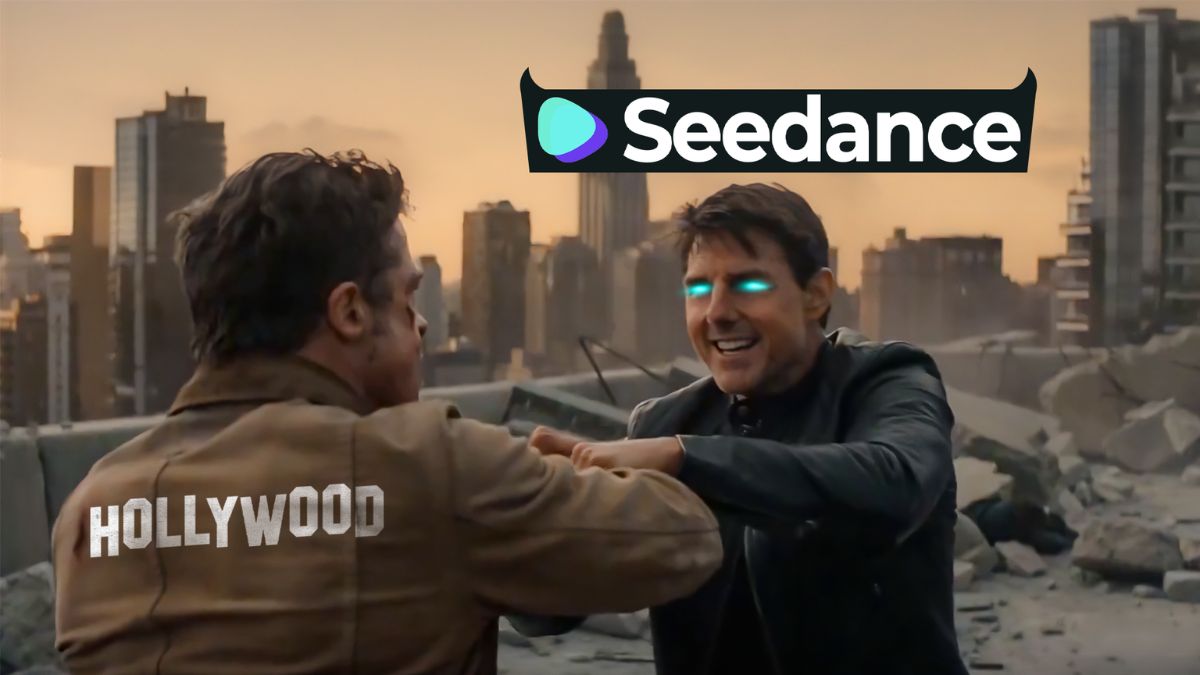
Unless you’re very lucky, you’re probably aware of the latest updates that bring new advances in artificial intelligence. Recently, an AI-generated video of Brad Pitt and Tom Cruise fighting on a rooftop was released. The quality of this video was so good that it took me a while to figure out that it was generated by an AI. This AI leap forward comes from Seedance 2.0, a new AI model developed by Chinese giant ByteDance.
Brad Pitt and Tom Cruise’s AI video is pretty impressive, but it’s even more frightening about the multiple potential implications of advances in AI, and we’re here to talk about it all.
Hollywood faced its biggest threat
🚨Breaking news: China’s Seedance 2.0 is insane.
Spoiler: Hollywood has officially backed out.
10 wild examples:
1. Jeffrey Epstein knew too much pic.twitter.com/EG7eABzXzu
— FutureStacked (@FutureStacked) February 11, 2026
If you watch this video, you’ll be impressed by how realistic every aspect looks. In its cinematic lighting, physics, expressive faces, or even the rhythm of its edited punches, it was almost indistinguishable from a big-budget movie. However, in making this work, there were no cameras rolling, no stuntmen involved, and most importantly, no consent from the actors. All I needed to create this was a simple prompt in Seedance 2.0. This is impressive, but it also poses a seismic threat to Hollywood.
The danger here is not just the fact that AI can create hyper-realistic visuals. The threat it poses is to Hollywood’s greatest foundation: star power. The Global Box Office is run entirely by actors and their fan bases. Studios invest millions of dollars not just in the story, but in the quality of performance that the actors bring to the screen, and the fact that people flock to theaters to witness real humans they love and adore, bringing fictional characters to life.
If software could bring about the same effects, faces, voices, emotions, etc., it could create a huge crack in the very foundations of cinema and gradually reduce the power that movie stars currently have. This impact doesn’t just affect movie stars, but everyone in the pipeline.
The film industry may soon face off against music.
Now, as I mentioned earlier, the impact of technologies like Seedance 2.0 has other major implications that impact everyone in the film creative pipeline. Think about it. Why sign up for expensive contracts when software can provide accurate performance at a fraction of the price?
Why hire stuntmen, extras, make-up artists, set builders, and even VFX teams when everything can be accomplished with a simple prompt? Its long-term effects can also be seen on the economic health of scenic spots around the world. Because why would movie studios pay high prices for filming locations when photorealistic locations can be generated with just a few clicks?
Hollywood and the film industry around the world have experienced technological advances before. It’s nothing new, previous advances required HITL (Humans in the Loop), but technologies like Seedance 2.0 aim to eliminate human involvement, which is a major threat to those who make a living from film.
Seedance 2.0 ignores consent
The Motion Picture Association of America (MPAA) and Disney have filed a lawsuit against ByteDance over the Seedance 2.0 project, alleging “massive copyright infringement.”
Watch this video and you’ll see the real reason Hollywood is panicking: survival. In the past… pic.twitter.com/5UZXcYzEY9
— China Eng🇨🇳 (@Eng_china5) February 15, 2026
Another big problem with AI software like this is that it completely ignores consent. Take Brad Pitt and the Mission Impossible star’s video for example. The video was born even though neither actor consented to its creation, and someone made money off of it without the permission, compensation, or creative involvement of two of the world’s most famous faces.
Now, over time, celebrities may seek legal protection or enforce licensing frameworks, but this example is alarming. Because this video surfaced and started this conversation that we’re having on the internet. But who knows how many such clips there are on the internet, and such celebrities have no idea that their faces are being used for someone’s 2am curiosity.
But today, Disney and SAG-AFTRA issued a strongly worded warning to ByteDance for copyright infringement and blatant misuse of its IP. In response, ByteDance pledged to take safeguards to prevent such breaches from occurring in the future. But Hollywood recognizes that legal action is not a permanent solution to the growing threat of AI.
Shockwaves beyond Hollywood
The film industry is currently the biggest threat, but the long-term implications are even more troubling. Technologies like Seedance 2.0 can be used to fabricate convincing footage for harassment, propaganda, fraud, and even reputational damage. A similar case has already been featured in the 2025 film “G20.”
While the film was poorly received, it explored how artificial intelligence can be used to fabricate videos, weaponize them, manipulate global events, and destabilize public trust and decision-making. It seemed like just a fictional story, but recent events have made it a reality and it’s very disturbing.
Imagine living in a world where anything can be simulated to cinematic perfection and the evidence itself becomes a suspect. Whether it’s a leaked video, a confession, or eyewitness footage, it can be dismissed as a fabrication, and in the worst-case scenario, a fake can be accepted as truth. The impact of this technology on society is far more destructive, going far beyond entertainment and could literally cause a global meltdown if it negatively affected politics or journalism.
What makes a technology like Seedance 2.0 scary isn’t what it creates, but the uncertainty it creates, making it impossible to tell what’s real and what’s fake. Brad Pitt and Tom Cruise’s AI video may seem like harmless viral fun, but it’s actually a proof of concept. It shows that reality can now be manufactured with such precision that it can fool millions of people. Hollywood may be the first to feel the effects, but at this rate it won’t be the last.