
Humanoid robots move out of the lab and onto the factory floor to perform real-world tasks alongside humans.
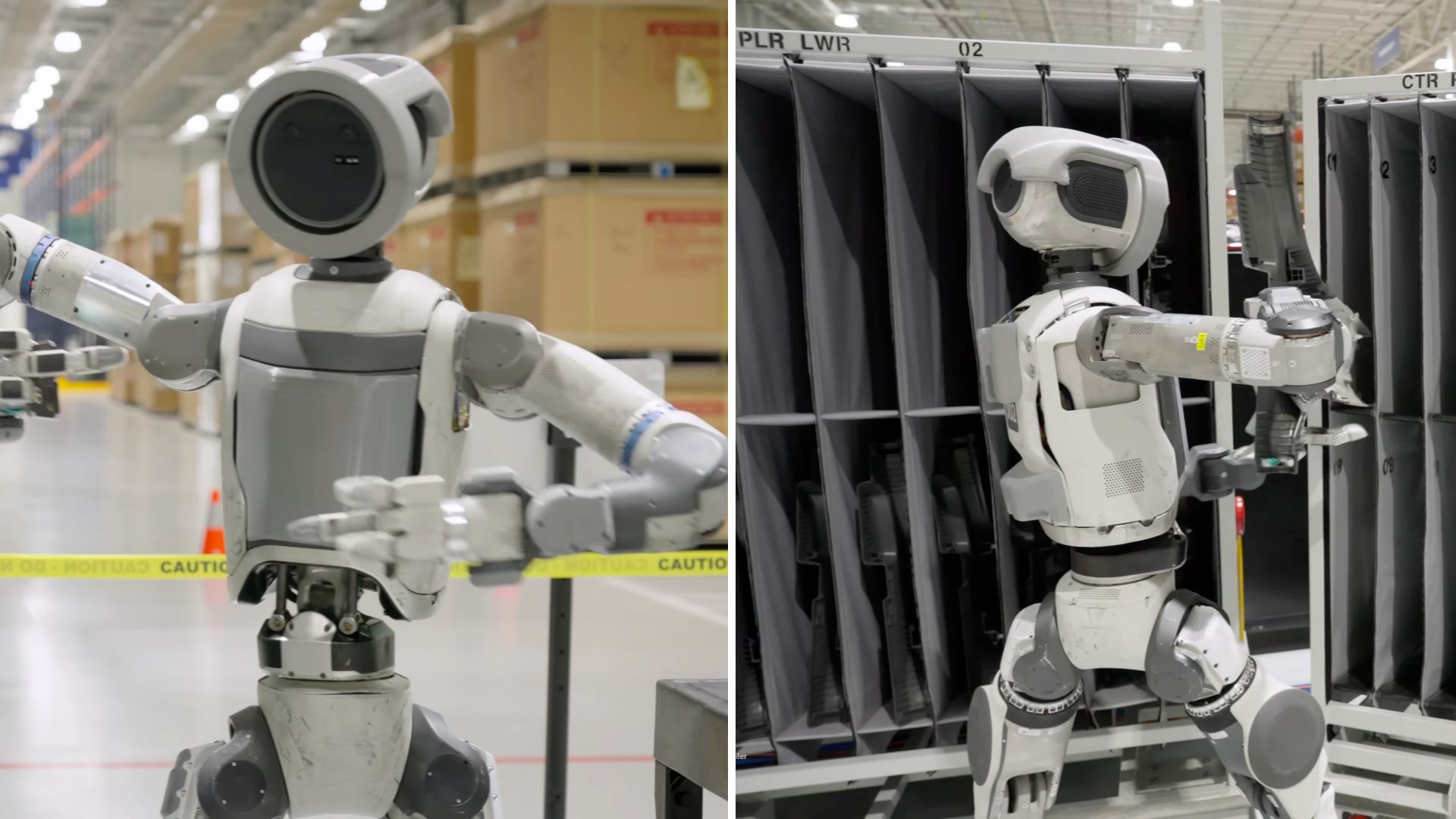
A new video shows Boston Dynamics' Atlas humanoid robot performing real-world manufacturing tasks for the first time at Hyundai's vast auto plant near Savannah, Georgia.
At 5'9″ tall and 200 pounds (91 kg), Atlas is incredibly agile, performing flips, running, and even dancing with precision. Once a rigid, mechanical prototype, this AI-powered humanoid can now effortlessly perform complex exercises.
The debut highlighted rapid advances in robotics as companies around the world race to develop human-like machines that can perform real-world tasks.
Last month, Boston Dynamics described the unusual and twisty way Atlas rises from the ground, confusing viewers who were expecting human-like movements.
Beyond human movement
Boston Dynamics' humanoid robot Atlas has gone beyond the lab and into the factory, demonstrating its ability to push the boundaries of robotics.
CBS' 60 Minutes recently visited the Hyundai factory near Savannah, Georgia to see the Atlas in action, and the footage was amazing. Unlike humans, Atlas stands and moves in ways that defy traditional biomechanics, bending and rotating its limbs far beyond human limits.
In a video, Boston Dynamics CEO Robert Prater highlighted the new version's major advances. All of Atlas' joints can rotate a full 360 degrees, making it easy to perform complex operations. “We don't want robots to be limited to human capabilities; we want them to exceed human capabilities,” Prater said.
At the company's Massachusetts headquarters, 60 Minutes watched Atlas perform backflips, cartwheels, and even a dance, showing just how smooth and agile it is compared to previous versions.
Scott Kinderma, head of robotics research at Boston Dynamics, explained the design benefits. Continuous rotation of the joint not only increases range of motion, but also improves reliability by eliminating the need for wires spanning moving parts. Atlas also includes advanced AI powered by Nvidia chips, allowing it to learn new tasks.
Using a remote control system, a human operator guides Atlas's hand, and Atlas autonomously replicates. According to Techeblog, its three-fingered hand is designed to switch configurations for manipulating small or large objects, and tactile sensors provide precise force control.
Atlas rises efficiently
Last month, Boston Dynamics described one of Atlas' most impressive movements: the twisting way it picks itself up off the ground.
Unlike humans, who stand intuitively using whole-body sensory feedback, robots operate with limited sensors and must calculate every movement. Atlas begins lying down, swings his legs forward, folds them to the sides, and pushes them with controlled force to a standing position. This unusual movement allows the robot to avoid stepping on itself, check the foot sensors, and position the robot above its center of gravity to reduce energy usage.
This process also acts as an internal diagnostic, allowing Atlas to abort the ascent if sensor readings are off. While other humanoids use exaggerated recovery movements, Atlas' movements balance safety, efficiency, and reliability. Its design reflects the challenge of reproducing everyday human behavior with limited sensors.
Despite the current excitement, Boston Dynamics warns that the humanoid robot revolution is only just beginning. “AI software is evolving rapidly, but building reliable machines takes time,” Prater says.
To become widespread, robots need to be reliable and affordable. For now, Atlas represents an important step forward, offering a glimpse into a future where humanoid robots could become essential to manufacturing and other sectors. Hyundai, which owns Boston Dynamics, plans to introduce the Atlas into industrial environments, where its precise, energy-efficient movements will be essential for repetitive and physically demanding tasks.


