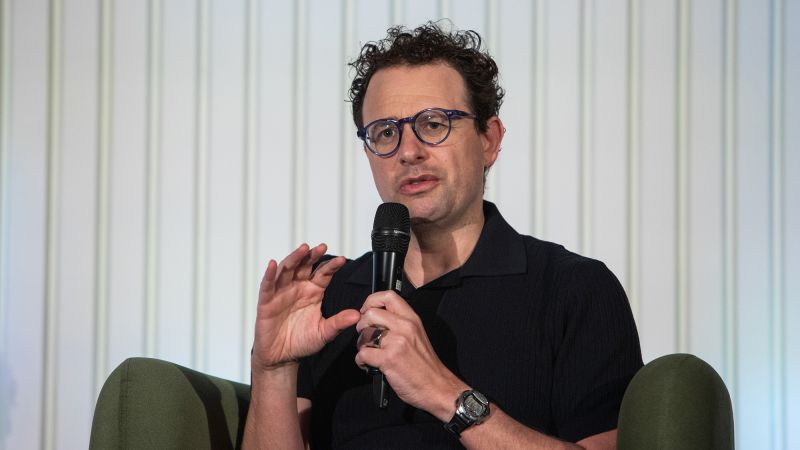
Anthropic CEO Dario Amodei was at the White House on Friday for a high-stakes meeting with the president’s top advisers, while his AI company is battling the Trump administration in court for blacklisting its Claude AI model.
Mr. Amodei met with Susie Wiles, the president’s chief of staff, two sources familiar with the meeting told CNN. Axios was the first to report on the meeting.
The meeting comes as the U.S. government attempts to balance its hardline approach to Anthropic with the national security implications of turning its back on the company’s breakthrough technology, including its Mythos tool that not only identifies cybersecurity threats but also provides a roadmap for hackers to attack businesses and governments.
The White House said the meeting was “introductory” and “productive and constructive.”
“We discussed opportunities for cooperation and common approaches and protocols to address the challenges associated with scaling this technology,” the White House said in a statement Friday afternoon. “This conversation also considered the balance between driving innovation and ensuring safety. We look forward to continuing this conversation and plan to host similar discussions with other leading AI companies.”
Anthropic similarly called the meeting “productive” for discussions on “cybersecurity, America’s lead in the AI race, and the safety of AI.”
“This meeting reflected Anthropic’s continued commitment to working with the U.S. government on responsible AI development. We appreciate the time and look forward to continuing discussions,” a spokesperson said.
Until recently, Anthropic’s Claude was the only AI model available on the Department of Defense’s classified networks. But President Donald Trump recently announced that his administration would cut ties with Anthropic after the company refused to lift terms that would allow the military to use Claude for “any lawful purpose,” including autonomous weapons and mass surveillance.
After talks over Claude’s use collapsed, the Pentagon declared Anthropic a “supply chain risk,” a label previously reserved for companies with foreign adversaries. That would effectively put Anthropic on the government’s blacklist.
Anthropic sued the Trump administration in response, and a federal judge in California last month blocked the government’s efforts to “punish” Anthropic, saying federal agencies other than the Department of Defense cannot use supply chain risk designations to sever ties with the company. The government appealed this ruling.
But two weeks later, the administration won a victory in the D.C. Circuit Court of Appeals, which said it would not prevent the Pentagon from severing ties with the company pending legal challenges in a separate lawsuit brought by Anthropic.
In a unanimous decision, the appeals court said that intervening at this stage of the case “would force the U.S. military to extend transactions with undesirable vendors of critical AI services in the midst of a significant ongoing military conflict.”
The Pentagon said it wanted unfettered access to Claude for “all lawful purposes,” as complete freedom to use these tools is necessary, especially in times of war. Antropic wants to work with the military, but argues that its AI models are not yet reliable enough to be used in autonomous weapons and that U.S. law is not yet fast enough to protect Americans when it comes to using AI in mass surveillance.
Meanwhile, Anthropic announced an upcoming powerful AI model called Mythos. The company and experts have warned that this could be a “watershed moment” for cybersecurity, with select groups gaining early access to assess cybersecurity risks.
Bloomberg reports that the Office of Management and Budget has already informed government agencies that it is preparing to provide access to Mythos in preparation. Axios reported that the White House is also in talks to gain access to Mythos. Antropic declined to comment on whether the Trump administration is working on testing Mythos.
Public filings show that Anthropic recently hired Ballard, the lobbying firm where Wiles worked for many years. The disclosure indicates that Mr. Ballard was specifically hired to “advocate for:” [Department of War] Procurement. ”
“The White House continues to actively engage across government and industry to protect America and Americans. This includes working with leading AI laboratories to ensure its models protect against critical software vulnerabilities,” a White House official told CNN. “Any new technology that may be used or deployed by the federal government requires a technical period to evaluate its fidelity and safety. The joint efforts of all involved will ultimately benefit the industry, and our nation as a whole.”
CNN’s Devan Cole and Kristen Holmes contributed reporting.