
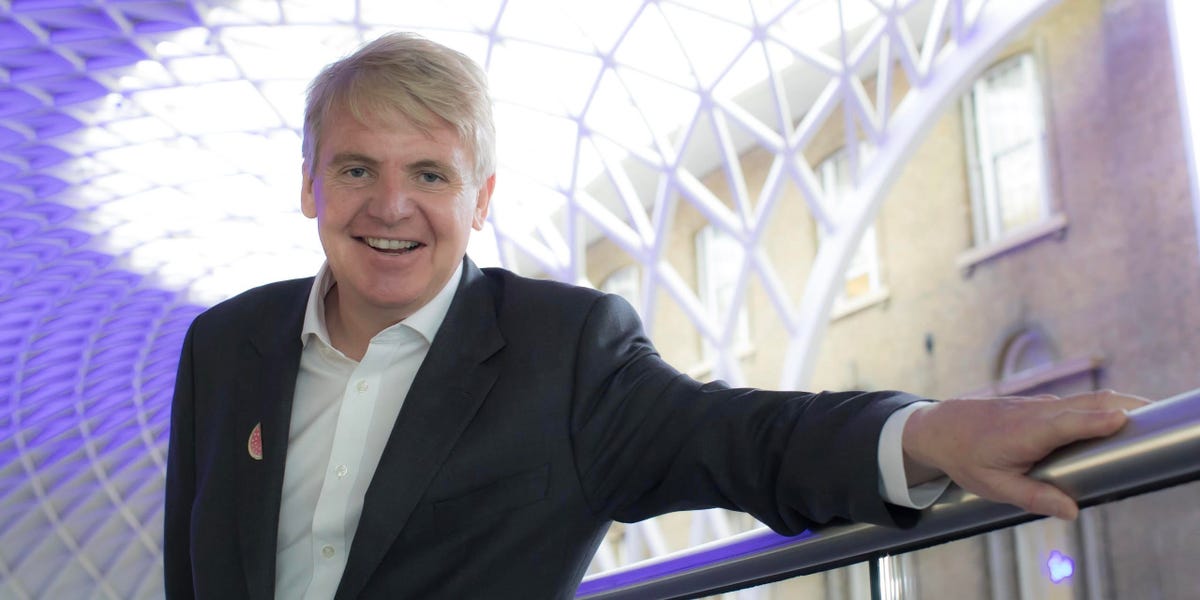
Jim Mellon is pessimistic about US stocks, determined to change what people eat and optimistic about the future of young people.
The billionaire investor and author spoke to Business Insider in late February about why Warren Buffett’s cash hoard is a red flag, why he wants to feed the world with bioreactors, and why we should lean into what makes workers human in the age of AI.
Mr. Mellon is executive chairman of Agronomics, a venture capital firm that supports grown food companies, and author of “Moo’s Law: An Investor’s Guide to the New Agricultural Revolution.”
He said he felt U.S. stocks were “pretty overvalued” given that the country is home to about 3% of the world’s population but accounts for more than 60% of the world’s market capitalization.
Mellon said this, in addition to their “grossly inflated” valuations and “record margin debt,” was a “warning signal” that Big Tech companies, with their “unique moats”, were moving into circular trading and “more or less doing the same thing” by pouring huge amounts of money into building AI data centers.
He said he has been “bullish” on gold and silver in recent years and is reluctant to “jump on the crypto bandwagon” as government policies around the world are eroding the value of national currencies.
Mellon said the energy sector is “probably the best place to invest” at the moment, as the AI boom is fueling demand for power-hungry data centers, putting a strain on the power grid, and because he sees energy as “very cheap as a percentage of global stock markets.”
He said there were bargains to be had in the UK and emerging markets. But he said he would be “very cautious in China” given the risks of foreign ownership and state control and would “avoid the U.S. market completely.”
He also encouraged people to hold the Japanese yen because it is “very cheap” against the dollar and yields are higher than in the past thanks to rising interest rates.
Mellon also pointed out that Buffett’s Berkshire Hathaway had more than $350 billion in liquid assets at the latest count.
“The fact that he has so much cash on hand tells me that he sees less positive things in the world right now,” he said of recently departed CEO Buffett.
The future of food
Mr. Mellon, a veteran biotech investor, touted how cellular agriculture can grow cells into meat and fish, and how precision fermentation can use yeast to create egg proteins, dairy products, and different types of oils.
He told Business Insider he’s on a mission to transform the world’s food system because of how it sickens so many people, contributes to the climate crisis through carbon emissions, and treats so many livestock.
Producing “clean foods” instead of traditional foods would do far less damage to the environment and avoid health problems caused by hormones, antibiotics, heavy metals and microplastics in food, he said.
Cost is a key issue, but costs have already come down dramatically, he continued, adding that he believes it will soon be cheaper to produce beef and pork at scale in bioreactors than to raise cows and pigs for slaughter.
Mellon said he feels very motivated to make that change. “If I don’t make money doing this, it doesn’t matter.”
Advice for the AI era
When asked how young people can get ahead when they can’t afford to make a living and when AI threatens to eliminate huge numbers of jobs, Mellon said he’s willing to hire and that other employers should too.
“We were all fresh out of school at some point and we were given a chance, and we should give that to others,” he said. “And in a highly competitive environment to fill positions, now is an opportunity to attract top talent at reasonable rates.”
Mellon, who wakes up around 4 a.m. every morning and works every day of the year, said it’s important that young people don’t give up easily.
“Don’t shut yourself into a shell just because you read all the negative things,” he said. “Don’t worry too much, just go out and do something.”
Mellon also argued that workers can avoid AI by developing interpersonal skills, as people will always need human connection.
“We have to think that there will still be jobs that require empathy,” he says. “Social care will become even more valuable. As people age, aged care will become even more valuable.”
Mellon noted that just 10 to 15 years ago, an entire generation of graduates was encouraged to learn to code, but these jobs are now among the most threatened by AI, and going all-in on the technology at the time is “probably not the right way to go.”
Separately, Mr Mellon, who owns 10 dogs but has no children, said he supported raising inheritance tax to 100% and using the proceeds to give all young people a lump sum.
That way, “instead of starting your life always worrying about money and trying to scrape together enough money to buy a house, you actually have the money to actually start something,” he said.


