We want to hear from you. Take our short AI survey and let us know your thoughts about the current state of AI, how you're adopting it, and your hopes for the future. Learn more
While many in the tech world are still fixated on the latest large language models (LLMs) powered by Nvidia GPUs, a quiet revolution is happening in AI hardware. As the limitations and energy demands of traditional deep learning architectures become increasingly apparent, a new paradigm called neuromorphic computing is emerging, which promises to reduce the computational and power requirements of AI by orders of magnitude.
Mimicking nature's masterpiece: How neuromorphic chips work
But what exactly is a neuromorphic system? To find out, VentureBeat spoke with Sumeet Kumar, CEO and founder of Innatera, a leading startup in the neuromorphic chip space.
“Neuromorphic processors are designed to mimic the way biological brains process information,” Kumar explains. “Rather than performing sequential operations on data stored in memory, neuromorphic chips use networks of artificial neurons that communicate through spikes, just like real neurons do.”
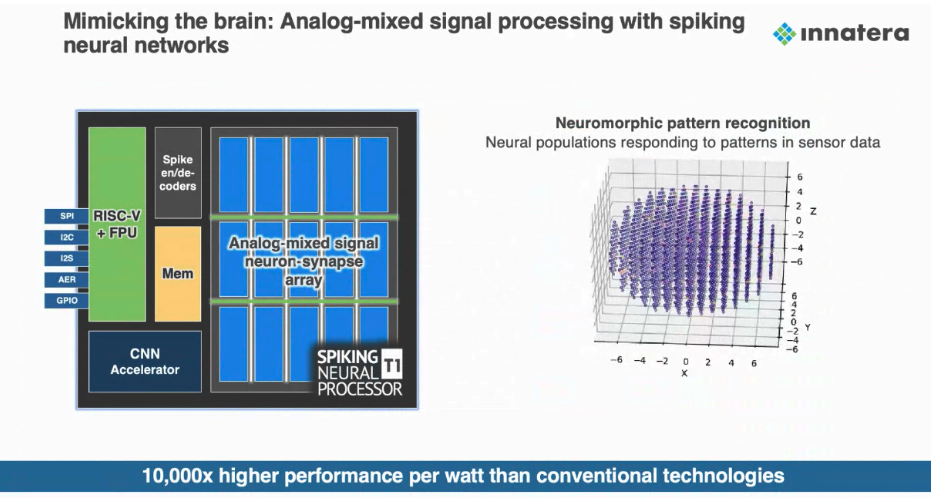
This brain-inspired architecture gives neuromorphic systems distinct advantages, especially in edge computing applications in consumer devices and industrial IoT. Kumar highlighted several compelling use cases, including always-on audio processing for voice activation, real-time sensor fusion for robotics and autonomous systems, and ultra-low power computer vision.
Countdown to VB Transform 2024
Join enterprise leaders at our flagship AI event in San Francisco July 9-11. Network with your peers, explore the opportunities and challenges of generative AI, and learn how to integrate AI applications in your industry. Register now
“Importantly, neuromorphic processors can perform complex AI tasks using a fraction of the energy of traditional solutions,” Kumar noted. “This enables capabilities such as continuous environmental awareness on battery-powered devices, which wasn't possible before.”
From doorbells to data centers: Real-world applications emerge
Innatera's flagship product, the Spiking Neural Processor T1, announced in January 2024, embodies these advantages. The T1 combines an event-driven computing engine with traditional CNN accelerators and a RISC-V CPU to create a comprehensive platform for ultra-low-power AI in battery-powered devices.
“Our neuromorphic solution can perform calculations using 500 times less energy than traditional approaches,” Kumar said, “and our pattern recognition speed is about 100 times faster than competitors.”
Kumar illustrated this point with a compelling real-world application: Innatera has partnered with Japanese sensor vendor Socionext to develop an innovative solution for detecting human presence. The technology, which Kumar demonstrated at CES in January, combines radar sensors with Innatera's neuromorphic chips to create a device that is both highly efficient and privacy-preserving.
“For example, take a video doorbell,” Kumar explains. “Traditional doorbells use power-hungry imaging sensors that need frequent recharging. Our solution uses a radar sensor, which is much more energy efficient.” The system can detect a person's presence even when they're not moving, as long as there's a heartbeat. Because it's non-imaging, privacy is protected until the camera needs to be activated.
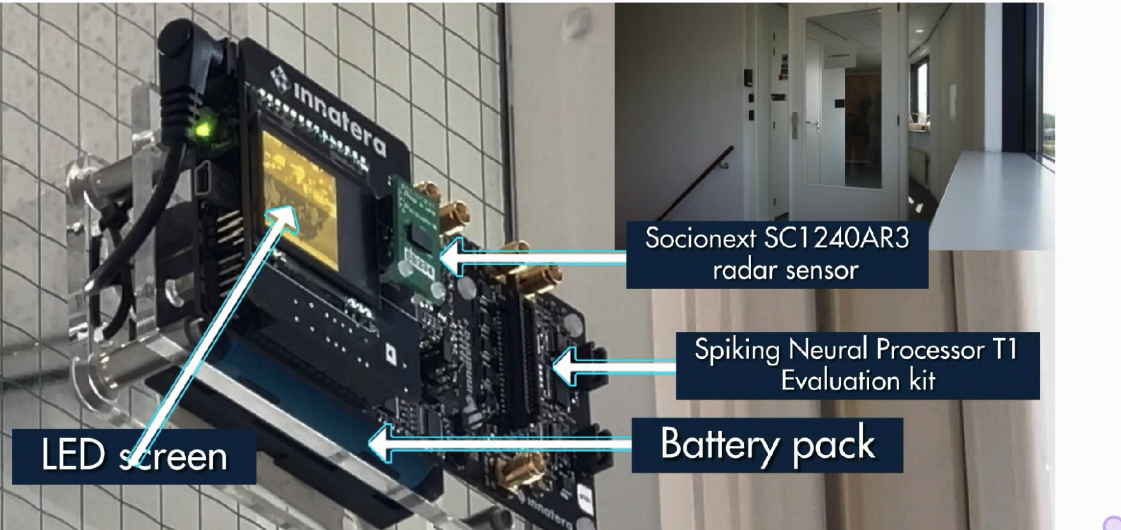
Beyond doorbells, the technology has a wide range of applications, including smart home automation, building security, and even occupancy detection in cars. “This is a perfect example of how neuromorphic computing can transform everyday devices,” Kumar noted. “We're bringing AI capabilities to the edge while actually reducing power consumption and enhancing privacy.”
Do more with less with AI computing
The dramatic improvements in energy efficiency and speed have generated significant interest in the industry. Kumar revealed that Innatera has signed contracts with several customers and is seeing a steady increase in interest in neuromorphic technology. The company is targeting the sensor edge applications market with the ambitious goal of bringing intelligence to one billion devices by 2030.
To meet this growing demand, Innatera is ramping up production: Spiking Neural Processors are scheduled to go into production in the second half of 2024, with volume deliveries starting in Q2 2025. This timeline reflects the rapid progress the company has made since spinning out of Delft University of Technology in 2018. In just six years, Innatera has grown its workforce to around 75 employees and recently appointed former Apple vice president Duco Pasmooij to its advisory board.
The company recently closed a $21 million Series A round to accelerate the development of its Spiking Neural Processor. The round was oversubscribed and included participation from investors such as Innavest, InvestNL, EIC Fund and MIG Capital. This strong investor backing underscores the growing excitement surrounding neuromorphic computing.
Kumar envisions a future where neuromorphic chips increasingly handle AI workloads at the edge, while the larger underlying models remain in the cloud. “There's a natural complementarity there,” he says. “Neuromorphics excel at processing real-world sensor data quickly and efficiently, and large language models are great for inference and knowledge-intensive tasks.”
“It's not just a matter of computational power,” Kumar points out. “The brain can deliver incredible intelligence on a fraction of the energy that current AI systems require. That's the promise of neuromorphic computing: not just more powerful, but dramatically more efficient AI.”
Seamless integration with your existing tools
Kumar highlighted developer-friendly tooling as a key factor in accelerating the adoption of neuromorphic technology: “We have built a very extensive software development kit that allows application developers to easily target our silicon,” Kumar explained.
Innatera's SDK uses PyTorch as a front end. “In fact, neural networks are developed entirely in the standard PyTorch environment,” Kumar points out. “So if you know how to build neural networks in PyTorch, you can use the SDK to target our chips.”
This approach significantly lowers the barrier to entry for developers already familiar with popular machine learning frameworks, allowing them to leverage the power and efficiency of neuromorphic computing while leveraging their existing skills and workflows.
“This is a simple, out-of-the-box, standard and extremely fast way to build and deploy applications on our chips,” Kumar added, highlighting the potential for rapid adoption and integration of Innatera's technology into a wide range of AI applications.

Silicon Valley Stealth Game
While LLM gets all the attention, industry leaders are quietly acknowledging the need for radically new chip architectures. Notably, OpenAI CEO Sam Altman, who has been vocal about the imminent arrival of artificial general intelligence (AGI) and the need for massive investment in chip manufacturing, has personally invested in Rain, another neuromorphic chip startup.
The move is significant. While Altman has spoken publicly about scaling up current AI technologies, his investment signals a recognition that the path to more advanced AI requires a fundamental shift in computing architecture. Neuromorphic computing could be one of the keys to closing the efficiency gap facing current architectures.
Bridging the gap between artificial and biological intelligence
As AI permeates every aspect of our lives, the need for more efficient hardware solutions will only grow. Neuromorphic computing is one of the most exciting frontiers in chip design today, with the potential to enable a new generation of smarter, more sustainable intelligent devices.
While large-scale language models get all the attention, the real future of AI may lie in chips that think like the human brain. “We're only just scratching the surface of what's possible with neuromorphic systems,” Kumar says. “The next few years are going to be incredibly exciting.”
As these brain-inspired chips make their way into consumer devices and industrial systems, we may be ushering in a new era of artificial intelligence — faster, more efficient, and closer to matching the incredible capabilities of biological brains.
Source link