4
Music has always been visual — and in 2026, it’s inevitable.


Long before algorithms entered the creative conversation, music and visuals were already inseparable. Album artwork, stage lighting, music videos, and even fashion have always shaped the way listeners connect with sound.
As we head into 2026, that relationship is evolving again. This time, AI music video generator. What once required cameras, film crews and weeks of editing is increasingly being reimagined through intelligent systems that respond directly to the music itself.
For artists, this change is not automation for convenience. it’s about new visual language It emerges from the sound.
From traditional music videos to intelligent visual systems
The history of music videos reflects the evolution of technology. Early videos recorded performances. Subsequent decades introduced storytelling, symbolism, and cinematic ambition. Today’s platforms emphasize speed, adaptability, and visual impact across multiple formats.
Our AI music video generator perfectly reflects this moment.
Instead of building all visual elements manually, artists can now work conceptually, choosing mood, style, and emotional direction while the AI transforms audio into synchronized movement. Rhythm becomes movement. The melody becomes a color. The structure becomes a visual flow.
This is not a substitute for artistic vision. it is new medium.
Actual features of AI music video generator
At its core, the AI music video generator listens to the music before creating it.
Modern systems analyze:
- tempo and beat pattern
- Dynamic changes within the track
- emotional tone and intensity
- Structural elements such as drops, bridges, transitions, etc.
From there, the AI generates visuals that organically respond to the music. The result is a visual experience that feels rhythmically alive, rather than static animation layered over sound.
By 2026, the process has been refined enough to support serious works of art, as well as experimentation and novelty clips.
Why artists are turning to AI-driven visuals
AI music video tools are increasingly being adopted for both practical and creative reasons.
creative accessibility
Not all artists have access to professional video production. AI removes that barrier and allows the visuals to exist at the same pace as the music.
Speed without compromise
Releasing music today means staying present visually. AI allows artists to quickly create high-quality videos without compromising aesthetic intent.
laboratory
Multiple visual interpretations of a single track are now possible. Artists can explore abstract, cinematic, or performance-driven visuals at no additional cost.
Platform flexibility
AI-generated videos can be adapted for streaming platforms, social media, or live performances, all from the same creative foundation.
Shift in 2026: Emotions, identity, and real-time visuals
As AI models improve, music visualizations are becoming more nuanced.
Emotion recognition systems can now distinguish between similar tempos with very different moods. Slow, melancholic tracks create a visual that is completely different from minimalist ambient pieces, even if they have rhythmic similarities.
The identity of the artist is also becoming central. Instead of a generic output, creators can tailor visuals to their own personal aesthetic, including a consistent color palette, motion style, and visual signature across releases.
In live environments, real-time AI visuals are starting to redefine performance, allowing images to be generated as music occurs.
Beatviz: A tool built around sounds, not templates

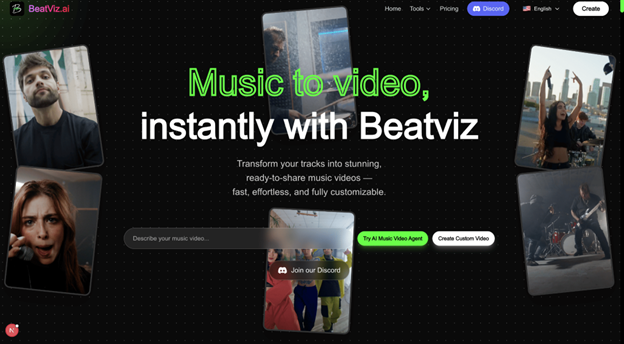
Some of the platforms forming this movement are: beatbiz It reflects the broader creative philosophy behind the AI music video generator space.
Rather than prioritizing strict presets, Beatviz musical responsiveness — visuals that feel connected to the track’s beat, structure, and emotional arc. The goal is to visually support the music rather than overpower it.
For independent musicians and producers, this approach allows visuals to grow directly from sound, preserving artistic intent without technical complexity.
More importantly, tools like Beatviz demonstrate how AI can continue to serve creativity rather than dictate it.
AI as a creative partner, not a replacement
As the creative field continues to debate AI, music provides an important perspective. From electronic musical instruments to digital production, technology has always shaped sound.
AI Music Video Generator follows in that tradition.
Artists still define the vision. AI simply accelerates execution and expands what is visually possible. The emotional core of music remains human.
A new visual era for independent music
Perhaps the most meaningful impact of AI-driven visuals is cultural. Independent artists now have access to tools that were once reserved for major production companies.
This results in the following:
- Increasing diversity in visual storytelling
- A more experimental aesthetic
- A stronger visual presence for emerging artists around the world
As listeners, we experience music more often, more creatively, and more directly, not just as something we hear, but as something we see.
towards the future
By the end of 2026, AI music video generators will no longer feel new. You will feel needed.
As music continues to evolve, the way we visualize it will evolve with it, guided by artists, supported by technology, and shaped by sound itself.
In that future, platforms like Beatviz won’t define creativity.
they are give a new dimension.
#This is a contributor’s post. The opinions expressed here are those of the poster. Illustrate Magazine does not endorse or review any brands mentioned. We do not and cannot investigate any affiliation with the brands, products, and people mentioned. It is the poster’s responsibility whether or not to disclose. As with any other account or article, contributors may be paid a professional fee. #