
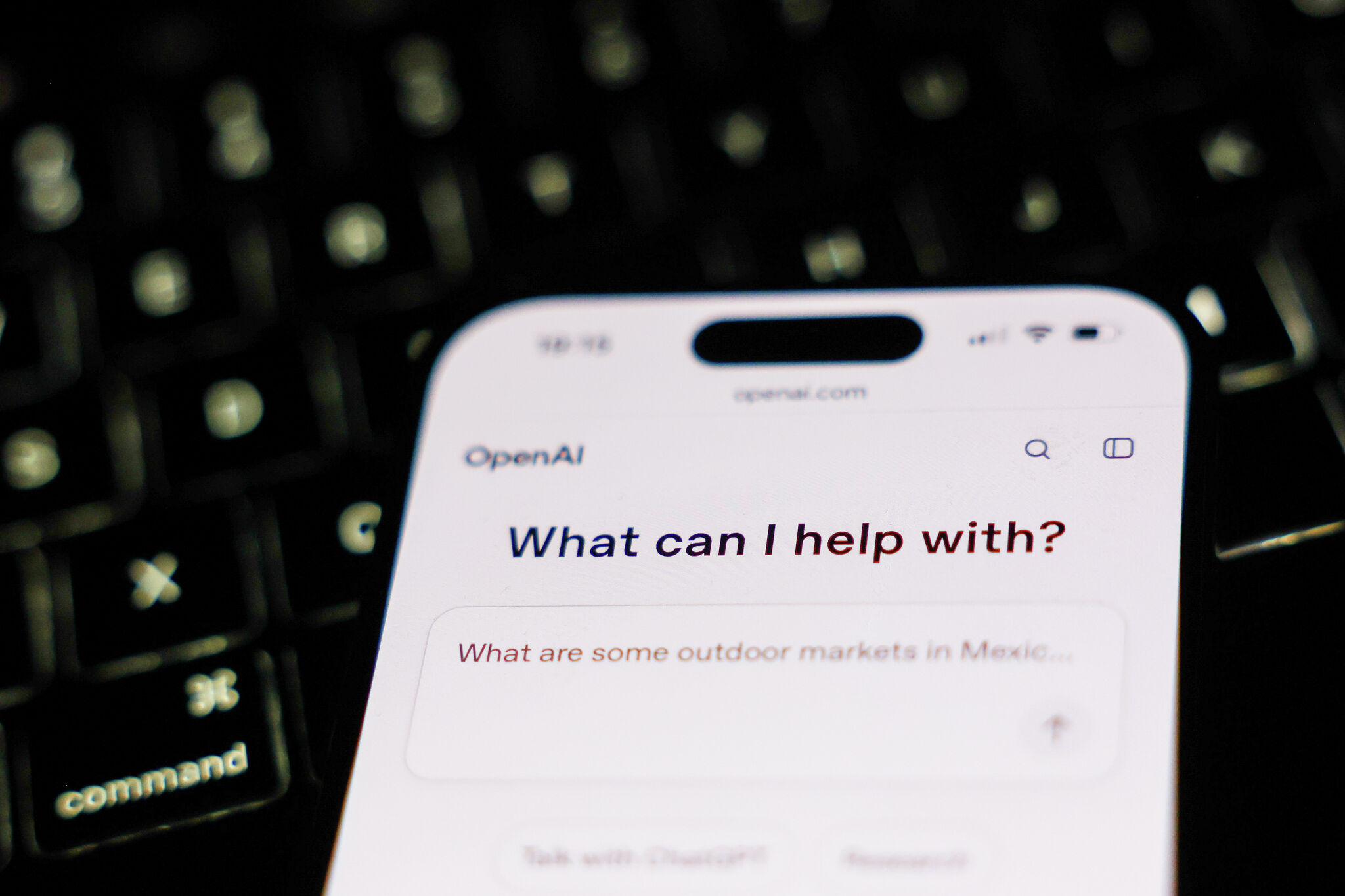

May 17, 2026. Laptop keyboard and OpenAI ChatGPT website displayed on a mobile phone screen. Baylor University is part of a consortium of researchers who argue that religious perspectives are often omitted from AI responses.
As artificial intelligence spreads into workplaces and classrooms, researchers at four universities say it has a major blind spot: religion.

The AllFaith benchmark, a series of tests on how AI handles different religions, found that religious perspectives were often omitted from AI responses, claims the Consortium for the Evaluation of Faith and Ethics in AI (CEFE-AI).
Article continues below this ad
CEFE-AI, a collaboration between researchers from Baylor University, Brigham Young University, the University of Notre Dame, and Yeshiva University, argues that religious bias remains underexplored in AI research, highlighting that only 0.2% of more than 12,000 papers on AI bias have addressed the issue.
But the findings go beyond that, with researchers arguing that religion and AI should be more closely integrated.
What the research shows
The AllFaith Benchmark includes hundreds of real-world ethical questions sourced from ChatGPT recordings and contributions from faith communities. The researchers tested the benchmark across 14 large-scale language models (LLMs) from companies such as Anthropic, Google, xAI, and Open AI.
Article continues below this ad
The consortium cited a survey of 1,125 Americans that found that most people expect a religious perspective when asked about ethics. But the researchers said nearly all of the AI models tested failed to include religious content in their responses.
Researchers also reported measurable differences in AI responses following conversion bias tests.
The consortium said most models showed negative bias against Jehovah’s Witnesses and positive bias against Catholics. While the Anthropic and Meta models reported the least bias overall, Grok showed the strongest bias, with results favoring Catholics and Protestants and reflecting negative bias against Jehovah’s Witnesses, Baha’is, and Hindus.
Article continues below this ad
A broader question: AI and religion in ethics
The findings raise broader questions about what role, if any, religion should play in AI-generated answers to ethical questions. CEFE-AI believes that religion should play a greater role in the ethical guidance of AI.
“Consistent with research showing the deep moral relevance of religion for the majority of the world’s population, we also found that people believe religion is important in hundreds of real-world ethical issues,” Paul Martens, associate professor of ethics at Baylor University, said in a news release announcing the study’s findings. “However, when faced with similar ethical issues, AI systems largely ignore the role of religion.”
CEFE-AI said this work is still in its early stages. Ongoing research aims to foster constructive conversations about how AI products can be improved to better serve humanity. Martens argues that this is not just a goal, but an obligation.
Article continues below this ad
“Of the many challenges that arise at the human-technology interface today, this is one that Baylor University and the other faith-based universities in the consortium are uniquely equipped to, and perhaps obligated to, address,” Professor Martens said in the release.
In addition to Martens, a core team of five other Baylor faculty members contributed to the research. The director of the Baylor Ethics Center said Christian universities care deeply about how AI interacts with faith and ethics.
“As an expression of the Golden Rule, we expect the same accuracy and fairness from our sisters and brothers of other faiths,” Martens said.

A person holds a copy of Pope Leo
Another faith-based voice in the AI debate
The consortium’s research joins a growing body of research exploring the intersection of AI and religion. Just last week, Pope Leo XIV released an encyclical addressing the social and ethical implications of AI.
Article continues below this ad
According to the National Catholic Register, the pope characterized AI as the new industrial revolution and warned that it cannot replace human intelligence.
“A very important human element is missing. AI will not judge what is truly right and wrong, and it will not be able to feel true wonder in the face of the beauty of God’s creation,” he said.
According to USA TODAY, the pope urged that human dignity and moral responsibility must remain at the core of AI development, and that the tools should be regulated to serve the common good.
Article continues below this ad


