Industry insiders say the AI IDE and AgentCore platform updates strengthen AWS’s position in the fierce competition with Microsoft and other AI coding competitors in enterprise AI development.
This week’s Amazon Bedrock AgentCore update addressed the same AI agent governance and security concerns that Microsoft mentioned when announcing Agent 365 at last month’s Ignite conference.
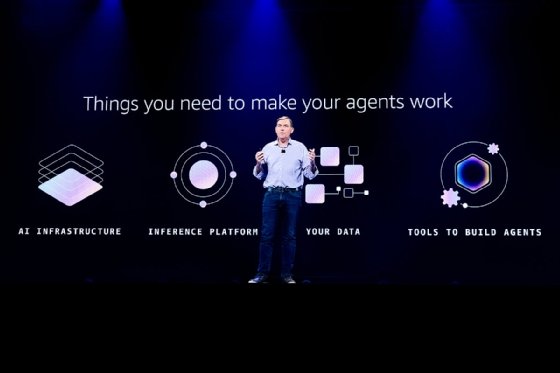
AgentCore’s new policy capabilities also grew out of AWS customers’ struggles to deploy enterprise AI agents in production, according to comments from AWS CEO Matt Garman during his keynote address at the annual AWS re:Invent conference on Tuesday.
“Most customers feel unable to deploy agents for their most valuable and critical use cases, which is why we are announcing the policy today at AgentCore,” said Garman. “Policies provide real-time, definitive control over how agents interact with enterprise tools and data. These policies can now be set to define not only what tools and data agents can access, but also how they can access them, and what actions they can take and under what conditions.”
Other updates to AgentCore this week include AgentCore Evaluation, which allows developers to continuously monitor the behavior of their AI agents, and AgentCore Memory, which helps agents learn from past experiences to improve decision-making.
A new autonomous frontier agent and a feature called Kiro powers, released in preview this week, both add to the context used by AI-assisted code generation tools to ensure high-quality output. Kiro autonomous agents maintain consistency independent of individual code repositories and coding sessions. Kiro Power, on the other hand, can automatically preload a set of Model Context Protocol (MCP) tools and agent framework expertise when a developer prompt is entered. Other frontier agents previewed by AWS this week include security agents that proactively protect applications throughout the development lifecycle, and DevOps agents that can automatically resolve incidents and proactively prevent them.
Jason Andersen, an analyst at Moor Insights & Strategy, said in an interview with Informa TechTarget this week that comparing AWS Kiro and Frontier Agent to their GitHub counterparts (i.e. GitHub Copilot Agent mode and Coding Agent, and Copilot Autofix) is, in some ways, like comparing apples to oranges.
Over the past year, I haven’t seen anything that comes close to what GitHub has been doing with autonomous coding agents.
jason andersenAnalyst Moore Insights and Strategies
While Kiro’s specialty is spec-driven development, GitHub can make developer-specific workflows more efficient by focusing within individual repositories, Andersen said. AWS application developer tools also have a long way to go to match GitHub’s 180 million developer install base, and Copilot still has a strong first-mover advantage.
But with this week’s update, Kiro has emerged as a unique challenger to Copilot, Andersen said.
“Over the past year, I haven’t seen anything that comes close to what GitHub has been doing with autonomous coding agents,” Andersen wrote in a LinkedIn post this week. “The combination of Frontier Agent, Kiro, and specification-based development will ultimately represent a complete alternative solution and should prompt serious consideration.”
AWS AgentCore and Microsoft Agent 365
With this week’s updates to Frontier Agent, Kiro, and AgentCore, a new battleground in enterprise AI is starting to take shape between AWS and Microsoft in the AI-driven development space, Andersen said.
“Functionally, we’re not talking about big individual differentiators,” he says. “It’s really a collection of different parts of the story. When you do something with the Kiro agent, it has the ability to work with AgentCore Memory to run for longer periods of time, potentially allowing you to do more complex jobs.”
Overall, AWS and Microsoft are taking different approaches to some of the same challenges, appealing to different parts of the enterprise AI development process and different ways of working, Andersen said. For example, Microsoft Agent 365, Copilot Fabric, and Foundry IQ tools offer comprehensive and clear product packages, but are a little more limited than Amazon Bedrock in terms of model and framework choices, he said.
“AgentCore architecture is also very interesting — new policy [feature] “It’s not its own separate service, it’s actually a feature of the gateway service,” he said. “You want to implement policy there, because once you put it into an agent, when you put it into a model, the policy becomes non-deterministic. AWS has some new ways to show some real sophistication on some of these engineering problems.”
AWS CEO Matt Garman will present the latest in AWS AI agent development during his keynote at re:Invent 2025.
Comparing AWS Kiro AI IDE and GitHub Copilot
According to a blog post by AWS Engineers, the Kiro project aims to reduce fragmentation and unnecessary effort in configuring coding agents, with both autonomous and privileged agents.
“Most AI coding assistants require active management of context,” reads the post introducing the Kiro autonomous agent. “You end up constantly re-explaining your preferences and patterns, and building systems that save context in a repository. When you close the session, you forget everything.”
In contrast, Kiro autonomous agents “maintain the context of the entire work,” according to the post. “When you give feedback on something, [pull request] When it comes to error handling, it remembers that pattern and applies it to subsequent changes…it already knows how your users work and gets better with each interaction. ”
Kiro’s capabilities bring a bundled approach to packaging context for AI agents, allowing complex environments to load that context more efficiently, AWS engineers wrote in a separate post.
“AI development tools are rapidly evolving,” the post says, citing Anthropic’s dynamic tool loading, Claude Skills, Cursor rules, and MCP tools. “Each requires separate configuration and management. You’re stitching together multiple primitives, such as tools and knowledge, to get a complete picture. [and] dynamic loading. And… switching between tools means reconfiguring everything.
“The challenge is not lack of functionality, but fragmentation,” the post continued. “Developers want uniform packaging.”
Kiro features include agent onboarding manuals called steering files, MCP server configuration details, and hooks to additional steering instructions or resources. Once these bundles are installed, you will see certain words in a prompt. payment or check out For Stripe, activate Stripe Power. It is then automatically deactivated when the developer moves on to another task.
Torsten Volk, an analyst at Omdia, a division of Informa TechTarget, said in an interview this week that Kiro’s power needs to be proven in practice, but it has the potential to address many of the issues that make vibecoding practices largely unsuccessful in enterprises.
“With Kiro, you can see that you can actually define the agent action space and really define best practices,” Volk said. “Whether it actually works in practice is something to consider, but that’s the next frontier. I’ve worked with several startups that are doing just that… They’re all trying to approach the problem of creating a prototype and then having to throw away the vibe code and start over for an enterprise development project.”
Kiro’s holistic focus beyond individual repositories may make its AI agents uniquely suited to address problems with AI agent-driven applications in production, Andersen said.
“The way AWS approaches this can be useful for maintenance and sub-releases, but when you look at the GitHub side, it’s much more about pull requests, merges, and actions,” he said. “Kiro’s power seems to be a little more runtime-focused and may eventually be able to handle the runtime world as well.”
Beth Pariseau, senior news writer at Informa TechTarget, is an award-winning veteran of IT journalism covering DevOps. Any tips? send an email to her or reach out @Parisaud.