
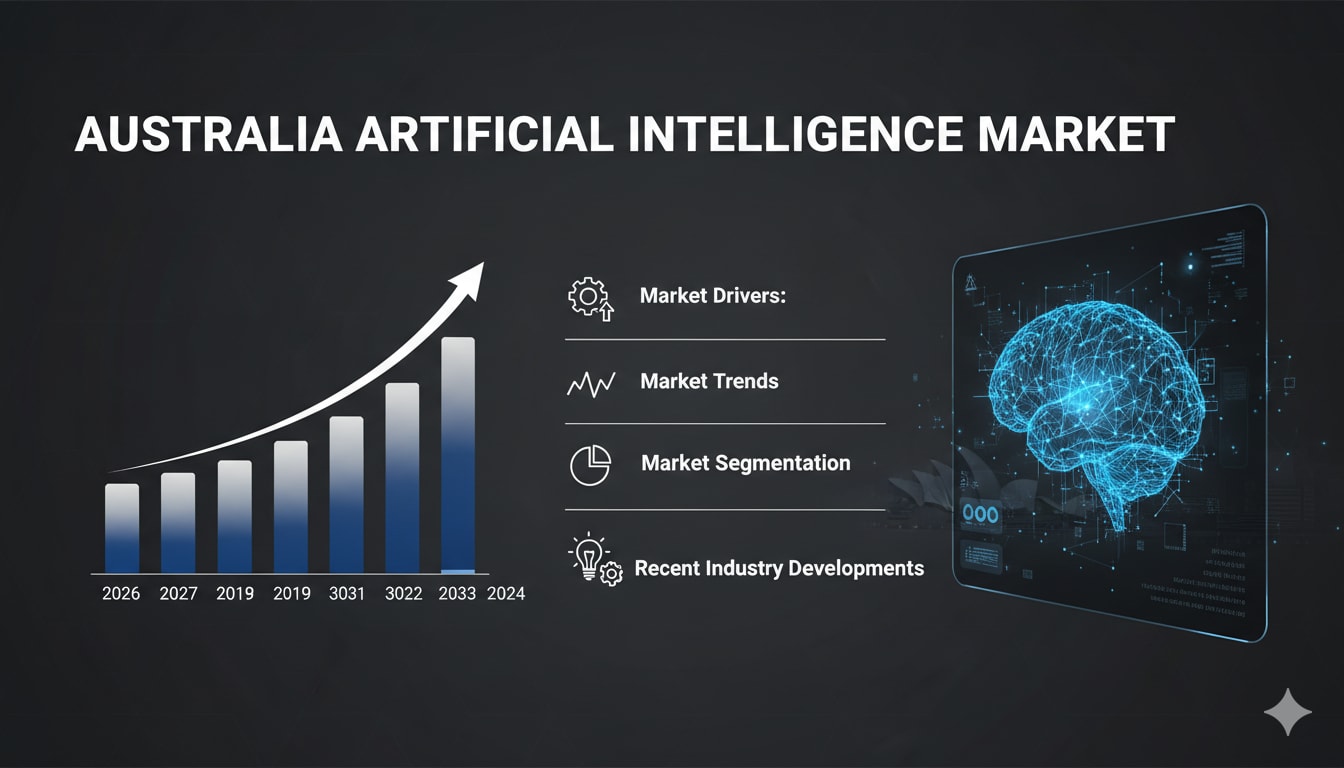
of Australian artificial intelligence market is solidifying its position as one of the country’s most dynamic technology sectors, supported by increased digitalization and corporate adoption. According to IMARC Group, the market is expected to reach USD 2,387.1 million in 2025, expand to USD 8,017.3 million by 2034, and grow at a compound annual growth rate (CAGR) of 14.41% from 2026 to 2034.
This strong growth reflects Australia’s strategic adoption of AI across industries including healthcare, manufacturing, financial services, retail and transport. Artificial intelligence (across machine learning, natural language processing, computer vision, and other technologies) is rapidly transforming business operations, decision-making frameworks, and customer experiences. IMARC’s detailed segmentation shows that the market is formed by multiple products (hardware, software, services), technologies, systems, and end-use industries, revealing a mature yet expanding landscape.
Request a sample report with the latest 2026 data and forecasts:
Why is the market growing so fast?
1. Government support and strategic investment
Government initiatives are the cornerstone of AI adoption in Australia. Federal and state governments have actively funded AI research, encouraged public-private partnerships, and developed frameworks to support the responsible and ethical deployment of AI technologies. These efforts reduce barriers to adoption for businesses and foster a national ecosystem that prioritizes innovation and competitiveness on a global scale.
Government involvement, by supporting infrastructure, research funding, and regulatory readiness, demonstrates stability and long-term commitment, and is a key factor in encouraging investment in AI solutions that transform the way companies operate.
2. Explosive growth in digital data
The proliferation of data from digital technologies such as connected devices, social media platforms, enterprise systems, and IoT sensors creates the raw materials needed for AI systems to deliver value. Vast amounts of structured and unstructured data enable AI algorithms to learn, improve, and provide insights across functions such as predictive maintenance, consumer behavior analysis, and risk analysis.
This rich data not only improves accuracy and outcomes, but also enables new use cases in real-time, strengthening the value proposition of AI solutions across all sectors.
3. Advances in machine learning and analytics
Continuous improvements in machine learning models, computational power, and analytical frameworks expand what AI can do. Enhanced algorithms enable more advanced pattern recognition, prediction, autonomous decision-making, and real-time optimization. These capabilities are particularly valuable in areas such as healthcare (diagnostic support) and finance (fraud detection and personalized services).
As research pushes the boundaries of what AI can achieve, adoption is accelerating beyond pilot projects to mission-critical deployments.
4. Introducing cross-sector companies
Australian businesses are increasingly recognizing the potential of AI to streamline operations, improve customer experiences and unlock new revenue streams. From intelligent automation in manufacturing facilities to personalized marketing in retail, AI is moving from experimental to essential technology.
Organizations are investing in AI platforms that integrate with their core systems, enabling real-time decision-making, predictive insights, and operational efficiencies that were previously unattainable.
5. Growing demand for smart, scalable systems
The demand for scalable and adaptable technology to support digital transformation has never been greater. From decision support engines to hybrid cognitive applications, AI systems are becoming essential tools for organizations looking to stay competitive in a rapidly evolving market.
This demand is driving technology adoption as well as investment in complementary capabilities such as cloud infrastructure, edge computing, and advanced analytics frameworks.
What is a chance?
1. Healthcare innovation
AI presents significant opportunities for medical diagnosis, treatment optimization, and hospital operations. With an aging population and increasing demand for personalized care, AI applications can improve outcomes while reducing costs.
2. Manufacturing efficiency
In manufacturing, AI-driven automation and predictive analytics can increase productivity, reduce downtime, streamline supply chains, and provide tangible competitive advantages.
3. Transforming financial services
Banks and financial institutions can leverage AI to improve both security and user experience by detecting fraud, automating customer service, and informing investment strategies.
4. Retail and customer engagement
Transform your retail operations with AI-powered personalization and predictive demand forecasting. With a deeper understanding of consumer behavior, retailers can optimize inventory and improve marketing accuracy.
5. Optimization of transportation and logistics
AI’s real-time data analytics capabilities improve logistics planning, route optimization, and fleet management, directly impacting operational costs and delivery performance.
6. Smart cities and urban planning
City authorities can leverage AI for traffic management, energy optimization, and public safety, laying the foundation for smarter, more sustainable cities.
7. Improve employee skills and develop human resources
As AI adoption increases, so will the demand for specialized skills in machine learning, data science, and AI implementation. Educational programs and training platforms have an opportunity to close this skills gap.
Recent news and developments in the Australian artificial intelligence market
• January 2025: Government regulatory action — The Australian Government announces enhancements to its National AI Strategy, focusing on an ethical use framework and data protection standards. The initiative aims to attract global technology partnerships by providing clear compliance guidelines, encouraging investment, and ensuring public trust in AI solutions across sectors. Early industry feedback highlights growing confidence among corporate adopters.
• June 2025: Corporate Expansion — A leading technology infrastructure provider announces a multi-million dollar investment in a next-generation AI hub in Melbourne, including an “AI Factory” and Innovation Center designed to accelerate research and development. The facility will support thousands of high-value technology jobs and provide companies with access to advanced AI testing environments and analytics platforms to strengthen the region’s AI ecosystem.
• September 2025: Adoption Milestones — Industry analysis reveals double-digit year-on-year growth in AI adoption across Australian businesses, with significant adoption in healthcare and finance. Organizations are reporting measurable efficiency gains with AI implementation, such as reduced processing times and increased accuracy of predictive tasks, reinforcing the upward trajectory of the market and measurable business value.
Why should you know about the Australian artificial intelligence market?
Australia’s artificial intelligence market is much more than just a technology sector, it is a strategic engine of innovation, productivity and competitive advantage for the country. For investors, the segment’s strong CAGR and diversified application base point to durable long-term value. Companies that integrate AI into their core operations can realize significant efficiencies, improve customer engagement, and generate new revenue streams. For policymakers, AI is both an opportunity and a responsibility, requiring ethical deployment, investing in capacity building and positioning Australia as a global leader in responsible AI innovation.
Understanding the dynamics of this market is essential for anyone looking to leverage Australia’s future growth with technology.


