How is artificial intelligence currently being integrated into education?
We are at the biggest turning point in modern education.
AI has surpassed the promise of becoming an everyday tool in the classroom. According to the HEPI Student Generative AI Survey (2025), college students’ use of artificial intelligence rose from 66% in 2024 to 92% in 2025, the largest increase ever recorded.
In the education sector, data reflects an uneven reality. According to the Stanford AI Index Report (2026), 70% of teachers are already using AI, but only half of institutions offer specific training. Additionally, the Digital Education Council’s Global AI Faculty Survey (2025) found that while 61% of faculty have implemented AI, 88% are implementing it in a rudimentary manner and without a clear pedagogical approach.
The real divide is not between those who use AI and those who don’t, but between those who use it wisely and those who don’t.
This is not a technological crisis. It’s a training crisis.
How are teachers using artificial intelligence in the classroom at each stage of education?
The use of AI in education varies greatly depending on the level of education.
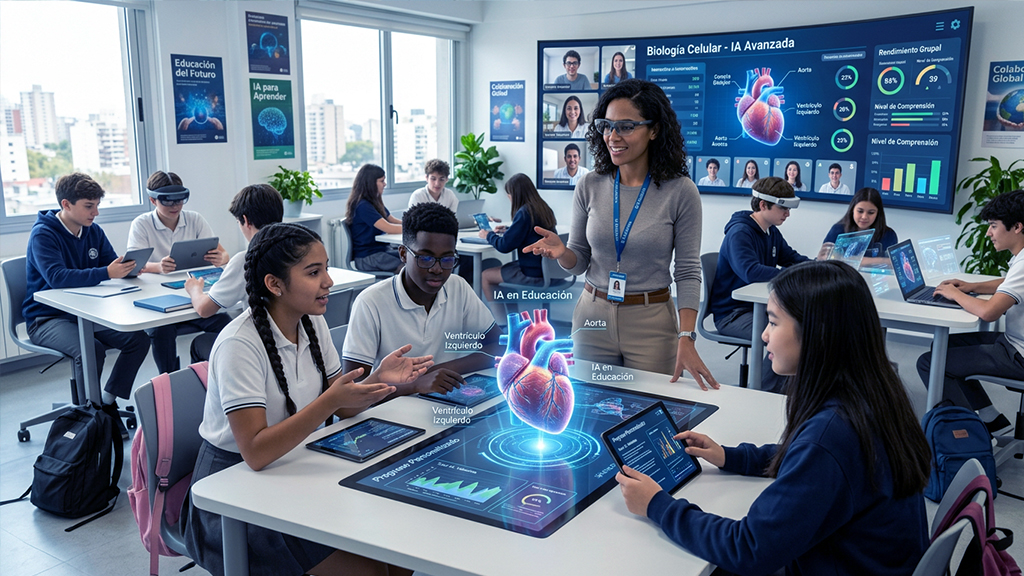
- Secondary education: Create personalized activities and visual resources
- B 6th form: Generating summaries, summaries, and test simulations
- University: Developing comprehensive guides, interactive resources, and advanced tools such as Research Assistant and NotebookLM
Teachers who make the most of artificial intelligence focus on the educational purpose, not the tool.
When your strategy is clear, technology stops being a barrier and becomes a facilitator.
How are students using artificial intelligence in their studies?
Although student use of AI is widespread, it is not always the most effective.
It is often used to:
- Generate work quickly
- Summarize content without editing it
- Get direct answers without deep understanding
This usage is understandable, but it has a direct impact on learning.
However, there are also very valuable applications of AI in education.
- 24/7 personalized instruction
- language learning
- research organization
- Creating original content
Learning how to use artificial intelligence effectively is itself a critical 21st century skill.
What are the risks of using artificial intelligence in education?
The main risks are the so-called cognitive debt: Everything your students can’t learn because you’re leaving the process to AI.
An MIT study (2024) found that heavy users of AI had lower activity in areas related to deep thinking. In addition, the so-called “illusion of knowledge” arises. Students believe they understand, but they do not retain the information.
The problem is that it doesn’t use artificial intelligence.
The problem is that you use it without thinking.
How can we use artificial intelligence educationally and effectively?
The key is simple: Think first, then use AI.
Before relying on tools, students should:
- generate unique ideas
- understand the problem
- set standards
Artificial intelligence must become a partner, not a replacement.
This means a change in approach.
- Copy → Compare
- From delegation to collaboration
- Consumption → Thinking
This difference determines whether the AI learns more or less.
Main applications of artificial intelligence in education
AI in the classroom already has effective real-world applications.
- Generate personalized content
- exam simulation
- smart tutoring
- Creating teaching materials
- organization of knowledge
These solutions allow each student to learn at their own pace and needs.
How are companies implementing artificial intelligence in training?
In the business environment, the adoption of artificial intelligence will begin soon.
The pattern is clear.
- initial resistance
- Application in real world scenarios
- Rapid deployment
This change is not technological, but spiritual. Once people understand that AI solves specific everyday problems, barriers will disappear.
Telefónica’s role in education and digital transformation
In this context, Telefonica is promoting access to artificial intelligence and digitalization through:
- Advanced connectivity
- innovative digital services
- Training and development programs
This approach will help citizens, professionals, and businesses effectively integrate AI, reduce the digital divide, and improve digital skills.
What will the future of education look like with artificial intelligence?
The future of education will be defined by two major changes:
- Teachers evolve into designers of learning experiences
- Students learn to use AI with critical thinking
The unique value of education will continue to lie in the ability to think, be creative, and adapt, which AI cannot automate.
It makes no sense to keep training people for tasks that machines are already good at.
Conclusion: The true impact of AI on learning
Artificial intelligence does not replace education. It evolves it.
The most important skills today are Ability to continuously learn (Learnability). Access to information is no longer an issue. The challenge lies in how it is used.
AI can be a means to improve learning, or it can be a shortcut that undermines learning. The difference lies in the criteria by which it is used.
Frequently asked questions about artificial intelligence in education
What is artificial intelligence in education and what is its purpose?
Use technology to personalize learning and automate educational processes.
What are the main risks of artificial intelligence in education?
Cognitive debt and loss of critical thinking.
How can we properly use artificial intelligence in learning?
Think first, then use AI to support your understanding.