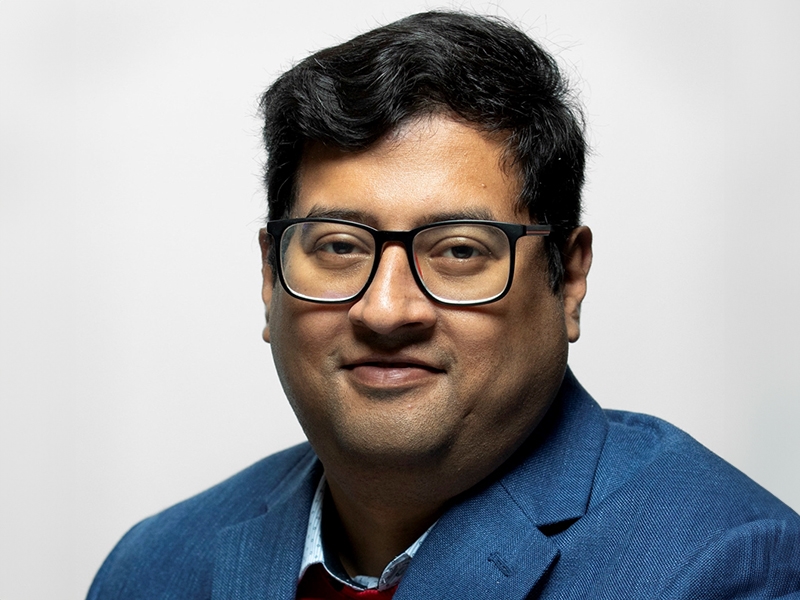
Aranyak Goswami joined the Arkansas Agricultural Experiment Station as an assistant professor in April to advance the three departments' research using bioinformatics.
Supercomputers and artificial intelligence are not typically thought of as working with animal science, but they are one of the tools in a relatively new scientific field called bioinformatics that can be used to improve the health and productivity of animals.
Aranyak Goswami is a bioinformatics expert who left human-focused medical research at Yale University and Stanford University to recently become an assistant professor at the Arkansas Agricultural Experiment Station. He will work with his three different departments to strengthen the research department of the University System's College of Agriculture.
“Artificial intelligence and machine learning are at the forefront of many aspects of animal and poultry production,” said Michael Looper, Head of Animal Science. “Dr. Goswami’s expertise in these key areas complements our current research programs in animal health, genetics and welfare.”
Goswami performs data analysis tactics to understand data generated from complex studies such as genetic sequencing, like assembling a jigsaw puzzle from millions of small pieces. The field known as bioinformatics, or computational biology, couples biological data with information storage, distribution, and analysis to support many areas of scientific research.
The term bioinformatics began to be used in the 1970s, building on the foundations laid in the 1960s.
Looper said collaboration between the fields of computational biology and animal science “will greatly benefit producers in Arkansas and beyond.” Professor Goswami is already collaborating with animal science professor Jiangchao Zhao to study the animal microbiome, which regulates digestion, reproduction, and infection resistance.
“One of my main interests is investigating the microbiome to improve the health of cows and poultry,” Goswami said. “There are a lot of genomes coming out that need to be sequenced, and there are some gaps in the field.”
Genome sequencing is a method used to determine the overall genetic makeup of a particular organism and find comparative changes in the genome. For example, Goswami's research will look at different gene expression patterns.
“We can study biological pathways that are activated and biological pathways that are not activated,” Goswami explained. “And what are the specific metabolic pathways they are using? And what are the protein interactions? What can we find to make them healthier and improve meat productivity?” ”
Goswami's analysis with gut health in mind can help animal scientists pinpoint the specific types of bacteria and viruses that affect animals and design probiotics and other therapeutic approaches. .
As a computational biologist, Goswami said he hopes to apply his experience in human health research and machine learning to animal health.
“What's exciting in the human field is generally more exciting in the animal field because genomes are not standardized,” Goswami said. “There's a lot of sequencing that needs to be done and a lot of techniques that need to be developed. So for computational biologists, it's a very interesting job.”
Machine learning in agriculture
Mr. Goswami will teach courses through the Dale Bumpers College of Agriculture, Food and Life Sciences. Through this experimental station, he will conduct research in the Animal Science and Poultry Science departments and the Agricultural Data Analysis Center.
“We are excited to have Dr. Goswami join our program here at Bumpers University and the Arkansas Agricultural Experiment Station,” said David Poultry Science Division Chair and Director of the Poultry Science Center of Excellence. Caldwell said. “We believe that ongoing research in the field of poultry food safety and disease prevention involving high-throughput sequencing and omics data will greatly benefit from Dr. Goswami's expertise in bioinformatics. Masu.”
Goswami said he looks forward to contributing to the development of the Agricultural Data Analysis Center as a “world-class center for machine learning, statistical learning and mathematical modeling for agriculture.”
“Most of our students have not had the opportunity to take an artificial intelligence course,” Looper said. “Through his teaching responsibilities, Dr. Goswami will introduce his students to the exciting field of machine learning in agricultural science.”
New field with potential for growth
Although bioinformatics is a relatively new scientific field, Goswami says it has a lot of potential for expansion. In 2017, Goswami completed his PhD in bioinformatics with a focus on microbial ecology, evolution, and genomics from the Indian Institute of Chemical Biology under Chitra Dutta in Kolkata. Goswami said Dutta is a pioneer in bioinformatics and computational biology in India and has a background in theoretical physics and mathematical sciences.
Goswami held a postdoctoral position at Yale University, collaborating with psychiatrists, epidemiologists, and physicians with an emphasis on cardiovascular, genetics, and internal medicine research. His most recent position was as a postdoctoral fellow and researcher at Stanford University.
At Stanford, Goswami worked on an initiative known as the Long Range Planning Report that emphasized the rights of postdoctoral faculty in areas such as pay, health care, safety and career development.
“Our work has the potential to transform the broader landscape of postdoctoral experiences across the United States,” Goswami said.
For more information about the Department of Agriculture's research, visit the Arkansas Agricultural Experiment Station website at https://aaes.uada.edu. Follow @ArkAgResearch on Twitter. For more information about the Department of Agriculture, please visit https://uada.edu/. Follow @AgInArk on Twitter. For more information about Extension programs in Arkansas, contact your local Cooperative Extension Service agent or visit www.uaex.uada.edu.
About the Faculty of Agriculture: The mission of the University of Arkansas System College of Agriculture is to strengthen agriculture, communities, and families by connecting trusted research with the adoption of best practices. The Bureau of Agriculture conducts research and extension activities within the nation's historic land-subsidized education system through agricultural experimental stations and cooperative extension services. The College of Agriculture is one of 20 institutions within the University of Arkansas System. We have offices in all 75 counties in Arkansas and faculty at five system campuses. The University of Arkansas System College of Agriculture does not identify individuals based on race, color, gender, gender identity, sexual orientation, national origin, religion, age, disability, marital status, veteran status, genetic information, or other legally protected information. status and is an affirmative action/equal opportunity employer.