Carson Easterling plans to specialize in control theory when he enters graduate school at Auburn University this fall, but he needed more preparation.
Applied Statistics and Machine Learning (ELEC 5970 6970 600) is an interdisciplinary course in the Department of Electrical and Computer Engineering that introduces students to basic and advanced machine learning tools through hands-on, application-driven projects.
It gave Easterling what he needed.
“Understanding the basics of artificial intelligence (AI) models and having a deeper knowledge of why they behave a certain way is invaluable,” said Easterling, a fourth-year electrical engineering major who will graduate in May. “From an electrical engineering perspective, machine learning is a great way to create models of very complex things, given the data.”
Ying Sun, Godbold Associate Professor in the Department of Electrical and Computer Engineering, is co-teaching the course with Louis Chen, Assistant Professor of Research and Extension at Tuskegee University. The class is in its fourth year and includes 23 Auburn students and nine Tuskegee students.
“Our classes cover a variety of machine learning algorithms, including K-nearest neighbors, support vector machines, decision trees, and neural networks, including both convolutional neural networks for computer vision and transformer neural networks, which are the basis of ChatGPT,” he said. “Typically, simple machine learning algorithms are better suited for small dataset problems, and more cutting-edge deep learning algorithms are better suited for big data problems. Students come from both engineering and agriculture backgrounds, so they may face different problems.”
Sun said the course will encourage both students and faculty to think more broadly about how AI can be applied.
“AI itself is interdisciplinary, and every industry and private company in Alabama will need AI,” he said. “We will continue to recognize the importance of AI in a variety of fields. Over the years that I have been teaching this course, I have begun working with NVIDIA and several professors from Auburn and Tuskegee universities on new projects in AI for agriculture, AI for education, AI for 6G wireless, and AI for robotics. Teaching this course gives me the opportunity to contribute to this growing AI trend.”
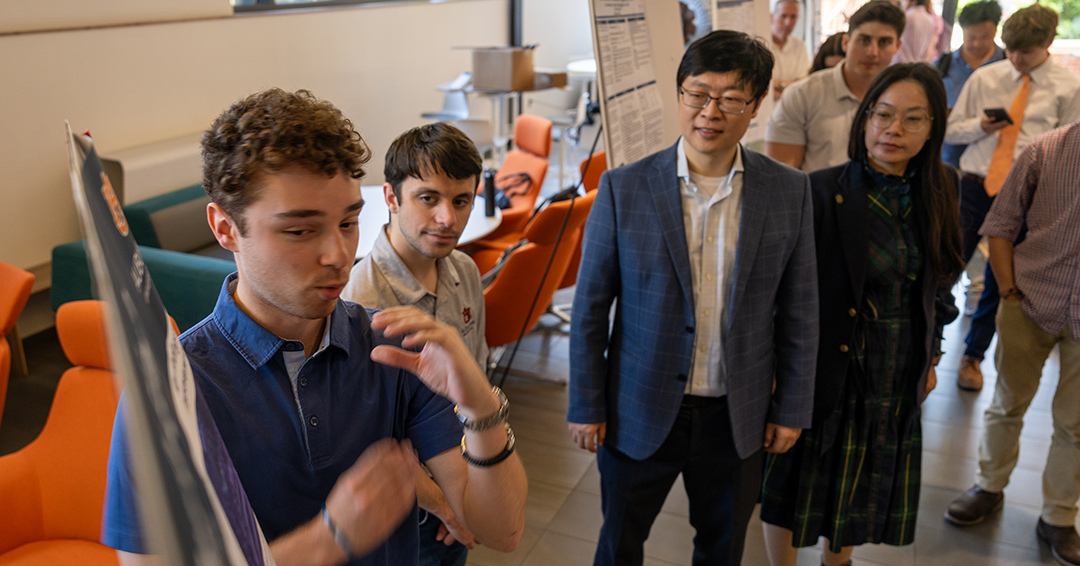
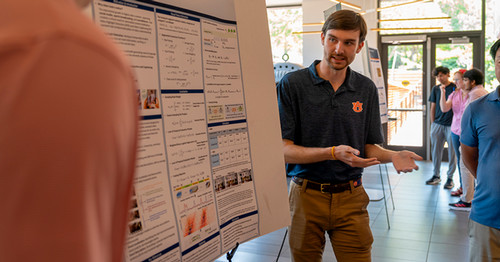
Like many end-of-semester classes, Sun’s course featured a poster presentation in front of faculty and colleagues on April 22 in Brown Hall.
They were complicated, to say the least.
What does it take to build temporally consistent real-time video captions? How can I create an interactive, large-scale language model tokenization analyzer that reveals how the model decomposes text? What about automatic video highlight detection and designing captions for long-form footage?
“Poster presentations formalize the project and get students excited,” Sun said. “Auburn engineering students are very talented. When they take their course projects seriously, the project outcomes are very good. These presentations are a great experiential learning activity for our students, and they are now ready for new AI-based engineering careers.”
Sam Shamon, a teaching and research assistant who will earn a master’s degree in electrical engineering in May, pointed out that the project has value beyond Auburn.
“I appreciate this course because it allows me to learn machine learning while immediately applying it to real-world projects,” he said. “The collaboration was especially valuable. It taught me how to effectively manage and divide technical tasks for major coding projects, a practical skill I didn’t have the opportunity to develop in other courses.”
Easterling said there are few substitutes for hands-on learning. He pointed to applications such as robotics and simulation where models trained in software can be transferred to physical systems, and said this class helps enable that transfer by converting abstract equations into code and results.
“When you’re in a classroom and you’re looking at linear algebra on the whiteboard, you’re like, ‘What’s going on?’ But once you start working on the code, when you start using the data, when you start looking at the output, you start putting the theory into practice and it sinks into you. That’s what’s great about this class.”