
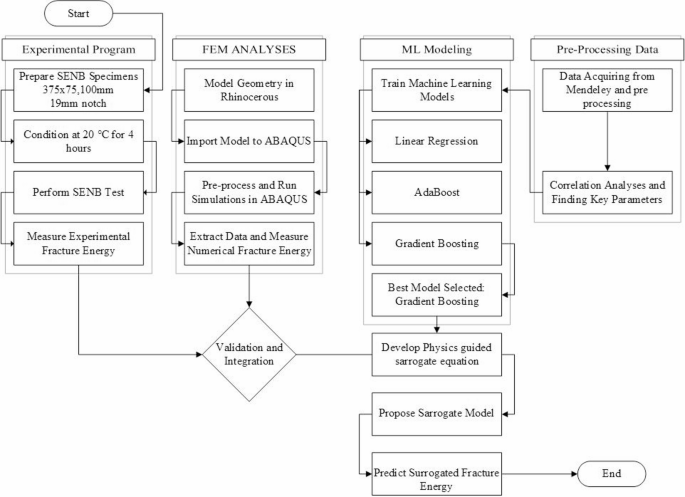
This study was conducted through an integrated multi-step methodology shown in Figure 1, designed to develop a physics-based machine learning framework for predicting the fracture energy of single-edge notch beams. It started with an experimental program that included single edge notch beam (SENB) tests on asphalt mixtures to obtain baseline fracture energy values. At the same time, finite element method (FEM) simulations were developed and validated against experimental results of force-displacement curves to generate numerical fracture energies. The comprehensive dataset of mixed characteristics was then utilized for machine learning modeling, performing correlation analysis and training multiple machine learning models including linear regression, gradient boosting, and AdaBoost. The core of this framework involved the development of novelty-based, dimensionally consistent surrogate equations that synthesize key mixture properties. In the final stage, the predictions from the surrogate model were validated against both experimental and numerical benchmarks to ensure accuracy and physical relevance. To clearly illustrate this progression, Section. 3 is structured to reflect the methodological sequence. Section 3.1 presents the basic reference experimental procedure and key fracture measurements. Section 3.2 then presents the development of the FEM model and its validation using experimental force-displacement curves. Section 3.3 focuses on the derivation of the surrogate fracture equation, emphasizing its dimensional consistency and its role in linking physical parameters to fracture energy. Finally, Sect. 3.4 describes machine learning models trained using both raw mixture properties and surrogate-derived parameters, followed by a comprehensive evaluation against experimental and numerical benchmarks.
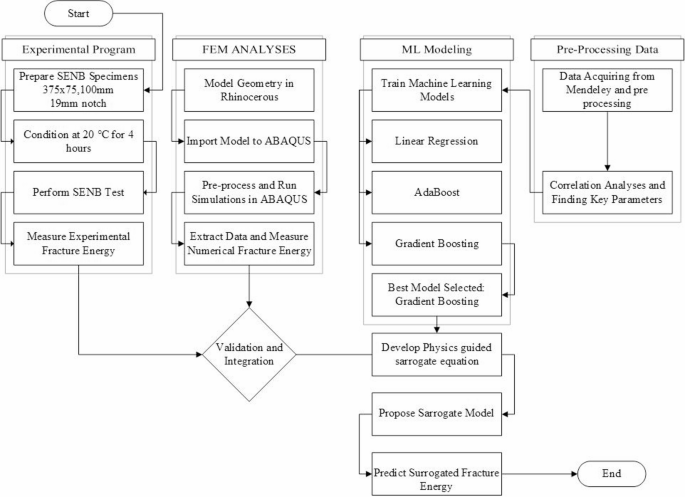
A hybrid framework for predicting fracture energy.
Experimental program
This experimental program was designed to obtain accurate data on the fracture behavior of asphalt concrete, which subsequently served as the basis for finite element analysis and machine learning predictions. Single edge notch beam (SENB) samples were fabricated in a standard rectangular shape with a length of 375 mm, a width of 75 mm, and a height of 100 mm. To control the crack initiation path, an intermediate notch with a depth of 19 mm was created in the center of each sample, as shown in Figure 2. The aggregates used in this study were obtained from the KARKON factory located near the expressway toll plaza, and the raw materials were sourced from the Margalla region. These aggregates were selected to meet National Highway Administration (NHA) Class B gradation specifications. Asphalt cement (bitumen) of grade 60-70 was procured from Attock Refinery Limited, Rawalpindi.
To study how temperature affects cracks, the samples were kept in a temperature-controlled chamber for conditioning. Before testing, each beam was held at the set temperature for 4 hours to ensure uniform temperature. The main test temperature was 20 °C, and the tests were performed in a three-point bending setup using a displacement-controlled loading system, as shown in Figure 3. Three specimens were prepared for each bitumen content level to ensure consistency and allow reliable averaging of results. A total of five asphalt content levels were tested, resulting in a total of 15 specimens (5 asphalt contents × 3 specimens per content level). During the test, the applied loads and corresponding mid-span displacements were continuously recorded until complete failure of the specimen. The load and displacement data were then processed to calculate the fracture energy (Gf), which represents the energy absorbed by the mixture per unit crack surface area. This metric provided a quantitative measure of the mixture’s resistance to crack initiation and propagation and formed the basis for subsequent finite element validation and development of an alternative machine learning model.
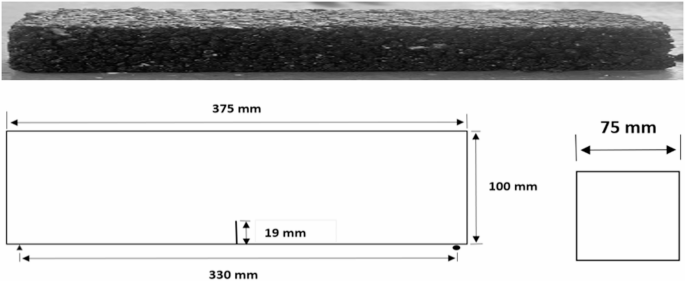
Single edge notch beam dimensions.

Single edge notch beam test.
FEM analysis
For the finite element method (FEM) component of the study, simulations were performed exclusively at 20 °C and correlated with experimental data at that temperature. The viscoelastic behavior of asphalt was modeled using Prony series coefficients. All inputs and details are shown in Table 1.
Beam shapes with single-edge notches were first created in Rhinoceros software and then imported into Abaqus/CAE. Material properties were assigned within Abaqus and boundary conditions were established to recreate the three-point loading test setup. Displacement control analysis was performed by applying a 5 mm displacement at the loading point. Prior to the final simulation, a comprehensive mesh sensitivity analysis was performed and five global seed sizes (15 mm, 9 mm, 8 mm, 6 mm, and 5 mm) were tested. Comparisons were made based on force-displacement curves obtained from SENB simulations. As shown in Figure 4, the curves corresponding to the 5 mm and 6 mm meshes were nearly identical in both peak load and overall curve shape, indicating mesh-independent behavior beyond this refinement level. As a result, a global mesh size of 5 mm was chosen for all subsequent analyses, as it provides sufficient accuracy at an optimal computational cost. For visualization purposes, the mesh model is shown in Figure 5.

Comparison of force and displacement curves at different mesh densities (mesh sensitivity study showing overlapping curves for 5 mm and 6 mm meshes, confirming mesh-independent behavior).

Following FEM simulations, the research focus shifted to fracture mechanics and machine learning (ML) phase. The force-displacement data and stress field evolution from the Abaqus model were extracted and the main fracture parameters, especially the fracture energy, were calculated. The fracture energy derived from this calculation was then utilized for two main purposes. One is for validation by comparison with experimentally obtained values, and the other is to serve as a target variable for developing a machine learning surrogate model of the dataset downloaded from the Mendeley website (https://data.mendeley.com/datasets/yb4brz3sdx/3).
Interpretation of correlation matrix (ITSM20 compliant)
Before starting the machine learning modeling, a correlation analysis was performed and showed that ITSM20 was strongly associated with stability, confirming the relationship between stiffness and load carrying capacity. The positive correlation between maximum specific gravity and viscosity suggests that dense aggregate packing and binder stiffness increase the stiffness of the mixture when resisting loads, which was also an important parameter in the experimental program. Stability to flow ratio also increases with stiffness. This shows that brittleness increases in stiffer mixtures, contrary to the experimental program. In contrast, as observed in the experimental program, asphalt content and effective asphalt content are negatively correlated with ITSM20 reflecting the trade-off between binder richness and stiffness, with richer the mixture being softer and more ductile. Flow also shows a weak negative relationship with stiffness, supporting the idea that more deformable mixtures absorb more energy but withstand less load. Overall, the results confirm that stiffness and stability dominate toughness, and binder content influences fracture energy and ductility. All correlation coefficients are shown in Figure 6. Table 2 shows the p-values of the Pearson correlation matrix showing the relationship between key asphalt mixture parameters and indirect tensile stiffness modulus at 20 °C (ITSM20).

machine learning framework
After performing the correlation analysis, three machine learning algorithms were implemented to predict fracture-related responses from the asphalt mixture dataset. The details are shown in Table 3. In a machine learning framework, a predictive model was trained using a comprehensive set of mixture design, physical, mechanical, and stepwise parameters as input features. Viscosity (Vis), Asphalt Content (AC), Maximum Theoretical Gravity (Gmm), Effective Asphalt Content (EffAC), and Air Bubbles. (Va), unit weight (UWt), stability (Stab), flow rate value (Flow), stability-to-flow ratio (SFR), percent passing through sieve #200 (P200), percent remaining on sieve #4 (P4), percent remaining on sieve #3/8 (P38), and coarse-to-fine ratio (CF). These inputs collectively capture the effects of binder rheology, mixture volumetrics, and aggregate structure on mechanical response. The target output for all machine learning models was the indirect tensile stiffness modulus at 20 °C (ITSM20). This was selected as the primary response variable due to its relevance in characterizing the stiffness of mixtures under service conditions. No models were trained using data at 30 °C. Three algorithms, including linear regression, gradient boosting, and AdaBoost, were evaluated using the same input-output structure across multiple cross-validation folds. To ensure reproducible performance, gradient boosting was applied using scikit learning with 100 trees, a learning rate of 0.1, a maximum depth of 3 for individual trees, a minimum split size of 2, and a complete training part. AdaBoost used a decision tree estimator as the base learner, with a total of 50 estimators, a learning rate of 1.0, and a linear regression loss for continuous target prediction. A standard linear regression model without regularization was also used as a baseline due to its interpretability and direct mapping of input parameters to output responses. These models were trained under identical conditions and later validated using k-fold cross-validation to assess their robustness and generalization ability.
Cross-validation procedures and error analysis
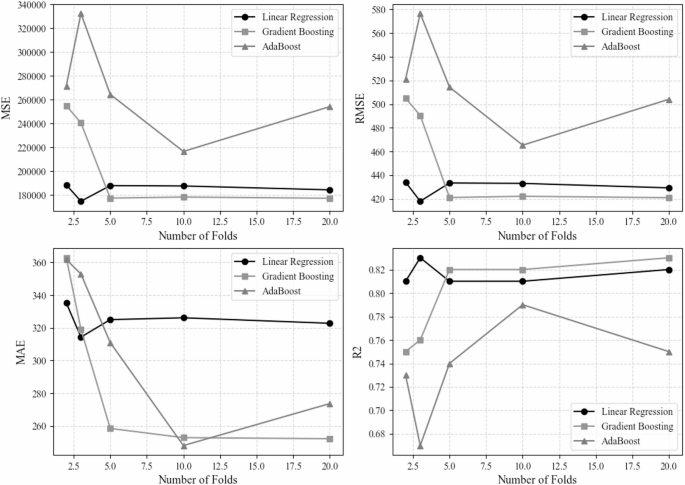
Following the correlation analysis, an A k-fold cross-validation procedure was applied to check the validity of the machine learning model. As shown in Table 4, we tested different scaling factors such as 2, 3, 5, 10, and 20 for all selected ML algorithms to examine the impact of scaling factor selection on the stability of performance metrics. This approach ensured that the model was evaluated based on different validation schemes and reduced the risk of overfitting to a particular data partition. Figure 7 shows the cross-validation-based error analysis of three machine learning models across four key metrics (MSE, RMSE, MAE, R).2) The number of folds varies from 2.5 to 20. Although linear regression and gradient boosting are both good models, with gradient boosting having a slight advantage in minimizing absolute error as the number of folds increases, AdaBoost was the least appropriate choice. A 10-fold cross-validation was ultimately adopted. This is to provide the most consistent R² and error metrics across models, ensuring a balanced and reliable evaluation framework.
Surrogate fracture parameters
After selecting the machine learning algorithm, surrogate failure parameters were defined based on the main mixture characteristics from the dataset. These parameters integrate stability, flow, and stiffness coefficients to represent fracture energy in a physically meaningful and dimensionally consistent manner. The characteristic beam dimension (k) is incorporated as a scaling factor to relate the surrogate parameters to the single-edge notch beam mechanism based on pure novelty. This formulation allows us to estimate the fracture energy for each dataset sample without performing full experimental tests, thus bridging the gap between observed material behavior and predictive modeling with machine learning modeling. The surrogate parameters in this study serve as target responses for the machine learning model, allowing for rapid and reliable assessment of fracture performance across a variety of asphalt mixtures while ensuring that predictions are based on interpretable material behavior observed in experimental programs. The approach adopted in this study provides a new hybrid framework that combines experimental work performed, numerical simulations performed, and data-driven insights for practical pavement design and mixture optimization.


