
This summer, Amazon’s cloud business struggled to keep up with surging demand for AI, missing out on real revenue from its flagship AI products.
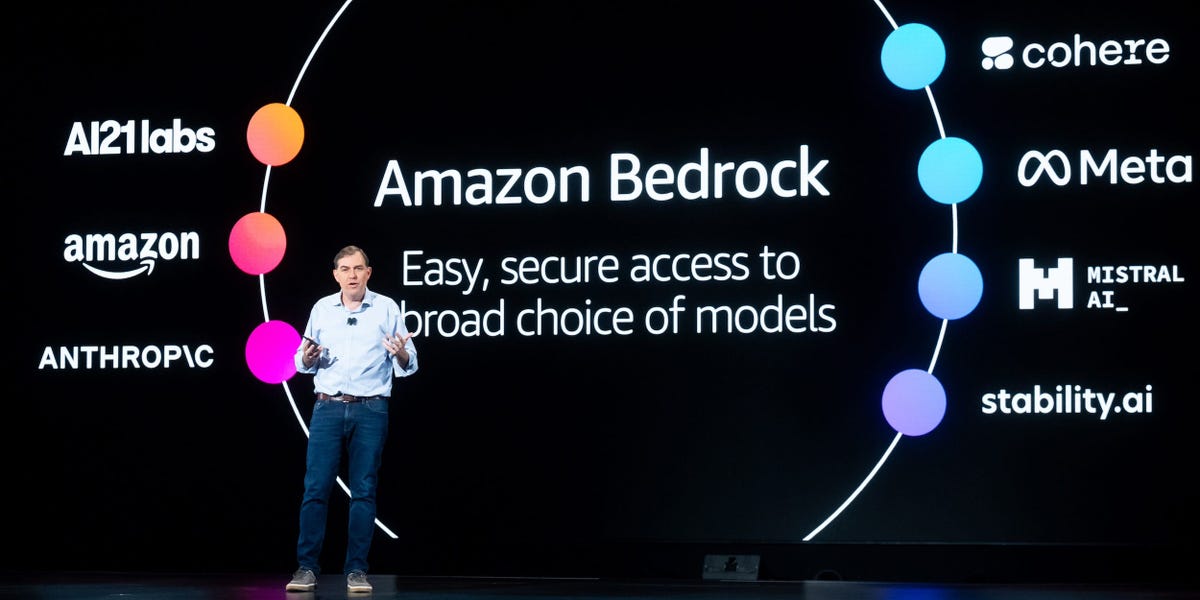
Amazon Web Services’ Bedrock service is at the heart of the company’s AI push. This gives developers access to powerful models such as Anthropic’s Claude and Meta’s Llama.
But over the summer, Bedrock faced “significant capacity constraints” and steered some customers to competing services, such as Google’s cloud services, according to a July internal document obtained by Business Insider.
This shortfall resulted in tens of millions of dollars in lost or delayed revenue. Epic Games moved its $10 million Fortnite project to Google Cloud after AWS failed to provide enough allocation to Bedrock, according to the document. (Quota limits control the amount of intelligence customers can access via the AI cloud service).
Oil trader Vittle is considering moving some projects off AWS, warning in a document that the decision risks hitting $3.5 million in revenue amid “protracted allocation approvals.” Other customers, including Atlassian and Govtech Singapore, are waiting for quota increases this summer and are at least $52.6 million behind on expected sales, the documents also revealed.
Bedrock “faces significant capacity constraints that threaten customer adoption and could cause significant revenue losses across multiple industries,” the July filing said.
The impact highlights the economic impact of AWS’s lack of capacity and explains why the cloud giants are now rushing to build out as many AI data centers as possible. It’s good to have high demand, but it’s a frustrating problem if you can’t meet it and lose customers to your competitors.
Indeed, Amazon CEO Andy Jassy has repeatedly emphasized the need to increase the capabilities of cloud infrastructure, particularly AI chips and data centers. It’s unclear whether the company has fully resolved these issues. Three current and former employees said the lack of capacity remained one of AWS’ biggest concerns through September.
An Amazon spokesperson said Bedrock is “growing rapidly” and that AWS is adding capacity to meet that demand. Considering customer feedback is core to Amazon’s culture, and it helps the company improve its products and services, the spokesperson added.
“At Amazon, we are vocal about being self-critical because that’s how we drive continuous improvement and deliver better outcomes for our customers,” a spokesperson said in a statement. “This internal candor is a hallmark of our culture, not a weakness. We appreciate all customer feedback, including the challenges our customers face, because it helps us make Bedrock even better. That’s exactly how we build a scalable, sustainable business that serves our customers well over the long term.”
A Google spokesperson declined to comment. Representatives for Anthropic Games and Epic Games did not respond to requests for comment.
“Acceleration of ability”
Like other cloud providers, expanding data center capacity is one of AWS’ top priorities.
During an October earnings call, Jassy said AWS has been “focused on accelerating capacity in recent months,” adding more than 3.8 gigawatts of power over the past year, more than any other cloud provider. AWS has doubled its power capacity since 2022 and plans to double it again by 2027, he said.
Jassy added that Amazon remains “very aggressive” in expanding capacity to meet strong demand, noting that AWS can quickly monetize new infrastructure. He said Bedrock is one of AWS’ most successful cloud products and is already showing potential to grow as big as EC2, which is a key revenue engine.
Part of Bedrock’s shortfall can be attributed to its prioritization of large customers. Jassy said in October that most of Bedrock’s workloads run on AWS’s in-house AI chip, Trainium, but usage to date has primarily been from “a small number of very large customers.” He added that more midsize companies are expected to adopt next-generation Trainium in the coming months.
Amazon is expected to reveal more details about Bedrock and its broader cloud strategy at its annual conference re:Invent in early December.
Amazon CEO Andy Jassy Noah Berger/Noah Berger
“Urgent need”
AWS’ July document said the capacity shortage is impacting customers across industries including finance, gaming, and technology. Companies like HelloFresh, Zalando and Ryanair were affected.
At the same time, companies like Stripe, Robinhood, and Vanguard were unable to migrate their AI workloads from Anthropic to Bedrock due to “slow capacity approvals and sudden rejections of workload requests,” the document said.
“These constraints are forcing customers to consider alternative providers such as GCP, OpenAI, and Anthropic, and demonstrate the urgent need for AWS to address Bedrock service allocation and performance challenges to remain competitive in the rapidly evolving GenAI market,” the document states.
Bedrock’s quota limits are based on the number of AI tokens that can be processed per minute, or the number of API calls that can be made in a given period of time. (token It’s how an AI model breaks down a query into digestible chunks of data. Industry pricing is based on the number of tokens processed. APIs are application programming interfaces and are a common way for applications to share data.
In recent weeks, investors have grown nervous about the tech industry’s big AI investments, with fears of a potential bubble weighing on the market.
The issue of Amazon’s AI capabilities is a double-edged sword here. On the other hand, these challenges suggest that customer demand remains very strong. On the other hand, this is another reason why big tech companies continue to spend so much money, which could further fuel the AI bubble.
Amazon said it will spend $125 billion in capital spending this year and plans to invest even more in 2026. AWS revenue reached $33 billion last quarter, up 20% year over year, marking the fastest growth since 2022.
performance issues
Capacity isn’t the only issue keeping customers’ workloads away from Bedrock. Latency and missing features also played a big role.
According to AWS documentation from July, customers using Anthropic’s Claude model via Bedrock chose to switch to Anthropic’s own platform or Google Cloud due to “ongoing capacity, latency, and feature parity issues.” Companies like Figma, Intercom, and Wealthsimple are among those migrating workloads “because of one or more of these challenges.”
The UK Government Digital Service considered moving Anthropic’s Claude 3.7 Sonnet model to Microsoft’s cloud because it was running slowly on Bedrock, the document added.
Thomson Reuters also chose Google Cloud over Bedrock for its CoCounsel AI product after finding AWS services to be 15% to 30% slower and lacking key government compliance certifications, the documents show. In May, executives raised these concerns with AWS executives, including CEO Matt Garman and vice president of computing Dave Brown, and the companies agreed to hold monthly review meetings.
Thomson Reuters CTO Joel Fron told Business Insider that the company recently “moved one component of its AI workload to Google Cloud to prioritize latency.” He added that Thomson Reuters still runs significant workloads on AWS and Anthropic as part of its multi-model, multi-cloud strategy.
Google’s “intensifying competition”
The July AWS document also notes that Bedrock is being pushed out by Google’s Gemini model, which boasts 5-6x higher quota limits and often better performance.
When comparing Access to Claude via Bedrock with Gemini Pro, an internal report states that the Google model performs better “across multiple benchmarks.” The document also says that Google’s smaller, cheaper model, Gemini Flash, “offers comparable quality at a fraction of the cost.” (And this was before the launch of Google’s Gemini 3, which made the internet giant’s AI performance even better).
Some startups have changed their plans because of this. Financial startup TainAI migrated 40% of its Claude workloads from Bedrock to Gemini Flash, saving $85,000 per day. Meanwhile, Hotel Planner was planning to migrate to Google Cloud or OpenAI, the document said.
A broader concern is that AWS lacks a coherent product vision for AI inference, the main area in which Bedrock competes, according to the document. The magazine noted that rivals such as Databricks, FireworksAI and Nvidia’s Dynamo are rapidly falling behind.
Without a clear strategy and a compelling long-term vision, AWS risks missing out on one of the most lucrative opportunities in the AI market, he warned.
“We still lack an inspiring long-term vision and comprehensive strategy,” the document said.
Any tips? To contact this reporter via email, please specify the following address: ekim@businessinsider.com or Signal, Telegram, or WhatsApp (650-942-3061). Use a personal email address, non-work WiFi network, and non-work device. Here’s a guide to sharing your information securely.

