
Appian has been saying for some time that AI only truly works when it is embedded in processes. At AppianWorld 2026 in Orlando, the company presented concrete examples of that claim. Agents that learn, systems that work together seamlessly, and outdated software that can finally be replaced: Appian wants to prove that “Serious AI” is more than just a slogan. The question is whether that picture holds up when you look beyond the keynote.
Only 16 percent of organizations derive high measurable value from their AI investments. This is according to research commissioned by Appian and conducted by Harvard Business Review Analytic Services. CEO Matt Calkins cited the report during his opening keynote in relation to his conviction: AI only becomes useful when it is structured. “The next phase of AI maturity depends on embedding AI at the core of how work is done,” he quotes the HBR report. He then adds dryly: “We’ve been doing that for years.” AppianWorld was therefore the stage to back up that claim, with concrete announcements designed to give it substance.
AI as a new process layer
To understand what Appian is trying to do, it helps to take a moment to consider where the cwompany comes from. Appian is not, by nature, an AI company. It is a process automation platform that has specialized for 25 years in digitizing and automating complex business processes at large, regulated organizations. Think of banks processing loan applications, pharmaceutical companies managing clinical trials, or governments issuing permits. Processes where an error is not only costly but sometimes downright dangerous. That is the market where Appian has been operating for decades, and where it is now adding AI as a new layer.
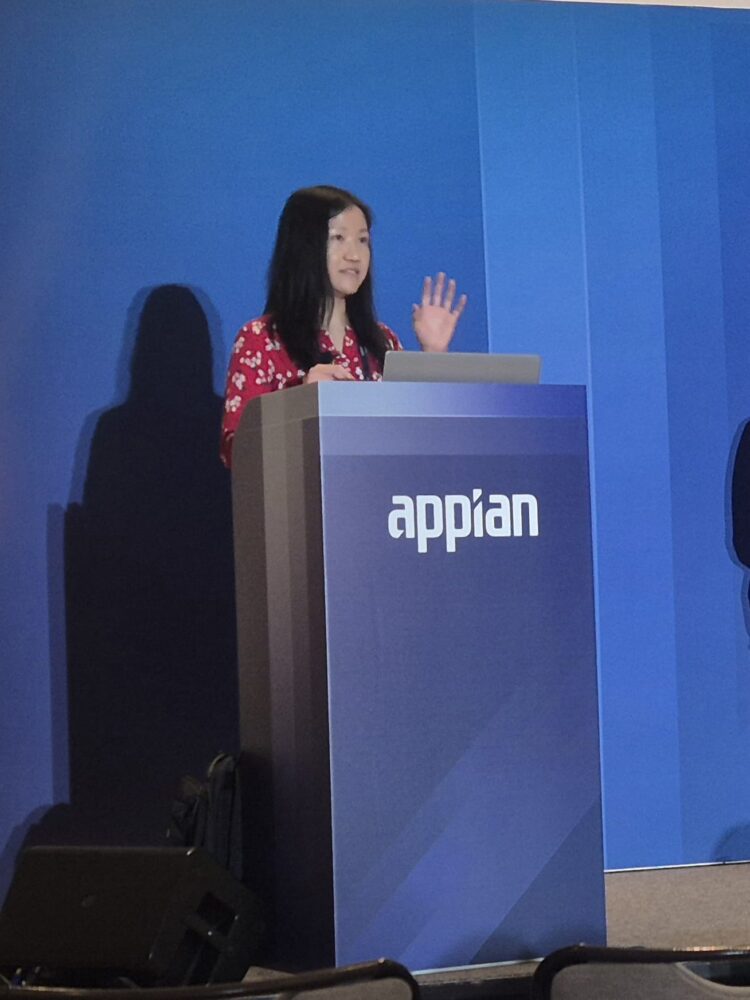
Why is that combination so important? The answer lies in a fundamental characteristic of AI that is often underestimated. An AI agent that doesn’t know your processes is fast and confident, but is often simply wrong, stated Wei Smith, Product Manager for AI Agents at Appian, bluntly during a session. “Speed and scale don’t help if the output is incorrect. They only exacerbate the problem.”
Jake Rank, Senior Director of Product Management for AI at Appian, saw this in practice after the general availability (GA) of Agent Studio. “Customers wanted to deploy agents for just about everything. Understandable, because the market is clamoring for agents. But experience showed that a standard business rule or a simple integration simply works better in many situations.” Appian has incorporated that lesson into Composer, which uses entered requirements to advise when you need an agent and when you don’t. “The organizations that get the most value out of AI aren’t the ones that deploy agents everywhere,” says Rank. “They’re the ones that know when not to.”
Participant in the process
Choosing an agent is one thing, but the challenge lies in ensuring that agent works reliably. During the keynote, Calkins explained how this works: an AI agent is given a single, well-defined task, is only allowed to do what the process permits, and is always under human supervision. Appian sometimes even verifies the outcome by having two AI models perform the same task and comparing the results. “A process is a reliability machine,” said Calkins. “It catches errors before they cause damage. That was already true for humans, and it’s now true for AI.” In that reasoning, AI is not a replacement for the process, but a new participant that relies on the process to function.

Siddharth Goyal, VP of Intelligent Automation at implementation partner Xebia, sees this confirmed in practice. Two years ago, his clients were still lining up to get their data in order, assuming that better data was the key to better AI. That discussion has shifted, he says. “Most value is created when organizations focus on the process, not the data. Think about the process within which you want AI to operate, and the rest will follow naturally.”
Don’t start with technology
Pfizer demonstrates what that means in practice. The pharmaceutical company has been working with Appian for years to manage contracts with healthcare professionals in 143 countries. Every day, 75,000 employees work with the system, in an industry where making mistakes is not an option. “In our industry, compliance is not a choice,” said Anne Furey, VP of Meetings, External Engagements & Travel at Pfizer, during the keynote. “It’s our license to operate.” Before implementation, closing a contract took six to eight weeks, sometimes longer. Now that time has been reduced to less than 24 hours. But that gain didn’t come from deploying AI first. “You can’t automate complexity. You have to eliminate it first,” said her colleague Kathy Maltz, Senior Director of Digital & Technology. “So we didn’t start with technology. We started by listening.” Only after Pfizer had simplified the process, standardized it, and eliminated unnecessary steps was AI added as an extra layer. The result is a system where AI processes documents, verifies data, and flags discrepancies, but an employee always makes the final decision.”
A similar pattern is emerging at investment firm Carlyle. The company manages more than $470 billion in assets, spread across thousands of legal entities and bank accounts in 27 countries. There, payment processes are not a back-office function, but the core of how deals are closed. Working with Appian, Carlyle built a global payment system where AI automatically processes invoices and extracts data, but humans provide approval. The result: a 40 percent reduction in the time between invoice date and payment, measured across more than 14,000 payment requests and over $4.5 billion in transactions in the first three months. Shakira Fraser, Head of Finance Operations at Carlyle, was clear about this when she took the stage: “This is not a roadmap, not a pilot, not a proof of concept. This is a production platform that is already delivering real results.”
Essential for a NASA mission
But perhaps the most compelling example comes from NASA. The U.S. space agency built a completely new contract management system, the NASA Contract Management System (NCMS), with Appian in nine months. For an organization with eleven complex system integrations, active across all NASA centers, and responsible for approximately 85 percent of the NASA budget, that is exceptionally fast. The impetus, incidentally, was not enthusiasm but necessity: NASA lost 135 people through a voluntary departure program and did not replace them, while the Artemis mission was accelerating. As the workload increased, staffing levels decreased. Before the implementation, contract specialists worked with a patchwork of outdated, standalone systems. They were so frustrated that many preferred to draft their contracts in Word rather than in the official system. For the organization, this meant no centralized data, no overview, and no control over its own procurement process.

), NASA
That changed with Appian, says Melanie Landers, who led the technical implementation as Enterprise Applications Program Lead. The system played a direct role in the Artemis II mission, with which NASA sent humans back to the moon for the first time since the Apollo missions. For that mission, 2,700 suppliers from 47 U.S. states collaborated: companies that supplied parts, materials, and specialized services for the construction of the Orion capsule and the launch vehicle. Every contract required for this went through NCMS. “Without well-functioning procurement processes, no rocket gets off the ground,” says Allison Sand, Acting Director of the E-Business Systems Office, who led the functional side of the project. “85 percent of NASA’s budget goes through procurement. We are an essential part of every successful mission.”
But not every successful implementation is on the scale of Pfizer or NASA. Mark Talbot, Director of Architecture and AI at Appian, described in a conversation with Techzine a telecom provider where his team built an agent that checks incoming architectural drawings: do the document types match this type of project? “Sounds simple, but it saves three days of waiting time per request,” he said. “The agent has access to the knowledge base, goes through the steps independently, and records its reasoning. An employee can see exactly how the decision was reached afterward.” This was followed by a second use case: identifying duplicate project submissions. Two small steps, both with demonstrable time savings. “This is exactly what we mean by Serious AI,” says Talbot. “Not spectacular, but reliable and measurable.”
Wrapper around existing functionality
The customer cases are impressive, but they don’t tell the whole story. Because behind the successes lies a reality that Appian itself doesn’t shy away from: the technology is promising, but not yet complete. Agents don’t yet improve themselves automatically, governance among business users is an open question, and the path from pilot to production is longer than many organizations expect.

Mark Talbot knows how things work in practice. As Director of Architecture and AI at Appian, he guides customers daily in developing and deploying agents. He is candid about what Appian agents are at their core: wrappers around an LLM, just like comparable tools such as LangChain or LangGraph. What sets Appian apart isn’t the agent itself, but the process layer surrounding it. Refining agents is still largely manual work today, he explains. His team manually feeds feedback data into an external model and then adjusts the agent’s prompts by hand. “The next step is for the platform to do that itself,” says Talbot. “All of an agent’s input, output, and reasoning is already logged in Appian. That data is there. Now the system needs to learn from it on its own, without anyone having to intervene.” Agent learning is the first step on that path, but it isn’t fully automated yet.
Rank explains why that step is so important. Without a learning loop , an agent’s accuracy drops as soon as business conditions change, new situations arise, or policies shift. You’d be constantly having to fix things. “With a learning loop, that same change actually becomes input,” he says. “The agent recognizes the pattern and performs better next time.” There is, however, a clear limit: the definition of an agent does not automatically change based on user feedback. “Fundamental adjustments always go back to the development environment, with all the associated checks. The developer decides.”
Business is responsible
Governance in low-code development by business users is another issue Talbot is candid about. Appian positions its platform in part as an environment where even non-technical employees can build agents. But what does that mean for control and compliance? “That’s a challenge,” says Talbot. “I strongly believe in involving the business, because they understand the work we’re trying to automate. But to be honest, I don’t know if our current approach is scalable.” His colleague Rank sees it differently. In his view, the responsibility for compliance lies with the business anyway, not with IT. “The closer we bring the tooling to the business, the better they can actually shoulder that responsibility,” he says. “Ultimately, they are the ones who say: this system is ready, this delivers value.” The two perspectives aren’t mutually exclusive, but they do show that Appian is still searching internally for the right answer to a question that’s at least as urgent outside the company.
There is also a more subtle risk that Talbot highlights and that few platforms openly address. Appian emphasizes the importance of a human in the loop, but what if that person stops actually looking? “If someone always accepts the AI suggestion without thinking, human oversight becomes a façade,” he says. “Real oversight requires process knowledge. You have to maintain that.” It’s a risk that Appian takes seriously. In Doc Center, the module that enables organizations to automatically process and review documents, Appian tracks who consistently accepts all AI outputs and who actually makes corrections. Not as a punishment, but as a signal: if no one is correcting anything anymore, the question isn’t whether the AI is good enough, but whether the human in the loop is still actually providing oversight.
Success can increase complexity
In addition to the technical and governance challenges, there is another risk that Goyal identifies from implementation experience: organizations systematically underestimate how long it takes for the capabilities to actually deliver value. “This isn’t a switch you flip. It’s a journey spanning several years,” he says. Eli Zogby, VP of Process and Platform Excellence at Canada Life, a Canadian insurer serving millions of customers, was strikingly candid on stage about how challenging that journey is in practice. “If I’ve explained it well here on stage today, it might sound like we have everything under control,” he said. “But that’s not the case.” Canada Life has built successful use cases, shortened cycles, and standardized processes. But every time a project succeeds, a new danger looms. “Ironically, project success can actually increase an organization’s complexity,” said Zogby. “You solve a local problem, you celebrate it, and you start over. But without shared patterns, you’re constantly reinventing the wheel.” The hardest step, therefore, isn’t the first use case. “The hardest part is what comes next: scaling, standardizing, and true adoption.”
Essential addition

The question that remains after all the honest observations is how Appian actually stands in a market with vendors who see the same opportunities and are all fully committed to them. CEO Calkins has a clear answer to that. He positions Appian not as a competitor to the major platform players like Microsoft, Salesforce, and ServiceNow, but as an indispensable complement. Not the one supplying the power, but the wiring that ensures the light actually turns on. “AI will indeed change everything,” he said in an interview with Techzine. “But it can’t do it alone. It needs a layer that makes it reliable in critical processes. We are that layer.”
Whether that positioning holds up is for the market to judge. In October 2025, Gartner placed Appian as a Leader in the newly defined BOAT segment—Business Orchestration and Automation Technologies—alongside Pegasystems and ServiceNow. But Gartner also noted that, as of that publication, Appian had been slower than some competitors in adopting AI agents. Agent Studio was still in beta at that time. Jonty Padia, Practice Director at analyst firm Everest Group, sees Appian as a company with a strong technological position but a cautious communication style. “Appian prefers to show what’s already working rather than what’s coming,” said Padia. “That builds trust, but in a market where competitors are rolling out ambitious roadmaps, it can mean your story doesn’t resonate as loudly as it could.” Appian Director Rank acknowledges the competitive pressure. “In recent weeks, there have been many press releases from competitors. We all see the same opportunities. It’s now a matter of who executes better and who wins the trust.”
Calkins’ answer to the question of whether AI makes Appian obsolete is unequivocal. AI is inherently probabilistic, he says. Everything it says is a guess, even if you ask it the same question twice. “That’s not a condemnation of the technology,” Calkins said. “But it means that AI always needs structure to work reliably. And that’s where we come in.” The reasoning is clear: as long as AI remains inherently uncertain, a platform that makes that uncertainty manageable remains indispensable.
The layer around AI will make the difference
CTO and founder Mike Beckley outlined how that uncertainty will evolve in the coming years—and what that means for the market—in the closing keynote. His message was strategically relevant, not just for Appian but for anyone thinking about where the real value of AI lies. He presented an overview of ten AI benchmarks from recent years and pointed out a pattern that is often overlooked in the discussion about the best model: the models are converging. That has an important implication for the market. “The distinction no longer lies in the model you choose,” said Beckley. “Whether it’s the latest commercial model or an open alternative, that matters less and less. What counts is what you build around it: the processes, the governance, the structure that allows the model to do its job.”
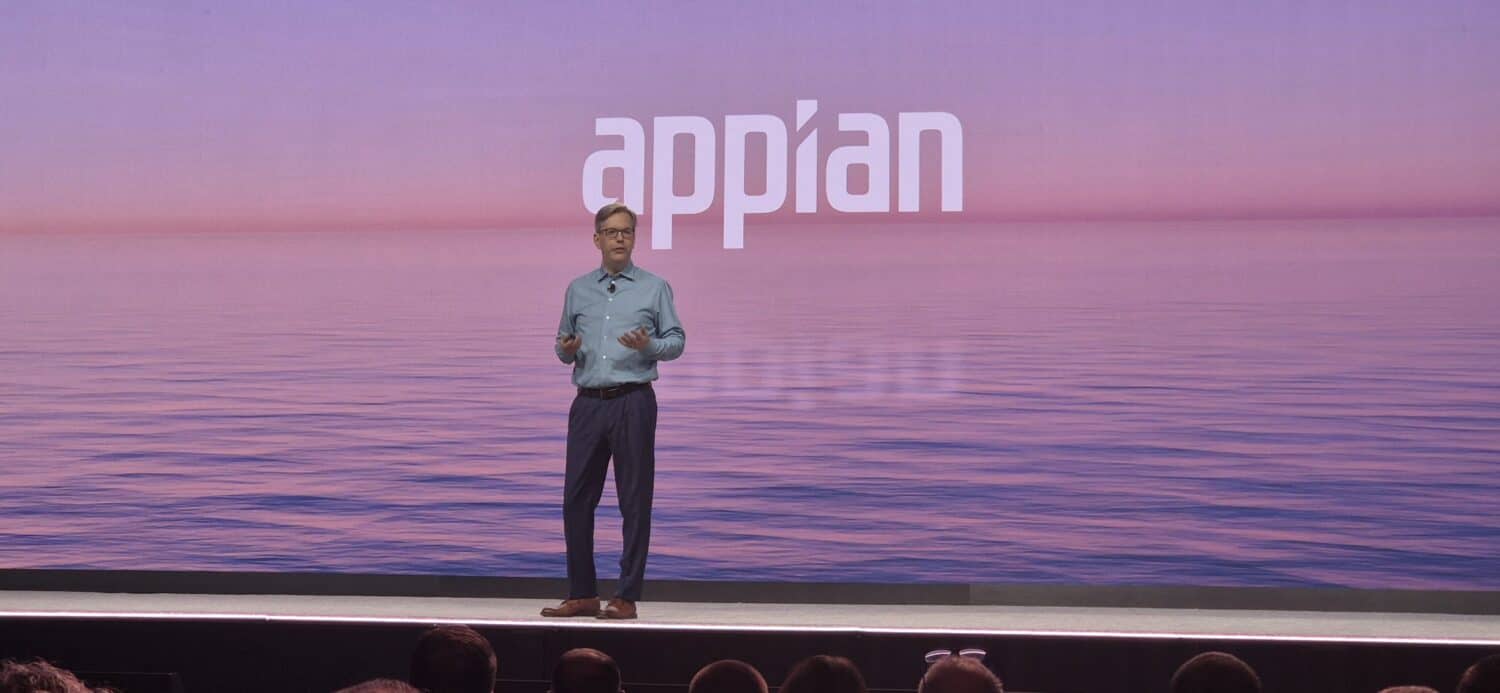
The Appian CTO also described specific changes in how enterprises will deploy AI in the coming years. The data fabric—the architectural layer that makes data from different systems available in real time without physically moving that data—is getting smarter. Today, the platform already knows where data is located and how systems are connected. What’s coming is a deeper understanding of the nature of those connections, so that an agent not only finds the right data but also understands what that data means in the context of a specific decision. “AI models are trained on everything on the internet, but they know nothing about your specific situation,” said Beckley. “The context layer gives them that knowledge at the right moment.”
Integrated platforms
Beckley also noted that the company is further opening up its platform to developers. Through MCP and new command-line interfaces, they will soon be able to build and customize Appian applications directly using their own AI development environments, such as Claude Code. During a live demo on stage, a team of Appian developers showed how a complete application was generated based on a business requirements document, including a data model, security roles, and process flows. That may sound like a technical detail, but it’s strategically relevant: it means developers no longer have to choose between the freedom of their own tooling and the governance of the Appian platform. They get both. The speed of AI-assisted development, with the security layer of an enterprise platform underneath. “This is the difference between vibe coding and building a real application,” said one of the product managers during the demo. “It doesn’t just generate objects; it understands the structure that makes an application secure, manageable, and production-ready.”
Finally, Beckley announced smart user experiences. Interfaces that adapt to who logs in, what role someone has, and the context in which a decision is made, rather than a single fixed screen layout for everyone. That’s a step toward a workplace where the software adapts to the user, rather than the other way around. “We want to open Appian up to the tools developers are already using,” said Beckley. “But open doesn’t mean insecure. The solution lies in a layer that sanitizes the input and output, so you can innovate at AI speed without compromising the security of your critical processes.”
Gartner’s figures make clear what all of this means for the market. Today, only 5 percent of enterprises use a consolidated automation platform that brings together processes, agents, bots, and people. Gartner expects that figure to reach 70 percent by 2030. The race to claim that position has begun. Appian doesn’t aim to be the most prominent player in this race, but rather the most indispensable one.