From art galleries to technology workshops, this conference explores how artificial intelligence is augmenting the work of artists, researchers, and engineers.
LOS ANGELES , July 17, 2026 /PRNewswire/ — Artificial intelligence is not limited to a single track. Seagraph 2026. Almost every program at the conference will feature everything from interactive installations and peer-reviewed research to hands-on workshops, community discussions, and industry-led training. The world’s leading conference on computer graphics and interactive technology, taking place July 19-23 at the Los Angeles Convention Center, will show how AI is being used to augment human creativity, rather than replace it.
Paige Bailey Veo 3.1 Lite Team NanoBanana 2 Team Genie 3 Team
SIGGRAPH 2026 conference chair Chris Redman said, “AI is showing up in a variety of ways, from the research field to the artistic side of conferences. AI is being used not as a replacement, but as a way to augment the work being done by the talented artists and engineers who participate.” “The lines between computer graphics, physics, and AI are blurring, opening new horizons and avenues for computer graphics research and new modes of interactivity, making the physical and digital worlds more complementary.”
Featured experiences at SIGGRAPH 2026 Among this year’s standout AI sessions, the art gallery’s installation ‘The Long Fall: A Descent Into the Ocean’s Living Memory’ traces the microscopic workings of plankton that silently build Earth’s climate as visitors descend from the white cliffs of Dover to the drifting marine snow. The work is built on Gravity Machine data collected during 18 expeditions by Stanford University’s Prakash Institute and features a “plankton instrument” and narration in the voice of Rachel Carson, brought back to life by AI. Artists include Jiabao Li from Northeastern University and the University of Tokyo, Manu Prakash from Stanford University, Will Talent from the University of Texas at Austin, and Michael Bruner from Texas A&M University.
Also in the art gallery, ‘Diffusion TV’ by Sihwa Park in collaboration with York University demystifies the AI diffusion model through nostalgic CRT televisions. By turning knobs and antennas on the set, viewers move through three channels of extinct animals of the past, endangered species of the present, and speculative creatures of the future generated by AI, and watch chaotic data resolve into a recognizable form.
The art paper “Light Architecture: Translation the AI Black Box Into Immersive Experience” by Yiyun Kang Studio and the Korea Institute of Science and Technology physically transforms invisible algorithmic structures into dynamic light and spatial audio, providing a sensory alternative to traditional explainable AI.
The spatial storytelling program Dog Walk: Telling the story of human-AI cooperation through companion robots documents how two artist-researchers co-parent a pair of robot dogs, merging human and machine perspectives to explore authenticity, embodiment, and holistic companionship. Contributors include Robert Twomey of the University of California, San Diego, and Jesse Fleming of The Awareness Lab. Both are involved with the Arthur C. Clarke Center for the Human Imagination.
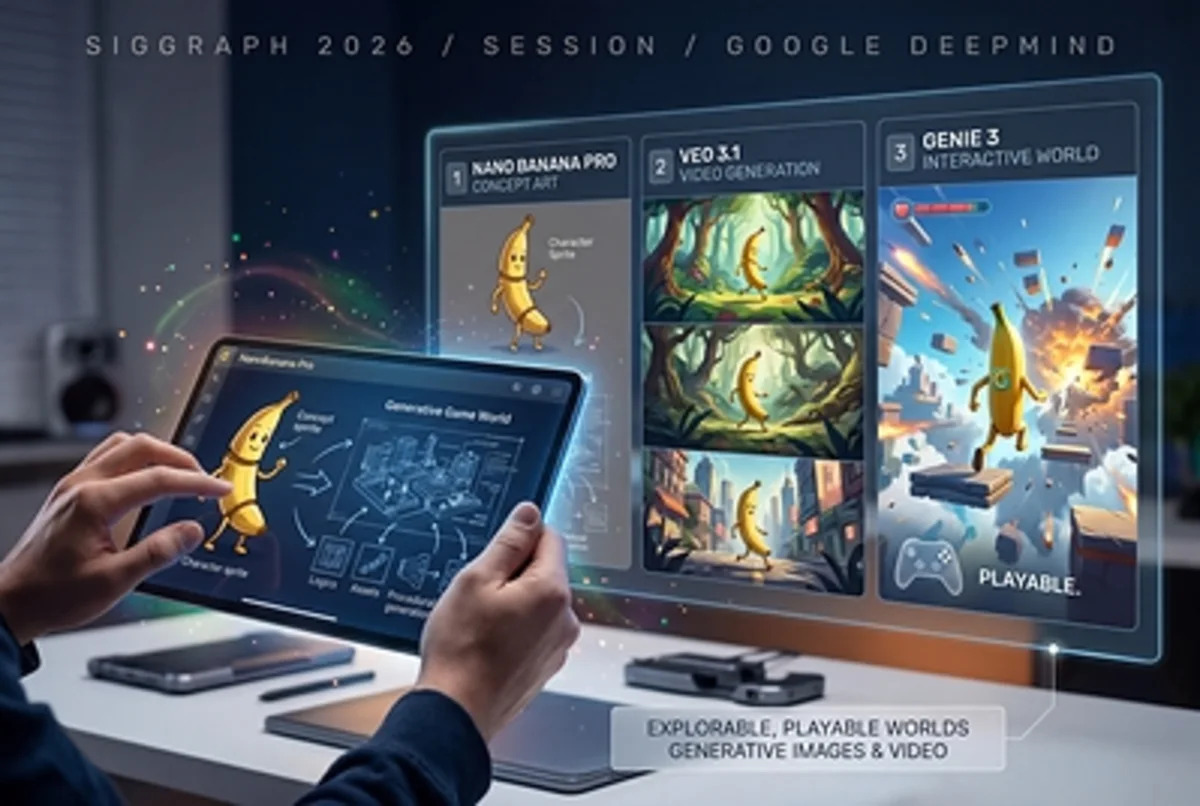
Hands-on courses allow participants to work directly with new tools. In “Dreaming in the Fourth Dimension: Media Generation with Gemini, Genie, and Veo,” Google DeepMind engineers, led by DeepMind and Google’s Paige Bailey, move participants beyond static pixels into explorable, playable worlds, using NanoBanana Pro for streamlined concept art, Veo 3.1 for video generation, and Genie 3 to turn images and text into interactive worlds. In “Practical Programming and Performing Quantum Teleportation,” Andrew Glasner will teach participants how to write and run quantum computing code and program quantum teleportation algorithms in high-quality simulators to transfer the state of a qubit to a partner, who can then decode it and reveal a secret message.
Technical workshop co-created by humans and AI Technical workshops will underpin much of the conference’s AI programming. Human-AI Co-Creation in Generative Art: Graphics Methods, Systems, and Applications features speakers from NVIDIA, Brown University, the University of Washington, Massachusetts Institute of Technology (MIT), Hong Kong University of Science and Technology (Guangzhou), University of California, Santa Barbara, and Stanford University, who examine AI not as an automation tool but as a creative partner that supports exploration, iteration, and artistic expression. In Lines and Minds: Visual Abstraction in Art, Psychology, and Computer Graphics, cartoonist and theorist Scott MacLeod joins researchers from Stanford University, MIT CSAIL, and Adobe Research to ask what role abstraction plays in how humans and AI co-create.
The 10th installment of “AI for Creative Visual Content Generation, Editing, and Understanding” brings together academic researchers and the technical architects behind current video production models to bridge the gap between raw visual tokens and cinematic language. Graphics4Science 2026: Graphics for Cross-Scale Reliable Scientific Instruments focuses on AI-powered scientific discovery, from computer imaging to generative modeling of molecular structures, while Differentiable Physics for Graphics and AI explores how differentiable simulation is transforming graphics, robotics, 3D vision, design, and manufacturing.
“AI is exciting and not something to be feared or overhyped. It is a truly amazing technology that allows us to do things that have never been done before, and SIGGRAPH is well-positioned to explore it without the mainstream hype and fear-mongering,” said Adam Bargteil, SIGGRAPH 2026 Technical Workshop Chair.
From community conversations to classrooms and industry floors Community members come together to lead dynamic Birds of a Feather sessions, sparking conversations about emerging themes and cross-disciplinary innovations shaping the future of computer graphics, interactive technology, and more. This year’s lineup includes AI. The Last 20%: Getting GenAI to a Deliverable Frame brings together artists, pipeline engineers, and tool builders from Foundry, RSP, and NVIDIA to explore pipelines that combine the speed of AI with the control of traditional workflows while keeping artists in command. Meanwhile, “Controlling the Frame: The Future of AI VFX, Generative Video, and Compositing” asks how much control artists actually maintain as relighting, background transformations, and look development increase post-capture. “Machine Choreographies: AI, Dance, and the Future of Embodied Performance” invites artists, technologists, and researchers to investigate how AI is reshaping movement, authorship, and bodies in motion. And the live demo-driven AI3D Frontiers: AI for 3D BOF #4 continues to be a hub for hackers, artists, researchers, and independent creators to build weird, early hybrids that define what AI for 3D will look like.
In the classroom, AI will take center stage on Educator Day on Monday, July 20, with half of the day’s six sessions focused on how technology is reshaping education. The panel, “AI’s Inflection Point: What It Really Means for the Next Generation of 3D Artists,” moderated by Adobe’s Alwyn Hunt, brings together university professors, self-taught independent creators, CG production veterans, and Adobe industry strategists to ask what educators should focus on as AI handles much of the technical execution that students once spent years learning. In NVIDIA: How AI is Transforming Education, NVIDIA’s Jacob Liberman will lead a discussion on how generative AI and large-scale language models are personalizing learning, accelerating skill development, and democratizing access to education, leveraging NVIDIA’s Deep Learning Institute and Studyfetch, an AI-powered learning platform. And in “Shaping the Storytellers of the Future: Integrating Advanced 3D, AI, and VP Workflows,” Foundry’s Juan Salazar makes a case for teaching the core concepts behind the craft, not just the technical steps, and training artists who know how to evaluate and direct their tools.
On the industry side, NVIDIA will host NVIDIA Physical AI Day on Tuesday, July 21st, with a full day dedicated to the convergence of graphics and AI. NVIDIA’s Ming-Yu Liu begins with “World Model: Graphics Unlocks the Frontier of Physical AI,” introducing the open frontier world model NVIDIA Cosmos 3 and exploring why 3D graphics are central to AI’s ability to see, understand, generate, and simulate the world.
Today’s sessions tell the story of how the physical AI world is built. NVIDIA’s Aaron Luk starts with data, showing how OpenUSD provides instructions, inspection, and trusted 3D scenes for AI agents and developers. Lightwheel’s Jonathan Stephens and Palatial’s Steven Ren transform these scenes into simulation-ready worlds that come to life. A real-time digital twin that helps Rivian accelerate its car designs, a physically aware simulation app that NVIDIA’s Damien Fagnou assembles in parallel with AI agent co-host Lexi, and a self-driving car simulation that renders a drivable, photorealistic world in real time on a single GPU. NVIDIA’s Miles Macklin introduces Newton, the open source physics engine underlying it all. Additionally, the Career Growth Panel, which includes voices from NVIDIA, Keywords Studios, and Miris, will track and tell the story of how 3D graphics skills impact careers in robotics, AI, simulation, and digital twins.
The conversation continues beyond the convention center. ACM SIGGRAPH blog posts track how the community is thinking about the role of AI in creative work, including “AI is not just about machines — it’s about people” and “Tracking life from above.” To see the full AI lineup, visit the conference schedule and register for SIGGRAPH 2026 today.
About ACM, ACM SIGGRAPH, and SIGGRAPH 2026 ACM (Association for Computing Machinery) is the world’s largest educational and scientific computing association, uniting educators, researchers, and professionals to foster dialogue, share resources, and address the challenges of the field. ACM SIGGRAPH is a special interest group within ACM that serves as an interdisciplinary community for members of computer graphics and interactive technology research, technology, and applications. The SIGGRAPH conference is the world’s leading annual interdisciplinary educational experience showcasing the latest in computer graphics and interactive technology. SIGGRAPH 2026, the 53rd annual conference hosted by ACM SIGGRAPH, will be held live from July 19th to 23rd at the Los Angeles Convention Center.
SIGGRAPH 2026 Logo
Sision
View original content to download multimedia: https://www.prnewswire.com/news-releases/siggraph-2026-puts-ai-to-work-as-a-creative-partner-across-research-art-and-industry-302828862.html