
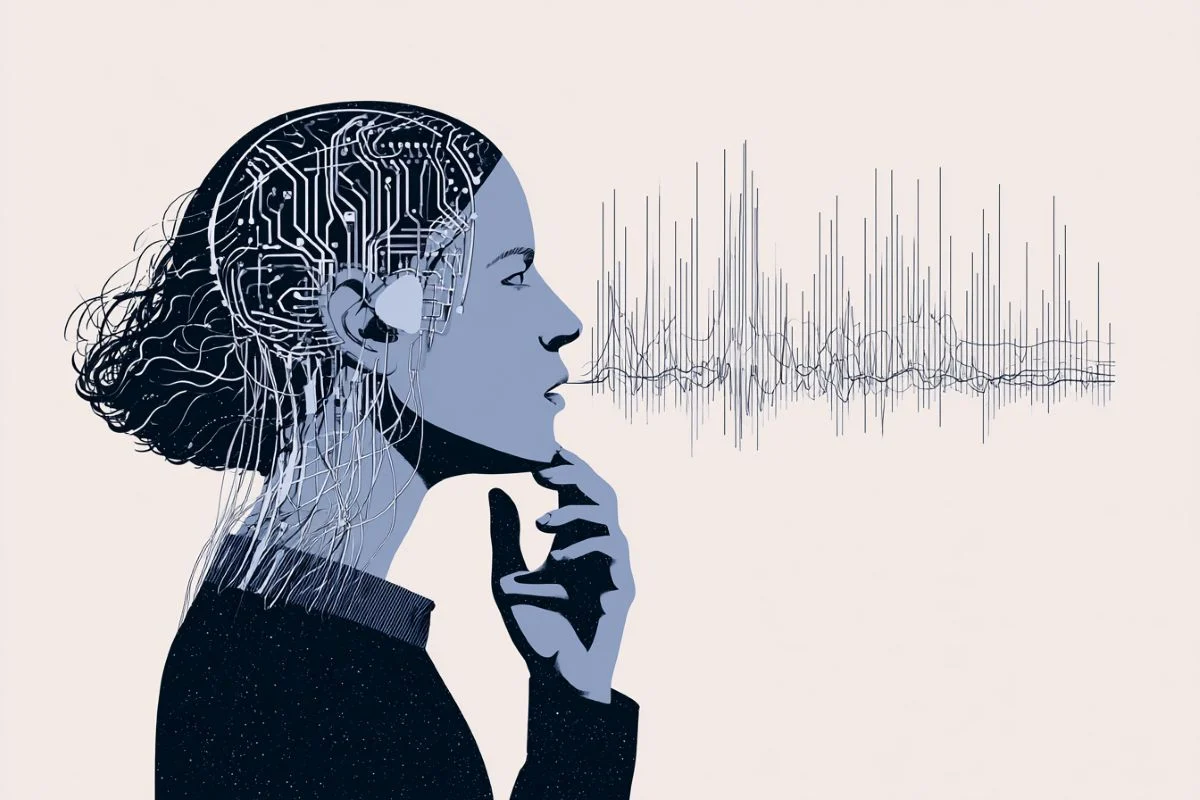
summary: Researchers have developed an AI-powered speech prosthesis that decodes dense intracortical signals into fluent, high-fidelity synthetic speech. The dual-stage deep learning pipeline leverages an audio decoding layer combined with a language processor from a large language model to achieve greater than 99% word accuracy with just 30ms of processing latency.
Tested on patients with advanced ALS, the interface enabled real-time expression of 2.7 million words over two years, including voice intonation adjustment and singing, marking a milestone for clinical brain-computer interfaces.
important facts
- Breaking through the data overload wall: Modern intracortical arrays capture firing data from hundreds of individual neurons simultaneously. While traditional statistical mathematics collapsed trying to make sense of this massive flood of data in real time, Dr. Stavisky leveraged advanced AI models to instantly read, classify, and decipher these complex neural patterns.
- Dual-stage AI decoding architecture: The neuroprosthesis achieves natural speech translation by routing raw cortical data through a specialized two-step deep learning pipeline.
- Audio layer: The first AI layer decodes real-time brain activity into phonemes, the fundamental blocks of sound from which speech is built.
- Language layer: The second layer applies a large-scale language model (LLM) architecture to instantly arrange these phonemes into clean words, phrases, and coherent sentences.
- Real-time speech synthesis and articulation: This interface utilizes deep learning models that convert flat text directly into speech rather than simply outputting it on a computer screen. This allows participants to control an audible synthetic voice that is directly modeled on their own pre-ALS voice recordings. The processing delay is very short (30ms), matching natural human speech, and allows users to adjust tone, intonation, and even sing.
- Practical life-changing benefits: After a two-year home implementation period, participants 2.7 million words Purely through brain signaling. Clinical BCIs provided complete communication independence, allowing users to participate in rich daily conversations with family members, independently control personal computers, and maintain full-time employment.
- Patient-driven concentration changes: Early in his research career, Dr. Stavisky focused primarily on motor-based BCIs for controlling robotic arms. But consistent feedback from paralyzed patients changed his trajectory. Moving objects helped, but patients unanimously said that getting their voice back was their absolute top priority, prompting a mid-career pivot to speech neuroscience just as consumer machine learning technology began to accelerate in 2018.
- Long term vision: Stavisky’s ultimate goal is to engineer the perfect “high-fidelity voice surrogate.” This is a clinical tool so advanced that when a user speaks over a standard telephone line, the listener has no idea that the voice is synthetic. Future developments will focus on scaling the system down to a completely wireless, fully internal medical implant while expanding access for patients managing stroke-induced aphasia or cerebral palsy.
sauce: AAAS
When Sergei Stavisky first started thinking about brain-computer interfaces (BCI) as an undergraduate at Brown University, he was motivated by three factors. “I love building things and wanted to work in the medical field. But I was also drawn to the mind.”
This combination now brings Stavisky into a field where what it means to lose, and potentially regain, a voice is rapidly being redefined.
Currently, Dr. Stavisky is an associate professor of neurosurgery at the University of California, Davis, and a leading expert in the development of AI-based speech artificial nerves. His work will be recognized this year with the Chen Institute science The award for Al Accelerated Research sits at the intersection of neuroscience, clinical care, and machine learning. But at its core, it’s a simple goal. It’s about restoring the ability to talk to the people you’ve lost.
That goal becomes clear in the story of one of the participants in his team’s research, a man with amyotrophic lateral sclerosis (ALS) who can no longer speak clearly.
Through an implanted device designed by Stavisky and his team and a series of AI models trained on his brain activity, the man is now able to produce fluent sentences, first as text and then as synthetic speech modeled after his pre-ALS voice. He has created millions of words in moments of everyday use.
Dealing with data overload
The science behind this achievement relies on the reality of data overload that has transformed neuroscience over the past decade. “Brain signals are very complex,” Stavisky explains.
Whereas researchers once recorded signals from a single neuron, modern systems can now capture signals from hundreds of neurons at once. But the behavior they are trying to decipher (such as speech) is one of the most complex human behaviors, and traditional statistical methods for processing data just don’t hold up to such complexity, Stavisky said.
He and his colleagues needed a way to process large amounts of neural data very quickly and flexibly. “AI turns out to be very powerful in that regard,” he said.
In Stavisky’s system, one model decodes brain activity into phonemes, the basic sound units of language. Another model uses large-scale language modeling approaches to transform those phonemes into words and sentences. In another direct speech approach, a deep learning system reconstructs speech and generates synthetic speech in real time.
The result is a system that can faithfully translate intent into speech and produce audible tones with just 30 milliseconds of delay. This is fast enough to approximate natural conversation.
In a study published in natural medicine In June, Stavisky et al. described how BCI helped participants with ALS maintain rich interpersonal communication with family and friends at home, control their own computers, and maintain full-time employment.
“Stavisky has developed an AI-based vocal neuroprosthesis that has immediate and transformative practical impact,” said Yuri V. Suleymanov, the magazine’s senior editor. science. “This restored communication in patients paralyzed by amyotrophic lateral sclerosis with more than 99% word accuracy, allowing patients to express 2.7 million words in two years using only brain signals. His team achieved real-time speech synthesis, allowing patients to adjust their intonation and even sing.”
From movement to speech
Stavisky said that early in his career, he worked on BCIs related to movement, which led him to focus on BCIs related to speech. He noticed that every patient had something in common. Restoring the ability to move a cursor or robotic arm is valuable, but restoring communication is always more urgent. “Communication has always been a top priority,” he said.
This realization, combined with new advances in machine learning and intracortical recording techniques, led to a mid-career transition from motor prosthetics to speech-language pathology. At the time, decoding speech from brain signals was widely considered to be one of the most difficult problems in neuroprosthetics. But advances in AI were accelerating at just the right time. Even consumer dictation systems were starting to reach usable performance levels around 2018, he said.
Looking to the future, Stavisky said the long-term goal is a “high-fidelity voice proxy,” a system that is “so natural that if someone is speaking on the phone, you won’t know it’s not their natural voice.” The future may involve devices that are smaller, fully implanted, and less obtrusive than today’s research systems. It will also require a transition from laboratory prototypes to widely available clinical tools.
The field is already expanding. Companies are beginning to participate in clinical trials of voice BCIs, and academic research institutions are also studying whether similar approaches can help people with stroke-induced aphasia, cerebral palsy, or other language disorders. Stavisky suggested the effects could extend far beyond paralysis.
“Ten years ago, Tianchao and I founded the Chen Institute to pursue fundamental questions about how the brain generates intelligence,” said Chen Institute co-founder Chrissy Luo.
“At the time, we couldn’t have imagined that AI would not only change how we study the brain, but what we could learn from it. Dr. Stavisky’s work accomplished what was previously thought nearly impossible: decoding brain signals directly into speech, restoring patients’ ability to communicate using their own voices.”
“This award was created for exactly this type of work, and we are proud to join AAAS and our partners at AAAS in celebrating his accomplishments. science. We remain committed to supporting researchers who are redefining what science can achieve. ”
Answers to key questions:
answer: Movement of a robotic arm or a computer cursor relies on relatively simple spatial instructions, where the brain essentially thinks about moving “up, down, left, and right” along a flat grid. However, speech is perhaps the most complex motor action performed by humans. To articulate a single word, the brain must coordinate hundreds of muscles in the tongue, lips, vocal cords, and diaphragm in highly precise sequences divided by milliseconds. Even if a patient physically loses the ability to speak, the brain still issues these complex, dense electrical commands. Trying to decipher large amounts of neural data using traditional statistics is like trying to read 1,000 books at the same time. The system crashes instantly and requires advanced AI to organize the data into meaningful patterns.
answer: The secret to the system’s natural conversation flow is its incredibly low processing latency of 30 milliseconds. Traditional assistive communication devices require users to carefully select each letter using an eye tracker, resulting in long and tiring silences that disrupt the rhythm of normal human interaction. Dr. Stavisky’s two-step AI framework completely bypasses this character-by-character input effort. By using a first-layer model to identify basic speech units (phonemes) and a second-layer model (similar to large-scale language models) to instantly predict intended words, the system almost completely bridges the gap between thought and speech, allowing users to speak at the speed of natural human thought.
answer: This milestone represents a monumental proof of concept for the entire field of neural repair. By demonstrating that an AI-driven interface can transform damaged neural pathways into highly accurate and expressive speech, this research opens up a direct clinical path to help millions of people silenced by a variety of conditions. The very same two-step decoding logic could eventually be fine-tuned to help stroke survivors overcome severe aphasia, young people managing cerebral palsy, or patients recovering from traumatic brain injury. This proves that the neurological map of language remains intact in the mind. All we need is to build the right digital bridges to bring those inner voices back into the world.
Editorial note:
- This article was edited by the editors of Neuroscience News.
- Journal articles were reviewed in full text.
- Additional context added by staff.
About this AI and neurotechnology research news
author: Megan Phelan
sauce: AAAS
contact: Megan Phelan – AAAS
image: Image credited to Neuroscience News


