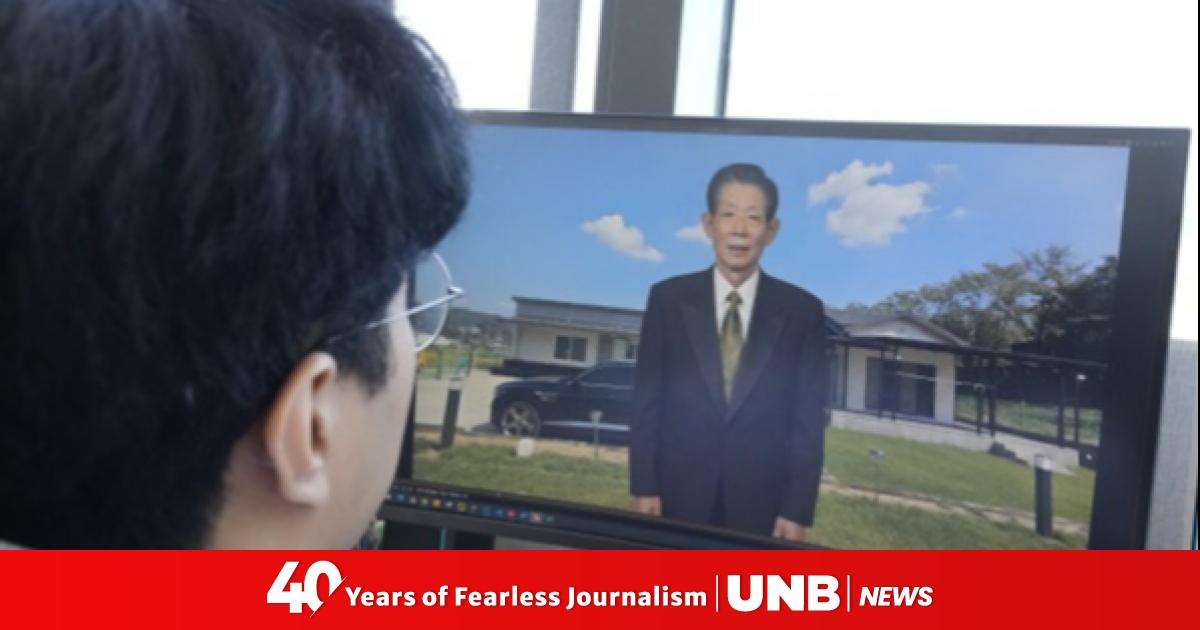
In South Korea, an increasing number of people are using artificial intelligence to create lifelike video messages from loved ones who have passed away to ease their grief. But this growing trend has also sparked debates over ethics, mental health, and the rights of the dead.
When Lee Gong Hui, a 28-year-old office worker, wanted to give his father a meaningful gift, he chose an AI-generated video featuring his late grandfather, who passed away before Lee was born.
The Seoul-based technology company used a script written by Lee to create a video in which a digital version of the grandfather speaks directly to his father, calling him “my most precious son.” The AI character apologized for making her work on the family farm as a child and for opposing her decision to become a hairstylist.
“My dad said he wouldn’t watch the video, but he did, and he cried. So I felt it was rewarding,” Lee said.
Lee said he wrote the script to express the emotions his grandfather would have wanted to share.
Several Korean startups are now offering AI services that recreate deceased people using photos and audio recordings. TV shows have also featured AI versions of late singers and actors, helping to bring the technology to wider public attention.
Experts say the technique has the potential to comfort grieving families, but also raises difficult ethical, legal and psychological questions.
“It’s a double-edged sword because it deals with human emotions,” said Yongman Ro, an artificial intelligence expert at the Korea Advanced Institute of Science and Technology.
Vaice, one of the companies offering the service, says it serves about 300 customers each month. Most of the customers are people in their 40s and 50s who want AI videos of their deceased parents, but some also request videos of their grandparents as gifts for their parents.
Vaice CEO Jeongu Won said the company only needs a few photos and a short audio recording to create a digital version of the deceased. The price for a 3-5 minute video is approximately 600,000 won (approximately 39,000 yen).
Wong said many families play videos during memorial services and traditional holidays. While most customers include messages of love, some customers express their feelings of regret over unresolved family conflicts in videos.
Lee said her grandfather died in a car accident before she was born and that her father always wanted to show him that she had built a successful life and family.
“I don’t know much about my grandfather, but when I saw the tears on my father’s face, I realized that he still missed his grandfather,” Lee said.
Interest in AI memorial videos is growing, but experts say the technology must be used with caution.
Chung Wan, professor emeritus at Kyung Hee University Law School, said South Korea needs a law to protect the dignity and rights of the deceased. He argued that if a person objected to such use during their lifetime, AI should not be able to recreate it, and that there should be clear rules governing the commercial use of human images and voices.
Experts are also eyeing the development of so-called “griefbots” or “deathbots” that allow users to have two-way conversations with AI versions of their deceased loved ones.
Chong warned that these technologies could make it harder for grieving people to come to terms with the death of a loved one.
“A healthy mourning process involves accepting the absence of the deceased,” he says. “Conversating with an AI system that mimics them could impede that process and trap people in an illusion.”
Wong said his company has not deployed AI chatbots because unmonitored conversations can raise unforeseen ethical issues.
Technology continues to advance rapidly. Choi Yuha, an executive at JL Standard, another AI company, said today’s systems can reproduce facial details such as wrinkles and skin texture with surprising accuracy.
Lo, an AI expert, said he created a one-minute AI video of his parents, who passed away last year, and showed it to his siblings during a family gathering.
The parents in the digital version told the family, “Don’t worry” and “Take care,” and everyone was moved.
But Lo said her family has only seen the video once.
“Once was enough to honor my late parents,” he says. “We moved on.”