

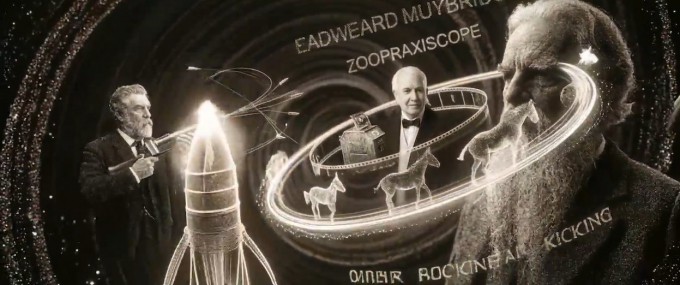
Screenshot of “Cinema Genesis”. Courtesy of ETRI.
Artificial intelligence (AI) technology that converts old 2D images into 3D stereoscopic images is being applied to actual content production.
The Electronics and Telecommunications Research Institute (ETRI) announced on the 10th that it has produced a short film, “Cinema Genesis,” which reconstructs material from early film history into three-dimensional 3D images using its proprietary AI-powered 2D → 3D conversion technology. The approximately four-minute film will be screened at the 43rd Busan International Short Film Festival (BISFF), and will later be screened at the festival’s showcase “BISFF in Paris” to be held in Paris, France.
Cinema Genesis features people who have contributed to the filmmaking process. Among them was Eadweard Muybridge, who first demonstrated the potential of moving images by taking a series of photos of running horses. Etienne-Jules Marais researched ways to record the movements of humans and animals with cameras. Thomas Edison invented a projector that played film and projected video. The Lumière brothers held the world’s first public film screening in 1895. Georges Méliès was a pioneer in screen compositing and special effects. Old photos and video materials of these figures were restored using AI and converted into 3D images.
Two core technologies developed by ETRI were applied here. One is “depth estimation technology,” in which AI autonomously calculates the distance of objects in a flat image to create a sense of depth, and the other is a technology that automatically converts 2D images to 3D based on that estimation. To restore the blurred photo, a generative adversarial network (GAN) technique was used, in which two AIs compete against each other to improve the final output.
The AI first restores and colors old photos that are damaged or blurred. It then calculates how close or far objects are within a single flat image to create a three-dimensional effect, applying the subtle visual differences created by binocular vision to complete a 3D stereoscopic video.
Also noteworthy is the “hierarchical encoding” technique applied in this project. This allows a single video file to provide both 2D and 3D content at the same time. This means that content can be viewed in standard 2D on a smartphone, and stereoscopically on a 3D-enabled TV or car display. Since existing video service infrastructure can be used, it is possible to deliver immersive content without making additional capital investment.
Kim Sung-hoon, chief researcher at ETRI’s Southeast Regional Intelligent Convergence Laboratory, said, “This is a typical example of applying AI video generation and stereoscopic conversion technology to content production.” “It is expected that it will be used in a variety of fields such as movies, dramas, and live performances, contributing to strengthening the competitiveness of the domestic content industry and spreading the Korean wave.”


