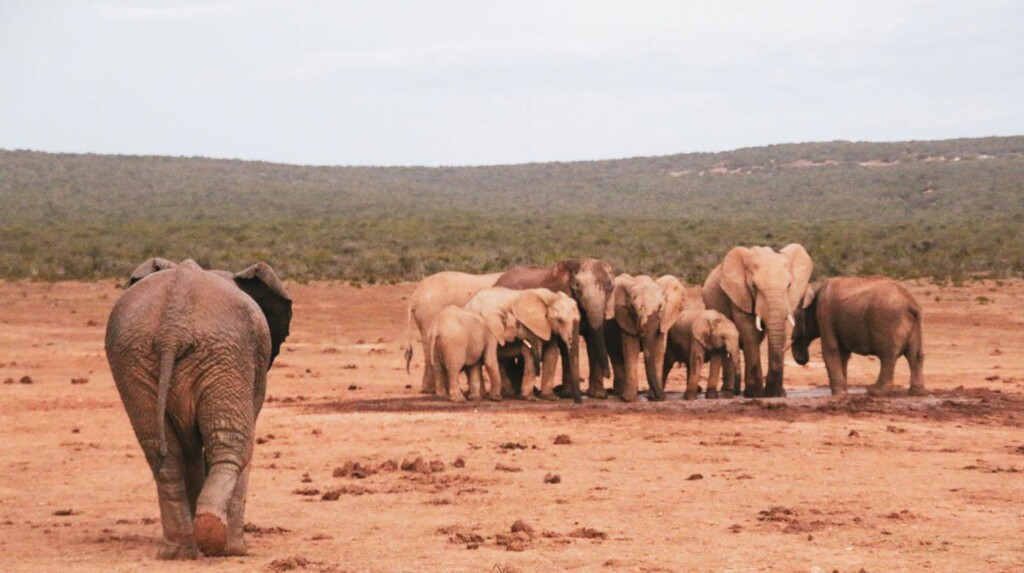
In a surprising, but perhaps unsurprising, study, a team of biologists and researchers using machine learning tools discovered that elephants call each other by their names.
For animals known to engage in highly social behaviours such as grieving, raising young in groups and using complex low-frequency vocalisations to communicate across miles of countryside, using names seems natural in their society, but knowing elephants' names in 'elephant language' could dramatically reduce human-elephant conflict.
The study, conducted at Colorado State University, was based on the simple observation that female leaders of herds of elephants the researchers were tracking in Kenya would use calls to gather all the elephants around them.
But sometimes, the exact same cry will bring out just one elephant from the herd.
To see if this has to do with naming habits, scientists from CSU, Save the Elephants and ElephantVoices used machine learning to analyze the vocalizations, grouping them into those that appear to be directed at multiple members of the troop and those that appear to be directed at a single individual.
When the researchers played the recorded calls, the elephants responded positively to calls directed at them by calling back or moving closer to the speaker, the CSU report said. Calls directed at other elephants elicited less of a response.
In animal vocalization ethnography, using names is considered “arbitrary communication,” said study co-author George Wittemyer, a professor at the Warner College of Natural Resources at California State University and chair of Save the Elephants' scientific committee. Using a name, Wittemyer said, means it's a sound that represents a thought, but doesn't mimic it.
“If we could only make sounds that resembled what we were saying, our ability to communicate would be severely limited,” Wittemyer says.
Arbitrary in this case means that the sound made when you say the name can be anything: it is simply something that is assigned to an object or person and is thought to indicate an abstraction of thought, i.e. a sign of a high level of intelligence.
More Intelligence Science: New research reveals why crows are as intelligent and even self-aware as humans
During the evolution of humans and elephants, complex social structures required precise communication.
“This is probably a case where we're under similar pressures that stem primarily from complex social interactions,” Wittemyer said. “That's one of the exciting things about this study: it gives us some insight into the factors that lead us to evolve these capabilities.”
See also: Octopuses' sleep patterns are strikingly similar to ours, and they can even dream.
Kurt Fristrup, a researcher at CSU's Walter Scott Jr. School of Engineering, is also excited about the discovery because it gives us an opportunity to understand what acoustic properties elephants use as “signatures” for their herd mates in communication.
“The discovery that elephants are not simply mimicking the calls of the calling individual was most intriguing,” Fristrup says. “The fact that they can use any acoustic label for another individual suggests that other kinds of labels and descriptions may exist for elephant calls.”
More elephant stories: Adult elephants in the herd react to birth shortly after adorable baby is born (VIDEO)
Finally, Wittemyer believes that because the individual animals in his study were consistently very responsive to having their names called, creating a master address book of all the elephants in a particular area could provide unprecedented opportunities for managing human-elephant conflicts.
“It's hard to live with elephants when you're trying to share the land and they eat your crops,” Wittemyer says. “I'd like to be able to warn the elephants, 'Don't come here. If you come here, you're going to get killed.'”
In April, scientists said they believed they had a conversation with a humpback whale, suggesting that humans may be on the verge of being able to converse with the animals with whom we share the Earth.
Check out the video explanation below…
Please share this excellent observational science on these genius giants…