Tech stock traders tend to be impatient. Lately, however, they’ve become seriously annoyed that the high price they paid to get into the AI game hasn’t yielded the returns they had hoped for.
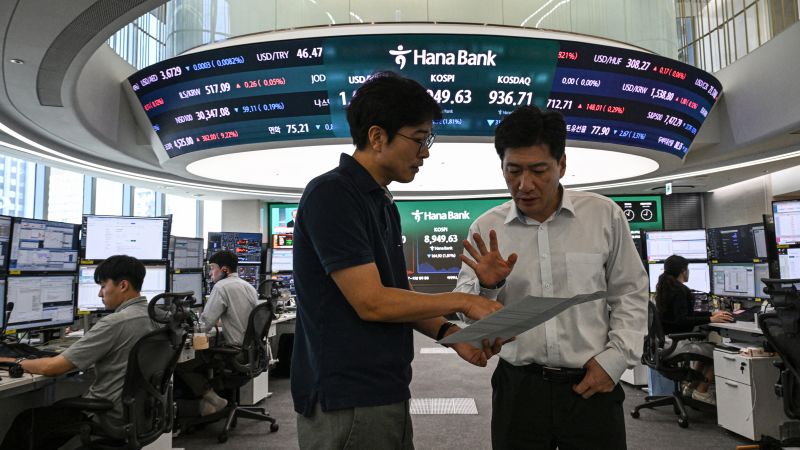
The Nasdaq index, a barometer for the technology industry, was set to fall another 1.2% on Friday, an overhang from another big drop in South Korea, where the Kospi index fell 5.8%. The Nasdaq ended the week in the red, falling more than 6% from its all-time high on June 2nd.
It’s natural for investors to be cautious. Valuations for AI stocks have soared in recent years largely on the promise of technology, not the bottom-line growth that drives most companies’ share prices higher.
Demand for AI is not slowing down. In fact, it’s the opposite. But the industry’s explosive growth has required companies to spend or borrow tens of billions of dollars to build and develop technology, without seeing immediate results.
It’s not necessarily Big Tech’s fault. AI has become an incredibly expensive endeavor. The surge in demand for the technology is fueling a data center boom, requiring large quantities of high-performance chips that semiconductor companies can’t produce quickly enough.
This caused chip prices to soar, creating a kind of K-shaped AI industry, igniting chipmaker stocks and sinking the high-tech companies supporting AI models.
Microsoft and Meta have lost a fifth of their peak value and are in a bear market. The remaining so-called Mag7 technology giants, Amazon, Apple, Google, Nvidia, and Tesla, are in correction territory, down at least 10% from their recent highs.
In a tale of two AI cities, Apple announced Thursday that it would raise the prices of its MacBooks and iPads due to a lack of memory, sending the company’s stock price down more than 6%. Memory and storage chip maker Micron soared nearly 16% on Thursday on a boom in demand for semiconductors, after reporting impressive earnings the night before.
These market trends are giving the industry pause. OpenAI is considering delaying its IPO as recent market fluctuations could make it difficult for the company to achieve its desired $1 trillion valuation, The New York Times reported on Thursday.
Half of the Kospi’s value is made up of just two tech giants (SK Hynix and Samsung), but another circuit breaker tripped on Friday, suspending trading for 20 minutes. Although the Kospi has risen about 90% this year, it has remained unstable for quite some time. But this week has been particularly eventful, with a 10% drop on Tuesday, 5% and 3% gains on Wednesday and Thursday, and another drop on Friday.
The tech sector has been fueling stock market gains over the past few years. Despite the recession, the semiconductor industry more than made up the difference, growing to 19% of the S&P 500’s value.
But rising bond yields and the possibility that the Federal Reserve will raise interest rates in the coming months could hurt the tech sector, which is especially vulnerable to pain from high borrowing rates.
So if the tech market aversion turns into a decline in tech stocks, the rest of the stock market will have to do the heavy lifting. The good news: Non-tech sectors are up across the board this week.
And even after accounting for its dependence on technology, the S&P 500 is just over 3% away from its all-time high.
Meanwhile, tech stock traders are tiptoeing around the mousetrap in hopes of getting through June without losing an appendage.