
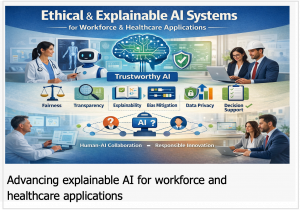
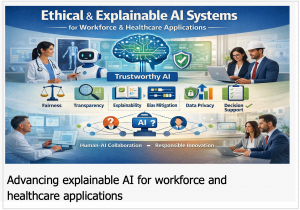
This research initiative highlights the importance of ethical and accountable artificial intelligence in workforce analysis and medical diagnostics.
— Mahfuz Islam Khan Javed
WOODBRIDGE, VA, March 2, 2026 /EINPresswire.com/ — Mahfuz Islam Khan Javed, an AI and machine learning researcher and graduate student at the Washington University of Science and Technology, whose research focuses on ethical and explainable artificial intelligence (XAI) across workforce analytics and healthcare applications.
This research effort focuses on transparent model design that helps stakeholders understand how predictions are generated. This approach is widely considered important where the output of AI can influence decision-making in recruitment and retention planning, as well as in support of clinical screening.
Jabed’s research profile includes research into time series forecasting for financial modeling, explainable predictive analytics for employee turnover, and interpretable deep learning approaches for patients with diabetes.
Detection of retinopathy. Across these areas, we focus on balancing predictive performance and interpretability to support responsible deployment of AI systems.
In finance-oriented research, Jabed published Stock Market Price Forecasting Using Machine Learning Techniques in February 2024, which describes applying machine learning approaches such as LSTM and Prophet to forecasting using market data.
Publications are listed on the publisher’s page with their DOI and citation/usage indicators.
In Employee Intelligence and Human Resources Analytics, Jabed has developed a stacking ensemble framework for predicting employee turnover with explanatory capabilities using SHAP to support interpretability of model outputs. His profile states that this research was accepted at the 2025 IEEE 2nd International Conference on Computing, Applications and Systems (COMPAS 2025). The COMPAS conference site states that accepted papers will be submitted for publication in IEEE Xplore in accordance with IEEE Xplore quality standards (and, per conference guidance, publication may depend on presentation and publication requirements).
In medical AI, Jabed’s profile includes an ICCIAA 2026 approved interpretable hybrid CNN and Vision Transformer framework for diabetic retinopathy detection. The ICCIAA conference focuses on computational intelligence approaches and applications, and the 2026 edition will be held at Petra University in Amman, Jordan.
“Responsible AI depends on clarity, not just accuracy,” said Mahfuz Islam Khan Javed. “When a model is interpretable, it becomes easier for decision makers to evaluate reliability, fairness considerations, and limitations before using the output in a real-world environment.”
In addition to his research, Jabed has gained expertise in practical machine learning processes through internships and training roles such as supervised modeling, performance evaluation, and interpretability techniques. Python and popular machine learning frameworks and tools such as TensorFlow, PyTorch, scikit-learn, and SHAP-based interpretability methods are among his technical skills.
Jabed is more interested in explainable AI, workforce intelligence and human resources analytics, medical AI applications for public health diagnostics, and predictive modeling for financial and risk forecasting. After completing his Bachelor of Science in Computer Science and Engineering in January 2024, he is currently pursuing a Master of Science in Information Technology (to be completed in April 2027).
As AI systems become increasingly integrated into economic, healthcare, and workforce infrastructures, the emphasis on transparency and ethical implementation continues to grow. Through continued graduate research and interdisciplinary collaboration, Jabed aims to contribute to the development of AI models that balance technical performance and accountability and ensure practical applicability in real-world environments.
His research and practice focuses on responsible AI development for economic resiliency, workforce optimization, and medical innovation. His research attempts to foster more open, responsible, data-driven decision-making in both public and private sector contexts by incorporating interpretability approaches into predictive algorithms.
About Javed Mahfuz Islam Khan
Mahfuz Islam Khan Jabed is a Woodbridge, Virginia-based researcher specializing in AI and machine learning. His research focuses on workforce intelligence and human resources analytics, medical AI applications for public health diagnostics, explainable AI, and predictive modeling for financial and risk forecasting. He has written and published research in the areas of predictive, explainable, and interpretable deep learning techniques. He is currently pursuing a master’s degree in information technology from the Washington University of Science and Technology.
Mahfuz Islam Khan Javed
leader universe
mahfuzislamkhanjabed@gmail.com
Legal disclaimer:
EIN Presswire provides this news content “as is” without warranty of any kind. Our company does not assume any responsibility or liability
The accuracy, content, images, videos, licenses, completeness, legality, or reliability of the information contained herein;
article. If you have any complaints or copyright issues related to this article, kindly contact the author above.


