
image:
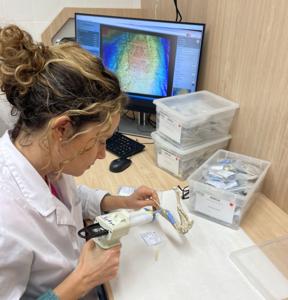
Professor Laura M. Martínez, Department of Biology and Institute of Archaeology, University of Barcelona (IAUB);
view more
Credit: Laura M. Martinez – University of Barcelona
Dental microwear research allows analysis of the minute marks that food leaves on the surface of tooth enamel during chewing. In paleoanthropology, this methodology helps reconstruct fossil primate and human diets throughout human evolution. The microscopic striations in tooth enamel are like microscopic archives that reveal whether a person’s diet was rich in foods with softer components or more abrasive. Now, a study was published in a magazine. scientific report presents an innovative artificial intelligence (AI)-based methodology for consistently identifying 3D wear patterns in an analyst-independent manner.
These 3D wear patterns vary among primates living in diverse ecosystems and with different dietary habits. This study also identifies which variables are most informative for the classification of dental microwear and proposes an analytical framework open to the entire scientific community to study this type of surface.
The research is led by Professor Laura M. Martínez of the Faculty of Biology and Institute of Archaeology, University of Barcelona (IAUB), a pioneering expert in the application of machine learning techniques in paleoanthropology. UB member Ferran Estebaranz of the Mira y Fontanars Institute of Humanities (IMF-CSIC) also participated in the study. Juan José Ibáñez (IMF-CSIC); Simón Rodríguez (Pontifical University of Comillas), Kristina Kit and David R. Insua of the Institute of Mathematical Sciences (ICMAT-CSIC) are leading researchers in the application of machine learning techniques to archaeological research.
Studying environmental changes through dental microwear
Dental microwear research has a long history in the study of the origins and evolution of human lineages. “Until now, simpler wear measurements, typically performed in 2D, have often been used, relying on traditional statistical methods that establish a relatively direct relationship between these parameters and diet,” explains Laura M. Martínez from UB’s Department of Evolutionary Biology, Ecology and Environmental Sciences.
In the current context, there is little precedent for applying AI technology to the study of dental wear and human paleoecological adaptations. Currently, Laura M. Martinez is leading a project using AI models trained on 3D tooth wear surfaces of primates with known dietary habits, with the goal of applying them to the study of Pliocene-Pleistocene fossil primates from Africa and Iberia.
“Good comparative models based on living primate and hunter-gatherer populations with known diets are essential to reconstructing the diets of fossil primates and humans,” Martinez added. “With the introduction of 3D technology, it has become possible to generate a huge number of variables, which are difficult to interpret by traditional statistics. In this context, AI facilitates the integration and compression of this complex information, thereby enabling the identification of patterns on 3D surfaces that are difficult to interpret directly,” the researchers explain.
The project focuses specifically on Cercopidonidae, a widespread primate family that occurs in a variety of habitats in northern, eastern and southern Africa, based on archeological sites dating back 4 to 1 million years. During this period, significant climate changes occurred that severely affected Africa’s ecosystems. The aim is to analyze the evolution of the diet of these primates, which coexisted in time and space with the earliest humans, in relation to climate change.
“Ceretidae lived in the same ecosystem and at the same time as hominids, making them an excellent model for understanding how climate change during the Pliocene and Pleistocene affected the diets and adaptations of these primates,” the researchers explain.
From this perspective, this study opens up a new scenario with models that can distinguish between extant primates with diverse dietary habits, thereby providing a reference framework in which fossil primates can be incorporated.
In the future, the team aims to significantly increase the sample size to improve the accuracy and robustness of the model. To this end, more samples from different species and diverse ecosystems with well-characterized diets and other ecological factors are being incorporated to increase the consistency of the analysis.
“A good primate reference model will allow us to develop robust reference models for interpreting our ancestral diets in 3D, in an integrated manner with other paleoecological and climate indicators,” concludes Laura M. Martínez.
journal
scientific report
Research method
experimental research
Research theme
not applicable
Article title
Machine learning approach to dietary classification from primate tooth microstructure
Article publication date
April 28, 2026
Disclaimer: AAAS and EurekAlert! We are not responsible for the accuracy of news releases posted on EurekAlert! Use of Information by Contributing Institutions or via the EurekAlert System.


