

As artificial intelligence (AI) becomes more integrated into workplace systems and operations, both the way work tasks are completed and the experience of work itself is being reshaped.
For many employees, AI is testing their tolerance for uncertainty and job insecurity. Some positions are fully automated. Others are becoming surplus. Full-time roles are often reduced to part-time or contract work.
These changes are very visible in this year’s news headlines. For example, UPS announced 20,000 job cuts in April while also expressing interest in bringing in Figure AI humanoid robots to take over warehouse operations.
Lately, this disruption has extended beyond frontline roles. Amazon has revealed plans to cut 14,000 corporate jobs as it reorganizes its organization around AI-enhanced efficiency. Microsoft laid off about 6,000 employees, most of them software engineers and programmers, as AI systems now generate up to 30% of new code for projects.
Employees will not be on equal footing in the face of these changes, nor will they experience the same level of vulnerability. The ability to respond to AI-related job threats varies widely by income, education, race, and digital access.
These disparities ultimately shape who is able to adapt and take advantage of new technological opportunities, and who is excluded and left behind.
AI will have an uneven impact on the workforce
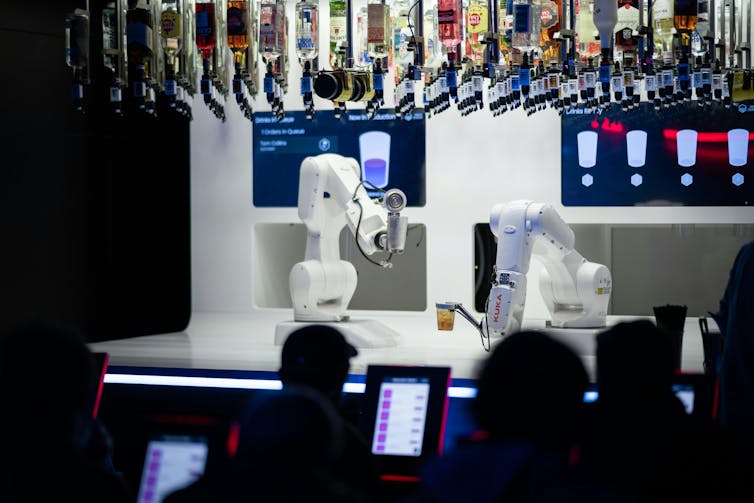
A key reason workers face unequal vulnerability to AI-related job threats is because automation disproportionately targets entry-level and front-line positions. These are typically low-paid roles, often held by people from low socio-economic backgrounds and marginalized communities.
These positions typically involve routine or repetitive tasks in areas such as customer service, retail, administration, warehousing, and food service. These jobs are up to 14 times more likely to leave than higher-paying jobs, according to the report. As a result, women are 1.5 times more likely to start a new job than men.
Those in these roles also face significant barriers to accessing employment and advancement opportunities, perpetuating a cycle of economic insecurity among already vulnerable groups.
(Michael Hussert/Unsplash)
In contrast, AI is significantly increasing the efficiency and productivity of knowledge workers in high-wage jobs. Research shows that 75% of knowledge workers are currently using AI tools and report an average increase in productivity of 66%.
These employees are in a much better position to integrate AI into their workflows. For example, national data shows that Canadian employees benefit most from AI when their jobs involve “complementary” tasks. These are tasks that AI can enhance or enhance.
This complementarity is strongly linked to education. This percentage is highest among employees with graduate degrees and declines steadily as education level declines. As a result, the benefits associated with AI will disproportionately flow to highly educated, highly paid professional workers, who will be able to manage larger workloads and complete tasks faster. Some workers save up to a third of their working hours.
AI can also improve the quality of work. Research shows that consultants who use AI produce 40% more quality work than consultants who do not use AI. These benefits can accelerate career advancement and income growth for people who are already in a privileged socio-economic position.
These patterns expand opportunities for those in high-income, professional roles, while deepening precarity and reinforcing existing class inequalities for those in low-income, entry-level, front-line roles.
Uneven access to skills training
Upskilling and reskilling are often presented as solutions to AI-related employment threats, but access to these opportunities is unevenly distributed across social groups.
Upskilling refers to developing more advanced skills within your current role, while reskilling involves learning entirely new skills to transfer to a different job. High-income and highly educated professionals receive far more institutional support for upskilling and reskilling, including employer-funded training, paid time to learn new tools, and access to advanced digital tools.

(Getty Images/Unsplash+)
In contrast, workers from lower socio-economic backgrounds and in low-income jobs often lack the financial means, time, and organizational support needed to develop new skills.
These structural disparities are reflected in participation rates, with Gallup and Amazon finding that 75 percent of workers in computing jobs are upgrading their skills, compared to less than a third of workers in administrative, food service, production, and transportation roles.
As a result, precarious and vulnerable workers are further disadvantaged by the barriers they face in accessing opportunities to respond to technological threats.
Digital access shapes who benefits
Differences in digital access and literacy create further inequalities in how different groups experience AI.
The digital divide is linked to disparities in digital and AI literacy across income, geography, age, education, and occupation.
People in high-paying white-collar jobs, urban areas, and well-resourced institutions typically have access to reliable internet, AI tools, and digital skills training. AI literacy also increases through formal education and vocational training, giving people more opportunities to experiment and incorporate AI into their work.
However, people in manual labor, rural areas, low-income households, marginalized communities, and older age groups often lack access to reliable connectivity, modern technology, and formal training, making AI adoption more difficult.
This makes them even more vulnerable to AI-related job threats. These disparities in access and skills reinforce existing socio-economic inequalities by concentrating the benefits of AI among advantaged groups while increasing risks for groups with fewer resources.
AI has great potential to positively impact employees, organizations, and workplaces. But without fair access to upskilling, reskilling, training, digital resources, and AI literacy, this technology could deepen the divide between different social groups. For AI to benefit society more broadly and equitably, it is essential to close these gaps and create fair opportunities for adaptation.


