what? Artificial intelligence (AI) can actually predict the success rate of fusion ignition and is featured in the prestigious science magazine Science!
This sounds like a science fiction movie plot, but it really happened –
Built by the US Lawrence Livermore National Laboratory, this generative machine learning model predicts the results of fusion ignition experiments at the US National Ignition Facility (NIF) at over 70%, indicating a “successful ignition.” here, Ignition refers to situations where the energy produced by fusion exceeds the laser energy used in the experiment.
Paper link: www.science.org/doi/10.1126/science.adm8201
This finding could provide guidance to future researchers conducting inertial confinement fusion (ICF) experiments. In ICF experiments, hydrogen isotope capsules are compressed and heated using a high-energy laser to initiate a nuclear reaction that generates fusion energy, an efficient energy solution in an era of energy shortages. Imagine aiming at the most powerful laser system on Earth with a small hydrogen capsule, releasing enormous amounts of energy just like you master the miniature sun.
The researchers said having a “successful predictive model” would inspire fusion energy researchers, help them coordinate experimental designs, and help them determine whether future increases in laser energy and other variables can improve fusion power and efficiency.
Why is fusion ignition prediction important?
The ICF project aims to compress and heat millimeter-sized capsules containing hydrogen isotopic hydrogen and tritium (DT) using NIF, the world's largest laser system. During the compression process, the nuclear reaction of the DT fuel releases fusion energy.
Computer simulation of ICF performance is extremely important in NIF experimental design. The NIF conducts approximately 12 ignition experiments each year, and researchers need to rely on these simulations to optimize their experimental design. To ensure the success of these efforts, predictive models must be developed that can accurately estimate observable target amounts before the experiment is run.
However, actual simulations need to reduce computational costs through simplified assumptions. This usually leads to a deviation between simulation predictions and experimental observations.
To reduce this deviation, researchers typically adjust uncertain parameters in the model during the “post-processing” stage to match the experimental measurement results. The adjusted model will be used during the “pre-processing” stage of small extrapolation to provide guidance for future experiments.
Although manual “post-processing” parameter adjustment methods have proven effective for small-scale extrapolation within the design space, computer models with real-world prediction capabilities to support decision-making during laser system upgrades or designing future high-yield facilities, particularly when these features operate under significantly different experimental conditions. Quantifying these uncertainties is particularly difficult due to the rarity of experimental data, vast design space, and high cost of simulation calculations.
This time, the prediction model proposed by the research team It provides a promising method for ICF experimental predictive modeling and a new framework for the development of operational models for other complex systems.
How does AI achieve fusion ignition prediction?
In this work, the researchers described a collaborative information model based on deep learning, combining simulations and experiments to account for multiple sources of uncertainty.
The research team's goal is to combine previously collected NIF data, high fidelity physics simulations, and expertise to provide quantitative predictions of fusion yields and other key diagnostic functions prior to experiments, taking into account uncertainty. This model can adapt to modified designs, act as a decision tool for future experiments, and provide a robustness indicator in design optimization studies.
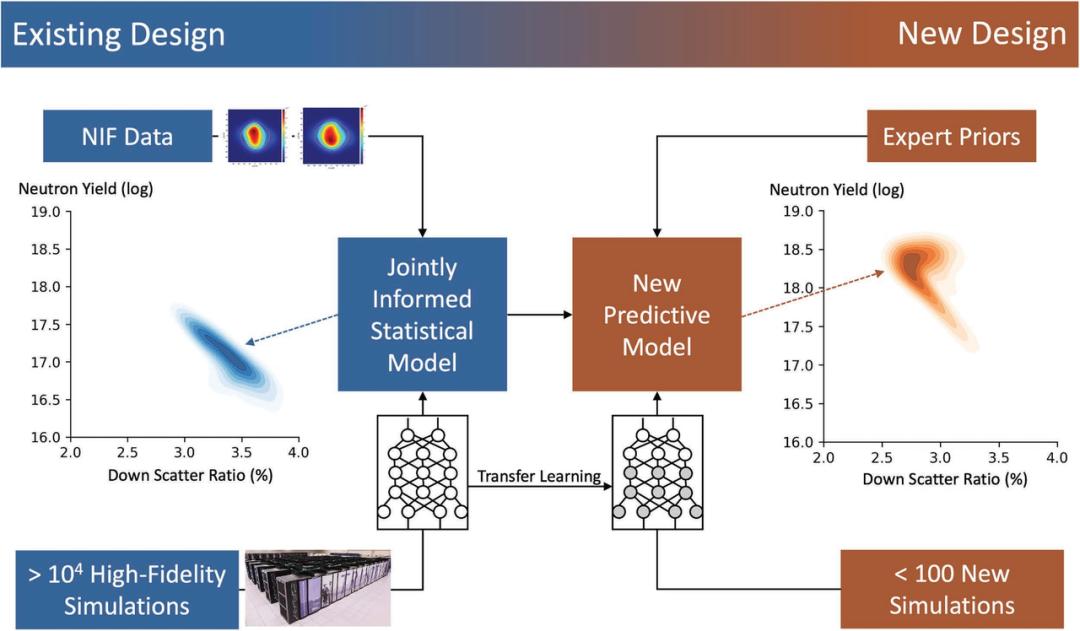
Figure | Workflow for predicting variation in proposed experiments.
Predictive models combine large-scale simulation databases, Bayesian analysis, and transfer learning techniques in machine learning to build statistical models based on both experimental and simulation data. This model is first constructed based on previous NIF experiments using statistical models based on both simulation and experiment. This model provides a set of input conditions for model uncertainty and interexperimental variation observed in a series of NIF experiments. These input conditions are then applied to the proposed design of future experiments and generate a distribution of expected results based on previous experiments.
This study integrates many improved methods for ICF experimental predictive modeling of databases, including advanced high-performance computing (HPC) workflows, Bayesian post-processing analysis, and large-scale simulation databases generated by learning techniques in machine learning.
As an extension of previously published Bayesian post-processing analysis, the model quantifies the variation in a series of nearly repeated experiments conducted between 2021 and 2022. These distributions are propagated forward through machine learning models of the design being tested to predict performance variability for future experiments.
In September 2022, NIF conducted the first ICF experiment using laser energy of 2.05 Megajoules (MJ). This was increased compared to the previous 1.9 MJ laser energy. This design achieved outputs above 1 MJ and laid the foundation for further improvements in performance.
One week before the successful firing experiment in December 2022, in the second expected experiment, driven by a laser energy of 2.05 MJ, researchers used this method to predict that the design had a 74% chance of exceeding a significantly higher split yield than the previous design. The actual results of the experiment were perfectly in line with the predicted confidence intervals, and other observable experimental volumes also met expectations.
Furthermore, in subsequent iterations of the design in December 2022, the results were consistent with the predicted distribution of variation. Accurate prediction of this variation by the model was verified by the intimate consistency between the experimental results and the predicted confidence interval.
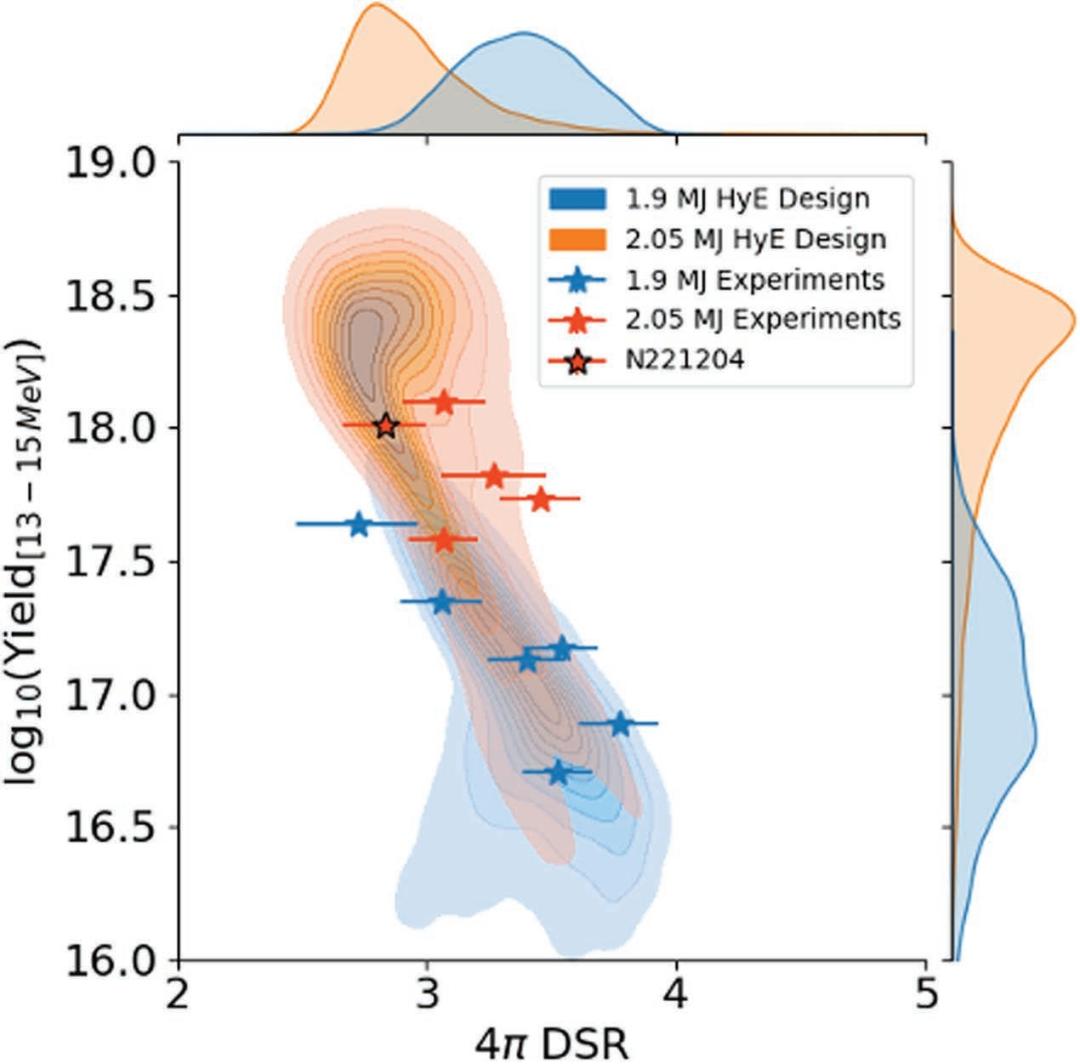
Figure |Relationship between main yield (performance indicator) and DSR (percentage) (confinement indicator).
It's not just fusion ignition predictions
The researchers made quantitative and physically meaningful predictions for controlled fusion experiments, achieving target gain >1.
The predictive model takes into account the inevitable variations in experimental conditions in situ, including variations in laser transmission and capsule quality, uncertainty in input conditions caused by uncertainty in experimental measurements, and changes in intentional design of future experiments.
By combining Bayesian analysis of previous experiments with transfer learning, we efficiently train surrogate models of new designs, allowing prediction of the expected outcome distribution of future experiments within a few days.
The predictive model takes into account the inevitable variations in experimental conditions in situ, including variations in laser transmission and capsule quality, uncertainty in input conditions caused by uncertainty in experimental measurements, and changes in intentional design of future experiments. Combining Bayesian analysis of previous experiments with transfer learning allows efficient training of surrogate models for new designs. They were able to predict the expected outcome distribution of future experiments within a few days.
This method provides an opportunity to optimize design decisions in future NIF experiments under reliable, data-driven uncertainty. It is not limited to ICF, but can also be applied to other areas of research that require scientifically based extrapolation to determine new configurations for complex engineering systems.
Overall, this work proposes predictive modeling methods under the conditions of rare data, with its application scope far beyond fusion ignition.
This article is from WeChat's official account, Academic Headlines (ID: Scitoutiao), author: Xiaoyang. It has been published by 36kr with permission.