overview
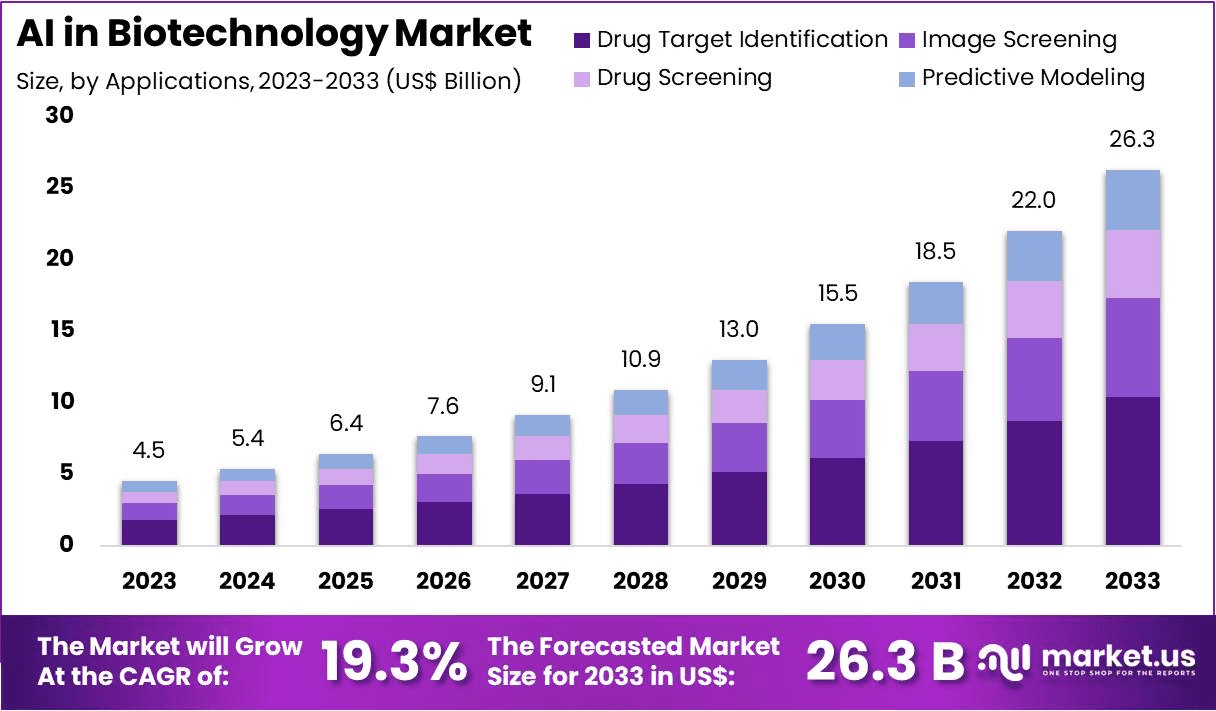
New York, NY – March 9, 2026 – global AI in the biotech market Size is expected to be worth approx. 26.3 billion USD By 2033, 4.5 billion USD In 2023, CAGR 19.3% During the forecast period 2024-2033.
Artificial intelligence (AI) is increasingly integrated into the biotechnology sector, creating significant opportunities for innovation, efficiency, and accelerating scientific discovery. The convergence of AI technology and biotechnology will enable researchers and organizations to more efficiently analyze complex biological data and develop advanced solutions for healthcare, agriculture, and environmental sustainability.
AI-powered tools are widely applied in fields such as drug discovery, genome analysis, and precision medicine. Machine learning algorithms can process large amounts of biological and clinical data, helping researchers identify potential drug targets, predict molecular interactions, and optimize therapy development. As a result, the drug discovery process, which previously took several years, can now be significantly shortened.
In genomic research, AI supports the rapid interpretation of genetic information, allowing scientists to better understand disease mechanisms and develop personalized treatment approaches. This technology also facilitates improvements in biotechnology manufacturing processes by enhancing quality control, optimizing production systems, and reducing operating costs.
Market trends indicate that AI integration in biotechnology is on a strong growth trajectory. Increasing investment in research and development, increasing demand for precision medicine, and expanding applications of bioinformatics are contributing to the adoption of AI-based solutions. Additionally, collaboration between technology companies, biotech companies, and research institutions is further enhancing innovation in this area.
Overall, the integration of AI in biotechnology is expected to reshape the future of life sciences by improving research efficiency, accelerating medical progress, and supporting the development of advanced biological solutions.

Important points
- In 2023, AI revenue in the biotech market will be 4.5 billion USD is predicted to reach 26.3 billion USD Expanding at a compound annual growth rate (CAGR) by 2033 19.3% During the forecast period.
- Based on product type, the market is segmented into hardware, software, and services. Software has the largest share among these segments. 52.3% 2023 shows strong adoption of AI-driven analytical platforms and bioinformatics tools.
- From an application perspective, the market includes drug target identification, image screening, drug screening, predictive modeling, etc. Drug target identification segment dominated the market by revenue share. 39.7% In 2023, it will be driven by the increasing use of AI in accelerating the drug discovery process.
- From an end-use perspective, the agricultural biotechnology sector has emerged as a key segment; 40.6% Driven by increasing adoption of AI technologies for crop improvement, genetic research, and sustainable farming practices, it will account for one of the total market revenues in 2023.
- North America maintains its top position in the region. 40.8% Supported by a strong research infrastructure, significant investments in biotech innovation, and the presence of leading technology and pharmaceutical companies, it will hold the No. 1 market share for AI in biotech globally in 2023.
regional analysis
North America leads AI in biotech market
North America maintains its leading position in the AI in biotechnology market. 40.8% The region’s dominance is primarily due to the strong adoption of artificial intelligence technologies across pharmaceutical and biotech companies.
Accelerated drug discovery, personalized medicine, and increasing demand for advanced diagnostics are encouraging organizations to integrate AI-driven platforms that increase data analysis and research efficiency. A notable development occurred in January 2024. When NVIDIA Corporation partnered with Amgen to leverage NVIDIA DGX SuperPOD for AI-enabled drug discovery and pharmaceutical research.
Asia Pacific region expected to record fastest growth
Asia Pacific is projected to register the highest CAGR during the forecast period, supported by expanding healthcare investments and advances in genomics. Countries such as China, India, and Japan are actively promoting the integration of AI in biotechnology. In June 2024, SOPHiA GENETICS collaborated with Strand Life Sciences to power genomics, bioinformatics, and AI-powered diagnostics across the region.
Usage example
- AI in drug repurposing: AI accelerates drug repurposing by analyzing chemical structures and clinical datasets to identify new therapeutic uses for existing drugs. This approach significantly reduces research timelines and development costs, allowing effective treatments to be discovered more quickly.
- AI in biomarker discovery: AI aids in biomarker discovery by analyzing large biological datasets to detect patterns associated with disease. This capability improves early diagnosis by identifying reliable disease indicators, supports precision medicine, and enhances treatment planning.
- AI in clinical trial optimization: AI improves the efficiency of clinical trials by analyzing historical and patient data to optimize trial design and participant selection. This reduces trial failures, lowers costs, and accelerates the development and approval of new treatments.
- AI in vaccine development: AI accelerates vaccine development by predicting viral mutations and simulating immune responses to vaccine candidates. This technology will shorten research timelines, improve the accuracy of vaccine design, and strengthen global preparedness for infectious disease outbreaks.
- Disease predictive modeling with AI: AI models analyze patient health data such as biomarkers and medical history to predict disease progression. This allows for early medical intervention, supports personalized treatment strategies, and improves long-term medical outcomes for patients with chronic diseases.
- AI in synthetic biology: AI supports synthetic biology by simulating genetic modifications and predicting biological outcomes. This increases the efficiency of genetic engineering processes and enables the development of microorganisms to produce medicines, biofuels, and other sustainable biological products.
- AI-powered diagnostic devices: Diagnostic systems that utilize AI analyze medical images and clinical data to detect diseases with high accuracy. These tools help healthcare professionals make faster diagnoses, reduce errors, and improve the overall quality of patient care.
- AI for protein folding and design: AI enhances protein structure prediction and therapeutic design by analyzing complex biological data. Accurate protein folding models support the development of advanced drugs and biologics, greatly accelerating biotechnology research and pharmaceutical innovation.
Frequently asked questions about AI in biotechnology
How is artificial intelligence used in biotechnology research?
Artificial intelligence is widely used to analyze large biological datasets, including genome sequences and protein structures. Machine learning models help researchers predict biological interactions, identify disease markers, and optimize laboratory experiments, greatly increasing research efficiency and shortening development schedules.
What are the key technologies used in AI-driven biotechnology?
Key technologies include machine learning, deep learning, natural language processing, and computer vision. These technologies enable automated analysis of complex biological data, enhance predictive modeling, and support applications such as drug discovery, genetic engineering, and disease diagnosis.
What are the factors driving the growth of AI in the biotechnology market?
Market growth is driven by increasing generation of biological data, rising demand for precision medicine, advancements in computing power, and increasing investments in biotechnology research. Additionally, pharmaceutical companies are deploying AI technologies to accelerate drug development and reduce research costs.
What are the main applications of AI in biotechnology?
Applications of artificial intelligence include drug discovery, genomics research, protein structure prediction, biomarker identification, clinical trial optimization, and precision medicine development. These applications help improve therapeutic outcomes while reducing the time and costs associated with traditional biotechnology research processes.
Which industries will benefit from AI in biotech?
Industries that will benefit from AI in biotechnology include pharmaceuticals, healthcare, agriculture, bioinformatics, and environmental science. AI-driven biotechnology solutions support improved crop development, advanced therapeutics, faster diagnosis, and efficient management of biological and medical data.
What role will AI play in drug discovery and development?
Artificial intelligence accelerates drug discovery by analyzing molecular structures, predicting drug-target interactions, and identifying potential therapeutic compounds. This shortens research timelines, lowers development costs, and increases the probability that drug candidates will enter clinical trials.
Which region is dominating AI in the biotech market?
Currently, North America dominates the market due to its strong biotechnology infrastructure, significant research investments, and presence of large technology companies. However, the Asia-Pacific region is experiencing rapid growth due to expanded medical research and increased government support for AI innovation.
conclusion
The integration of artificial intelligence into biotechnology is transforming research, drug development, and medical innovation. AI technology enables efficient analysis of complex biological data, accelerating drug discovery, biomarker identification, and genomic research. Market expansion is supported by increasing investments in research and development, rising demand for precision medicine, and increasing adoption of AI-driven analytics platforms.
North America currently maintains market leadership due to its strong technological infrastructure, while Asia Pacific is expected to see rapid growth supported by medical advances. Overall, the integration of AI is expected to significantly enhance biotechnology capabilities, improve clinical outcomes, and support the development of advanced medical and biological solutions worldwide.
Discuss your needs with our analysts
Please share your requirements in more detail so that our analysts can see if we can solve your problem.