
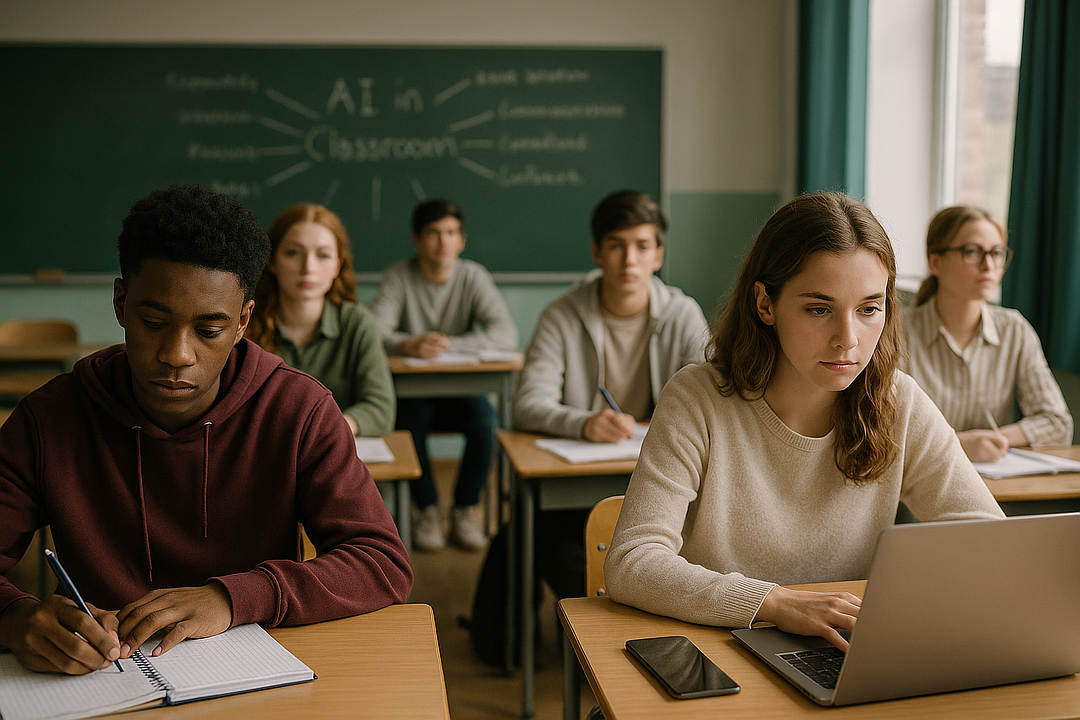
As artificial intelligence reshapes the way students learn, New Jersey educators are asking important questions: What will happen to fundamental skills like grammar and writing?
The rise of artificial intelligence in education is no longer a prediction, but a reality today. From ChatGPT to help with essay outlines to AI-powered tutors that provide instant feedback, schools across New Jersey are rapidly adopting new tools to stay ahead of the curve. But while these technologies promise personalized learning and increased efficiency, some educators warn that overreliance can undermine the fundamentals of communication.
“We’re seeing an incredible increase in AI-generated content,” said Laura Resnick, a Middlesex County high school English teacher. “But what I’m concerned about is: Are students still learning how to write well, or are they just learning how to prompt an algorithm?”
AI is coming to New Jersey classrooms
Starting in late 2023, several New Jersey school districts, from Hoboken to Cherry Hill, have launched pilot programs to integrate AI into lesson plans and student assessments. Some schools are experimenting with AI-generated quizzes, automated grading systems, and virtual instructional assistants.
In March, Gov. Phil Murphy’s office announced the creation of a task force to study the impact of AI on K-12 education. The group plans to release its recommendations this fall, but educators across the state aren’t waiting to hear their opinions.
“There’s potential here,” said Dr. Ravi Malhotra, an education policy expert at Rutgers University. “But we need guardrails. Without thoughtful integration, we risk short-circuiting critical thinking skills.”
Where does grammar fit into the AI equation?
One surprising sacrifice of AI-powered learning may be grammar. Now, with the advent of tools that provide instant corrections, sophisticated rewrites, and even audio generation scripts, some students are bypassing the learning process altogether.
“grammar rules still important“Knowing how to construct sentences, including understanding subject-verb agreement, proper punctuation, and parallel structure, is more than just an academic skill,” Resnick says. They are life skills. ”
She’s not the only one worried. A recent informal survey of language arts teachers in Bergen County found that 68% believe their students’ grammar skills have declined over the past two years. Many pointed to spell checkers and AI tools as factors.
“AI is like a writing calculator,” said a middle school teacher in Teaneck. “It’s convenient, but you can’t understand mathematics unless you’ve learned addition and subtraction by hand.”
Experts say grammar instruction needs to evolve, not disappear. Modern education needs to emphasize grammar as a tool for clarity and persuasion, rather than rote memorization, especially as students begin to create their own AI-assisted content.
the teacher walks a tightrope
The challenge for teachers is not just to keep up with new technology, but to strike the right balance. Many are choosing to teach AI literacy alongside traditional writing skills.
“We are not anti-AI,” said Megan Lopez, Union County curriculum coordinator. “But we want students to understand what AI can and cannot do. Bots can suggest synonyms, but they can’t teach tone, audience awareness, or the rhythm of good writing.”
To that end, some educators are incorporating grammar drills into their use of AI. Students can draft paragraphs using AI and manually revise them using specific grammar lessons. Some students are flipping the model, starting with student-written drafts and then using AI tools to compare and reflect.
Local responses to global change
The conversation in New Jersey mirrors the debate happening across the country. But the state’s diverse student population and high academic standards have shaped its unique regional response.
“We have an opportunity to take the lead here,” Dr. Malhotra said. “By building on human fundamentals like grammar and reasoning and approaching AI thoughtfully, we can create a generation that not only uses the technology, but also understands it.”
As school boards, parents, and policy makers continue to wrestle with what 21st century education should look like, one thing is clear: Grammar is not obsolete. In fact, it may be more important than ever.


