View AI as an organizational capability rather than a tool. Organizational readiness—not the technology itself—is the main barrier to AI delivering measurable near-term value in PLM.
We are in the midst of an unprecedented technological shift. While headlines and opinions surround artificial intelligence (AI), its true impact in industry lies in bridging gaps across product development and in fact, the entire product lifecycle. AI has the potential to unify the development, production and support of mechanical systems, electrical/electronic componentry, and the software and control systems that run them, as well as enable concept development, requirements management, simulation & analysis (S&A), and other product lifecycle disciples.
In addition, AI can bridge the critical gaps between in-house manufacturing and supply chains; and between CAD, S&A, PLM, ERP, homegrown BOM systems, MES, and other categories of engineering tools and enterprise systems; as well as enable the critical digital threads and digital twins they support. This holds true across multiple industries and their supply chains.
While the use of AI in PLM brings product design, engineering, manufacturing, and field service closer together, offering the potential for faster time-to-market and higher first-time quality, many questions remain. Workplace cultures are changing rapidly as AI is being used to shorten product development and other elements of the lifecycle by compressing decision-making timelines. This means knowledge workers need to adapt to new mindsets—moving from manual checks to making product decisions based on underlying insights that are rapidly emerging through the proper application of AI. Meanwhile, measurable ROI is still in the future for most companies, and many AI projects stall before reaching production.
And now that AI is being embedded in so many systems, operations, and products, its impact is likely to accelerate. What follows is a high-level look at what we at CIMdata expect from AI in PLM over the next six to 24 months. A follow-up article will delve into AI in PLM expectations for the next two to five years.
How AI is “seen” within PLM
There are several ways to organize AI capabilities, and it helps to know which one you’re looking at.
The first way to organize AI capabilities is by what the AI does (function). For years, “traditional” machine learning (ML) has been used for predictive maintenance, demand forecasting, and, closer to PLM, estimating the cost and schedule impact of an engineering change. Starting in late 2022, generative AI—most visibly large language models (LLMs)—expanded this scope by adding the ability to generate text, code, and images and to work with the unstructured documents that hold much of a company’s product knowledge. Generative AI did not replace predictive ML; the two coexist and complement one another.
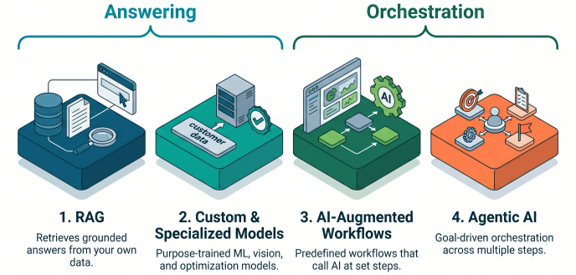
The second way of organizing these capabilities, by how AI is put to work, comes from my colleague, Dr. Diego Tamburini, Director, AI in PLM Practice and Executive Consultant at CIMdata. He groups them into four mechanisms, two that answer and two that orchestrate:
- Retrieval-Augmented Generation (RAG), which retrieves grounded answers from a company’s own data.
- Custom and specialized models, i.e., purpose-trained machine learning, vision, and optimization models.
- AI-augmented workflows, which call on AI at predefined steps.
- Agentic AI, which is goal-driven orchestration across multiple steps.
The two main views connect (i.e., answer and orchestrate). RAG is built on LLMs, most custom models are predictive, and orchestration mechanisms can call on either. Any of the four mechanisms can be bought, embedded in a provider’s software, or built in-house, and our recent study found that a hybrid of the two views is the most common.
Terms such as natural language processing (NLP), computer vision, and generative design come up often in this discussion, but they are not categories of AI in the same sense. NLP and computer vision describe the kind of data the AI works with, namely language and images. Today, most NLP uses LLMs, while computer vision for tasks such as visual inspection typically relies on purpose-trained models. Generative design, despite its name, is not generative AI. It generally uses optimization algorithms to explore design alternatives, and it predates LLMs by years.
Three AI in PLM observations
Observation 1: AI is a capability, not a tool.
AI is not a tool in the way your PLM solution or CAD system is. AI is a capability, and that difference matters. A tool changes what a task costs, whereas a capability changes how the work is organized around it. You install a tool. You reorganize around a capability.
Observation 2: In PLM, we are talking about augmented—not artificial—intelligence.
The distinction lies in how AI is used, not the technology itself. Augmentation merges human and machine intelligence to enhance human insight and decision-making, with people still accountable for the result, rather than trying to supersede human judgment.
Observation 3 (From Arthur Mensch, CEO of Mistral): Shift the focus from implementation to workflow
As Mensch compellingly frames it: “The question stops being ‘How do we add AI?’ and becomes ‘How do we want decisions made, work to flow, and people to engage when software can act?’”
AI in Action: current PLM adoption and market eality
Despite the attention on agentic AI, PLM users are doing less with AI than many of us think, as CIMdata’s 2026 study, AI in PLM: Adoption, Investment, and Readiness, reveals. As of early 2026, more than half the industrial users who participated (58%) were either researching and building AI awareness or running AI pilots, even though 85% use generative AI tools personally at least several times a week. Only 23% said they were operationalizing AI “in some areas” of their enterprises. In fact, only 13% of the users said they had scaled AI across multiple projects or integrated it into standard processes. And only 19% of them reported using or piloting any agentic AI.
Broader surveys show the same pattern. McKinsey’s 2025 State of AI survey found that 88% of organizations use AI, yet only about 6% attribute 5% or more of their EBIT to it. Boston Consulting Group found that only about 5% of companies capture value from AI at scale, and MIT’s Project NANDA, working from a smaller sample, reported that 95% of enterprise generative AI initiatives show no measurable return yet. The three surveys measure different things, but they point the same way: adoption is widespread, and value is still emerging.
As to the benefits of using AI, the industrial users in the CIMdata survey reported:
- Reduced manual / repetitive tasks: 41%
- Faster access to information: 36%
- Increased design innovation: 28%
- Reduced design cycle times: 26%
- Reduced development costs: 24%
At the same time, 31% had not yet realized any measurable benefit.
The study also reached 27 software providers—from established PLM providers to recent AI entrants—and 30 service providers, revealing how differently they see the world from users. None of the software providers expect their customers to prioritize innovation—zero—yet 36% of those same providers say their customers are realizing innovation-related value right now.
Users and service providers did agree on one thing, however. Both communities listed poor data quality at 60% as the leading obstacle—users as a barrier to adoption, service providers as a challenge in delivering implementations. Software providers, asked what holds their customers back, put data quality at just 37%. The survey also pointed to the users’ biggest issue with providers: over-promising and under-delivering, cited by 56%.
The standard AI story is speed and efficiency, and that’s what everyone’s planning for. But the discovery story—AI helping you find better designs—is real, users already rank it ahead of cost reduction, and almost nobody in the marketplace is telling it.
“AI tooling itself is not the main challenge,” notes my colleague Laurent Finck, CIMdata’s vice president for EMEA. “Once individual adoption is achieved, productivity gains begin to flatten because the existing operating model becomes a bottleneck. Handoffs, product prioritization, organizational structure, talent and governance cannot absorb the increased engineering velocity,” he pointed out, adding that, “human roles move from execution toward judgment and stewardship.”
AI Impacts On PLM’s Core Elements
In applying AI to digital twins, NVIDIA has released its Omniverse Blueprint for real-time computer-aided engineering digital twins, a reference workflow that software providers can build on. Its key AI element is a surrogate model—an AI model trained on results from conventional simulation solvers that can then predict results, such as airflow around a vehicle, fast enough for engineers to see the effect of a design change almost immediately. These predictions are approximations that still need to be checked against high-fidelity simulation, but they change how quickly engineers can explore alternatives. And digital twins are increasingly used to represent entire systems, processes, change histories, and production facilities—not just product models—spanning many applications, tools, and solution providers, which is accelerating the convergence of digital twins with digital threads.
Digital threads are being extended as AI exposes how fragmented their data is, and how that data changes, across mechanical, electrical, software, systems, manufacturing, service, and suppliers. As Aras Corporation notes, digital threads enhanced by AI now include requirements, architecture, testing, configuration, manufacturing plans, and field results, all connected by PLM. And digital-thread requirements for explainability, traceability, IP protection, and regulatory compliance are being used to qualify defense and automotive suppliers.
Digital transformationhas three levels of meaning here. One is digitization: digging all of an enterprise’s data and information out of departmental silos and formats (i.e., word-processing, CAD, BOMs, etc.) and into a form AI can use. AI can in turn help with this, for example by extracting structured data from legacy documents. On top of this, and as this is done, digital transformation impacts the entire enterprise—operations, organizations, and everything in between. Third, and ultimately most impactful, is the rapid extension of AI in the physical world of robotics in the factories and warehouses and then onto our roads and airways as “automated” vehicles and aircraft—themselves products developed and managed with PLM.
MBE—Model-Based Enterprise—is a paradigm shift from documents and drawings to models as the authoritative source for the creation, presentation, and exchange of all business information. In its many forms, AI is indispensable in extracting, consolidating, and converting all of an enterprise’s data and information into 1s and 0s that can be more quickly leveraged.
Governance is the other big divergence between users and providers. So that we’re on the same page, governance means accountability, oversight, and establishing “guardrails” to prevent mishaps (e.g., relying on AI beyond its current capability) about which we hear so much.
68% of the industrial respondents in our study cited IP protection and data confidentiality as a concern. Related issues were also cited: 46% listed output reliability and liability while 35% named transparency and explainability. But zero software providers listed governance among their top three challenges in developing and delivering AI. Again, zero. Zilch. Nada. The biggest concern of users is one the providers don’t yet see as a hard problem.
The implication should be obvious: Governance has to be owned by the PLM users. They cannot wait for a provider to hand over a framework. Users must set these bars themselves, decide who’s accountable for what, and make providers’ accommodations for governance a selection criterion when choosing the appropriate PLM solutions. Providers are not likely to solve this vital part of AI adoption for users.
AI in PLM disruptions
At least by implication, disruptions run all through the CIMdata study and the analyses we have presented. Two stand out:
• The hidden burden of poor data quality. AI is only as good as the underlying data. The fixes are many, costly, tedious, and time-consuming, and must not be ignored, though they can be scoped to the use cases a company starts with rather than to all of its data. If ignored, AI in PLM will only produce fast, confident, but wrong answers.
• Unprepared users and the need to enhance their skill sets or replace them. This creates a profound need for organizational change. The ways work has been done and results achieved will no longer suffice because AI in PLM generates evaluations and decisions faster than people can review them step by step. Oversight must shift from checking every step to setting the rules, monitoring exceptions, and owning the outcome.
As always, the causes and results of disruptions are intertwined as if they were somehow digitally wired together. CIMdata’s list of the most common reasons AI projects in product development stall—most of them are organizational, and avoidable:
Before committing to a project:
- The lack of a measurable success metric—cycle time, rework, hours saved, whatever. Name it before starting and base the ROI on it.
- Belated discovery of data shortcomings … the most common source of failure in AI projects and use. Examine whether the data is good enough, or even exists, before committing.
- Organizational unreadiness in (1) skills to build and run AI, and (2) actual adoption and use. Match the AI use case to your readiness; if skills fall short, buy rather than build, or use low-code tools.
As the project is delivered:
- Governance gaps, which should be uncovered during design phases and not in production; “gaps” include no decisions on accountability, on what the AI may decide autonomously, and where the data is “allowed” to go.
- Integration debt: AI working in a “sandbox” and never wired into the real workflow. Design for the actual workflow from the start.
- Lack of phase gates between pilot, go/no-go on evidence, and production; kill those that don’t clear, scale the ones that do.
AI in PLM rethink
It’s a foregone conclusion that readers—PLM users, solution providers, and service providers—are speculating about what AI-enabled PLM will look like in six to 24 months and planning how best to take advantage. Given how quickly AI is penetrating everything, what will be in PLM updates and new releases even six months out is speculative—let alone two years out.
Nevertheless, I offer some generalizations:
- New capabilities will burst forth from recent releases, which are innumerable and vary by PLM application, provider, and service firm. Suffice to say that AI will enable PLM users to tackle ever more complex products, analyses, and opportunities as they delve into increasingly convoluted environments.
- Opportunities will abound, arising quickly, even suddenly, but reaction time in product development may become paramount. Because product development itself has accelerated so much, new opportunities will have short life spans, placing developmental agility at a premium.
- Expectations will, of course, dangle off the ends of those new capabilities and opportunities and change rapidly. For PLM users in any capacity, career advancement will depend on how deftly expectations can be turned into competitive new offerings. And by “competitive,” I assume sufficient profit margins to generate a respectable ROI before a competitor makes the offering obsolete.
- AI is a capability, not a tool, so solving the problem at hand must take precedence. “How do we use AI?” is yesterday’s news.
- Adopting AI is a change in the operating model, not a tool installation. PLM users are being moved “above the loop”—setting the rules, watching for exceptions, and owning the outcome—organized into new teams and given new roles; data is made ready, and outputs are validated independently of whoever built the AI; security, privacy, regulatory concerns, and legal issues are raised earlier than ever.
- The market for AI in PLM is still in its early stages, and readiness is the main constraint to further adoption. Most industrial users are still researching or piloting; data quality and skills, not AI itself, are the brakes. A major gap is in governance and how to apply it.
- Business needs are driving AI adoption and they become production only with tight project discipline. Since most projects stall in the reality gap—the distance between what AI promises and the siloed data, single-system tools, and unfinished digital threads it has to work with—a funnel-like approach is recommended: business need, followed in order by AI fit, complexity and readiness, then ROI, and finally sourcing (buy or build).