For years, artificial intelligence (AI) has been growing behind the scenes in our lives. The first large-scale language models, which began as modifications to not-so-simple algorithms, could barely string together a few words, much like early visual systems that struggled to distinguish between street lamps and cats in digital images. More recently, AI has not only grown, but like Darwin’s finches in the Galapagos, it has penetrated almost every niche available in the digital world.
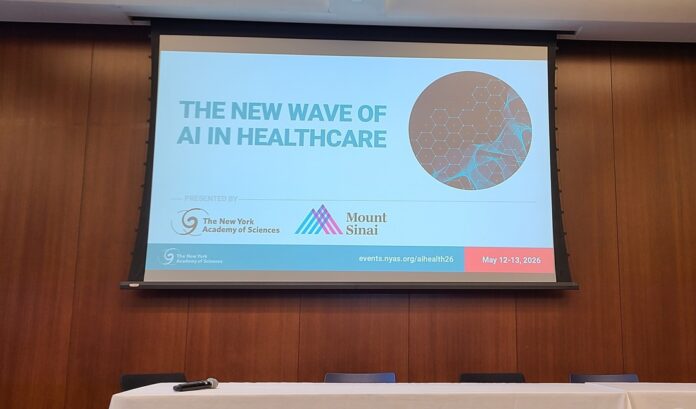
AI has permeated many people’s daily lives, both personally and professionally, and while modern healthcare has historically been reluctant to adapt to new technology, Raghav Mani, director of digital health at Nvidia, noted that the healthcare industry is adopting AI at three times the rate of other industries. Obviously, there’s a lot to discuss. That’s why the New York Academy of Sciences and the Windreich School of Artificial Intelligence and Human Health at the Icahn School of Medicine at Mount Sinai co-sponsored the third conference.rd The annual “New Wave of AI in Healthcare” is a two-day symposium on May 12th and 13th aimed at starting a dialogue among researchers, clinicians, industry leaders, and other stakeholders on all topics related to AI and healthcare.
Day 1
The first day began with lightning welcome remarks from organizers who expressed their personal experiences with AI in healthcare research and practice. While some, such as Dr. Nicholas Dirks, president and CEO of the New York Academy of Sciences, shared concerns about how to maintain human involvement in AI applications, he expressed awe, saying, “The pace of progress is breathtaking.”
Others have done more practical evaluations. Lisa Stamp, chief digital information officer at Mount Sinai Health System, asserted, “The future is not something we enter into, it’s something we create.” Similarly, Mount Sinai Health System CEO Brendan G. Carr, M.D., described AI as a “new partner” that helps clinicians integrate growing volumes of clinical data. Girish N. Nadkarni, M.D., a nephrologist and clinician at the Icahn School of Medicine at Mount Sinai, summed up the entire event before the first lecture began. “The real question is not whether AI will transform healthcare, but how.”
The keynote speech leading the discussion on the first day attempted to answer that very question. In a talk titled “Harnessing the Power of Platform Thinking to Transform Healthcare,” Dr. John Halamka, president of Mayo Clinic Platforms, spent 30 minutes exploring the power of data, questioning how AI can and should be used to analyze the variety of data currently available, but cautioned that this is no easy task given the sources of the data and the potential limitations of its use. He talked about practical applications of AI data analysis, including in the field of drug discovery. He also pointed out that AI has the potential to fill the shortage of healthcare workers.
The day continued with four talks exploring different aspects of the use of AI models in healthcare. Dr. Marina Sirota, a professor at the University of California, San Francisco, spoke about how clinical data can be used for predictive medicine. Mani and other participants, including Dr. Jonathan Carlson, vice president and managing director of Microsoft Heath Futures, discussed how AI agents and models can be used not only as data analysis engines but also as part of hospital and clinician toolkits at multiple levels to help synthesize patient data and diagnostic support. Concluding the discussion, Azra Bihorak, MD, senior associate dean for research at the University of Florida, explained how AI models need to be validated like any other tool. She also noted that while AI’s ability to assess problems and suggest the next best course of action is continually improving, human input is essential for successful collaboration.
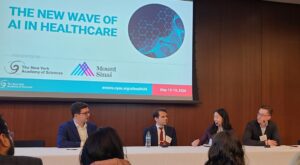
The final talk of the first day focused on how AI can be used directly in patient care situations. Following individual talks on how to integrate AI into electronic health records (EHRs), combine models to develop new insights, or rethink diagnostic capabilities to improve diagnostic equity, the final three speakers led a dynamic and sometimes heated panel discussion. Epic physician Karen Wong, MD, AstraZeneca Director of AI Digital Precision Health, Alexander Fedotov, MD, and Pierre Elias, MD, Assistant Professor at Columbia University Irving Medical Center, shared their thoughts on how AI will be used in the near future. While all agreed that AI cannot replace clinicians, they also recognized that AI will be a disruptive force. However, the onus is on clinicians to use technology appropriately, but they should rely on their intuition and judgment as trained professionals. When expressing his opinion on the future of AI use in healthcare in five years, Fedotov said, “I still want to see humans in control of all decision-making processes.”
2nd day
While the first day laid the foundation for the use of AI in the medical field from the bench to the bedside, the second day of the symposium featured further discussion and critique of AI at the logistic level.
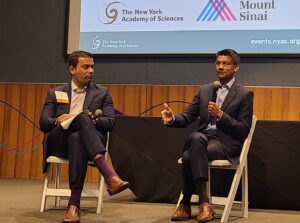
The day began with a keynote address by Mr. Nadkarni and Dr. Dave A. Choksi, a physician and professor at the City University of New York and former New York City Health Commissioner. He spoke about his leadership experiences and shared many anecdotes from his time working as a public health advocate and communicator during the COVID-19 pandemic. In response to a question about the importance of communication given the current state of health care and declining public trust, Choksi noted that “human relationships are more important than we know,” especially as the increasing use of AI can further layer feelings of abandonment, surveillance, and dehumanization. He emphasized that his job as a clinician is to build trust with patients and ensure they return for treatment. While he expects AI to transform healthcare in the coming years, he cautioned that it will be important to listen to and integrate feedback from frontline users, clinical staff, and patients.
The morning continued with talks exploring the use of AI in research and learning in healthcare. Joshua C. Denny, MD, CEO of NIH All of Us Research, presented a detailed overview of progress and research. all of us project. Despite recent funding concerns and funding cuts, the scope of the project remains on track, with researchers around the world taking advantage of the data obtained from this project and the way project leaders are working to establish parameters and modules to make it easier for researchers to implement AI in data analysis. Next, Dr. Andrew Gruen, Standards Lead at MLCommons, spoke vividly about the importance of establishing standards and benchmarks for the use of AI in researchers and healthcare settings. He spoke openly about the need for external evaluation and validation of AI models, not just training AI.
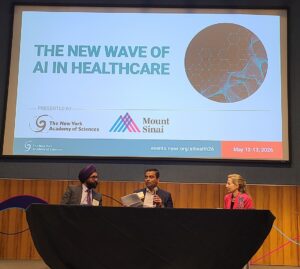
The symposium ended with several discussions on the interaction between AI and humans, with a view to using AI on a broader scale than just as a tool. Karandeep Singh, MD, executive director of health innovation at the University of California, San Diego, noted that while considering the variety of clinician and patient opinions on the use of AI, the use of AI in medical settings should be carefully considered before implantation. Meanwhile, Dr. Valdit Lavitsky, president and CEO of the Hastings Center for Bioethics, discussed the ethics behind the use of AI in patient-facing environments, particularly as chatbots used by patients. In a discussion after each presentation, the two delved into the risks associated with the use of AI, both in patient-side chatbots and in scribe technology used by clinicians and patients. Although they agreed in many cases about the need for transparency in AI use, disagreements arose on specific AI applications, such as the use of AI robots in the home to combat loneliness among older adults.
The final lecture by Dr. Tanzeem Chaudhry, Director of Health Innovation at Cornell Tech, summarized many of the topics previously discussed. Her research investigates how AI can be used in mental health treatment and explains how it can be used in various aspects of mental health treatment, from recording physiological symptoms with wearables to using chatbots for various functions. While these tools may ultimately be transformative, she cautioned that the current state of AI use in mental health is still growing.
Closing remarks by Alexander Charney, MD, PhD, professor at the Icahn School of Medicine at Mount Sinai, summed up the event well. He said that through the symposium, he imagined how clinicians and researchers 100 years ago and 100 years from now will think about the current state of medicine and the challenges they currently face in how to implement AI. “We are not the first human group to take on powerful technology and figure out how to use it to change society,” he said. He hopes that those of the past will see that we understand and respect the past, and are rigorous in our research and testing, and that those of the future will look with pride at our fearless tenacity in the face of new technologies. He hopes both groups understand that we “tried to do the right thing.” He concluded by saying that all of that can be seen here, along with the passion and unity of everyone participating in the conference.