
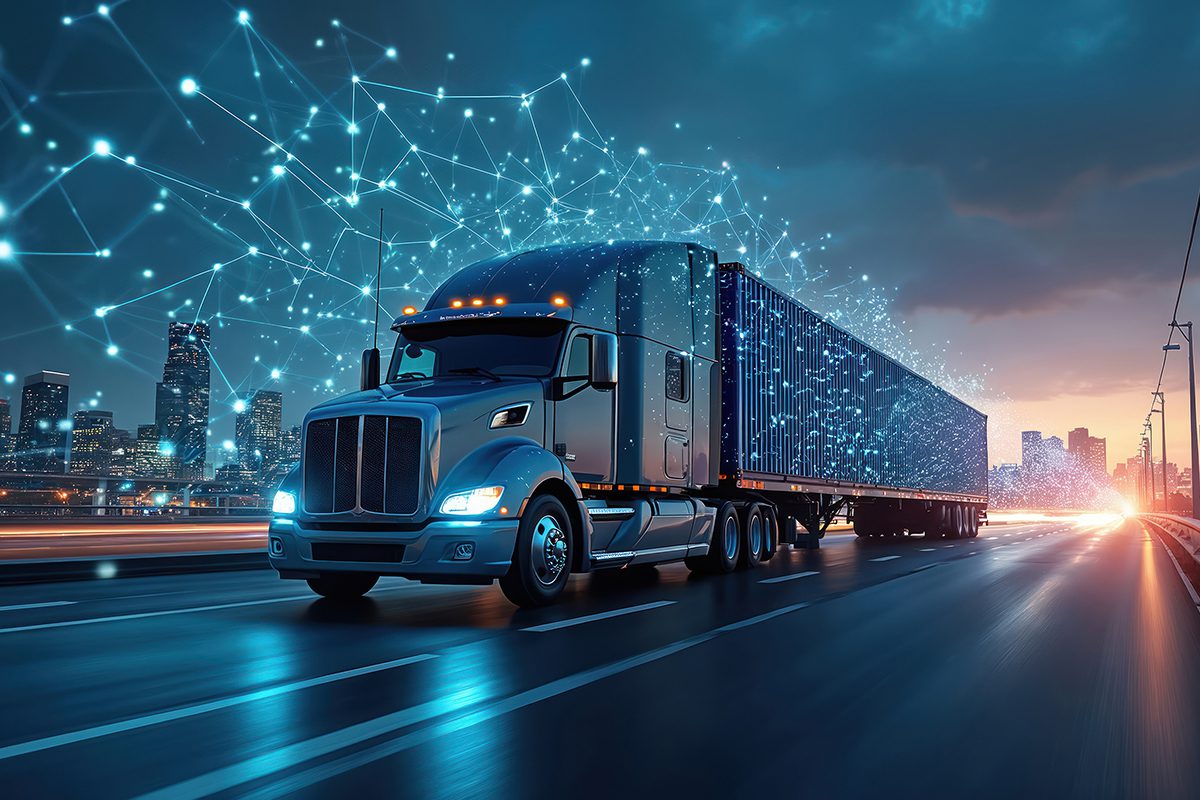
Artificial intelligence is entering an exponential stage of development, and its impact will soon reach every major industry, including commercial transportation.
Although many fleets still consider AI to be an emerging technology, the foundations for large-scale digital transformation are already in place. Vehicles are becoming increasingly digital, AI models are rapidly improving, and autonomous systems are beginning to operate in real-world environments.
Earlier this year, several articles written by leaders deeply embedded in the artificial intelligence (AI) ecosystem dominated headlines and started moving markets. Taken together, they all showed the same conclusion. Advances in AI are accelerating faster than most industries realize, and the economic impact could be felt much sooner than expected.
One of the most widely read articles was by Matt Schumer. “something big is happening” The piece quickly went viral and has now been read by more than 50 million people.
While Shumer’s article isn’t specifically focused on transportation, it does provide an important perspective on what’s happening across the broader AI landscape. His core message is AI has entered a phase of rapid and exponential progressModern systems already perform complex knowledge tasks such as coding, analysis, writing, and decision-making at levels that approach or exceed that of many humans.
He warns that this progress could cause powerful feedback loops. AI system to build a better AI systemdramatically accelerating the pace of innovation. If this happens, disruption will ripple through large parts of the global economy in just a few years.
Schumer points out that breakthroughs are happening in a small number of labs before being made available to the public, and that AI has already crossed critical thresholds and is advancing faster than most people realize. He believes many industries underestimated how quickly the real-world impact would be felt, just as the world was blindsided by the sudden outbreak of COVID-19 from December 2019 to March 2020.
His warning is simple. We are in the early warning stages of major technological change, and those who start learning and adapting now will be in a much better position than those who ignore the signals.
Schumer’s message echoes several other influential AI essays published or redistributed in recent months.
- In January, Anthropic co-founder Dario Amodei “adolescence of technology,” claim it We may soon have AI systems powerful enough to reshape society, but our organizations and governance structures are not yet ready to manage them responsibly..
- Published by Citrini Research in February “The global information crisis of 2028,” Hypothetical story to explain A near-future world reshaped by powerful AI systems that will begin to transform industries and cause economic shocks starting in 2026..
- At the same time, Leopold Aschenbrenner’s June 2024 essay was widely discussed. “Situational awareness: the next 10 years,” It began to be recirculated again throughout the tech community. his theory is artificial General intelligence (AGI) — AI systems that can perform most cognitive tasks at or above the human level — It could arrive within the next few years.
Although each piece approaches the subject differently, they share a common theme. Advances in AI are accelerating rapidly, and the resulting economic disruption may arrive much sooner than most industries expect.
Looking back from these two articles, we see that recent developments across the AI ecosystem further strengthen this story.
- New models from OpenAI, Google, and Anthropic continue to show dramatic improvements in inference, coding, and analytical capabilities. Many observers believe we are approaching the next moment. AI systems will match or exceed human performance across a wide range of tasks.
- The main constraint to achieving these capabilities is no longer imagination, but computing power. However, companies such as Microsoft, Amazon, and Alphabet; We are investing hundreds of billions of dollars in AI data centers and computing infrastructure to power next-generation models.
- meanwhile, AI is already moving from an interesting tool to a real productivity engine within many organizations. And the real-world employment implications are beginning to be recognized.
- Demonstration experiments of humanoid robotics and self-driving cars using AI are being conducted Ability to not only match human performance in physical tasks, but superior in many ways.
These developments may seem far removed from commercial transportation, but they are: The fundamental elements of rapid digital transformation are already in place.
- Modern commercial vehicles are essentially rotating data centers — Highly connected, monitored and digitally controlled machines. Dozens of electronic control units (ECUs) generate a continuous stream of operational data that can be captured, processed, and analyzed in real time. These capabilities will be further enhanced towards the realization of a fully software-defined vehicle.
- Increasingly sophisticated AI models are now able to ingest these vast datasets. Generate operational insights, recommendations, and automated decisions. In parallel, data centers are being ramped up at a breakneck pace, and AI capabilities are accelerating exponentially.
- self-driving car AI-powered systems are already in operation Commercial Miles is located in several regions and its geographic footprint continues to expand.
Considered individually, many of these advances may still feel incremental or not directly tied to commercial transportation applications. Many fleets have begun testing AI in pilot programs, demonstrations, or limited deployments. This makes it easy to think that large-scale change is still years away, or to be quick to dismiss the impact of AI as more hype than reality (with an eye roll, of course). but, In the context of widespread acceleration and advancement through AI, these technologies The early stages of a much larger digital transformation.
Fleets that have already begun experimenting with AI-powered tools are seeing measurable benefits in areas such as reliability, efficiency, uptime, safety, and cost savings, resulting in increased competitiveness and improved market position. They gain productivity, intelligence, and operational insights that others never have.
As AI models become more powerful every few months, the competitive advantage that early adopters of this digital technology gain will further deteriorate. And as the transition to software-defined vehicles continues, the ability to leverage the vast data streams generated by commercial vehicles will only accelerate.
Companies that recognize these signals and start rolling up their sleeves to learn, demonstrate, and deploy will be best positioned to lead in the next era of transportation. Those who don’t, on the other hand, risk being left behind. As history has proven, digital transformation and change can happen quickly – just add Kodak, Blockbuster, Nokia, and AOL.
If the past few months have shown us anything, it’s that Something big is really happening.
Now is the time for fleets, technology providers, and industry leaders to start understanding how AI is beginning to reshape the commercial transportation landscape. The digitalization, deployment, and real-world use of AI will continue to accelerate, and disruption will arrive with speed and without bias.
Are you ready for the next wave of technological disruption? Anyone who wants to be a successful leader will need to do so.
You can see my recent article here: Buckle Up. The digital revolution has arrived in commercial transportation.


