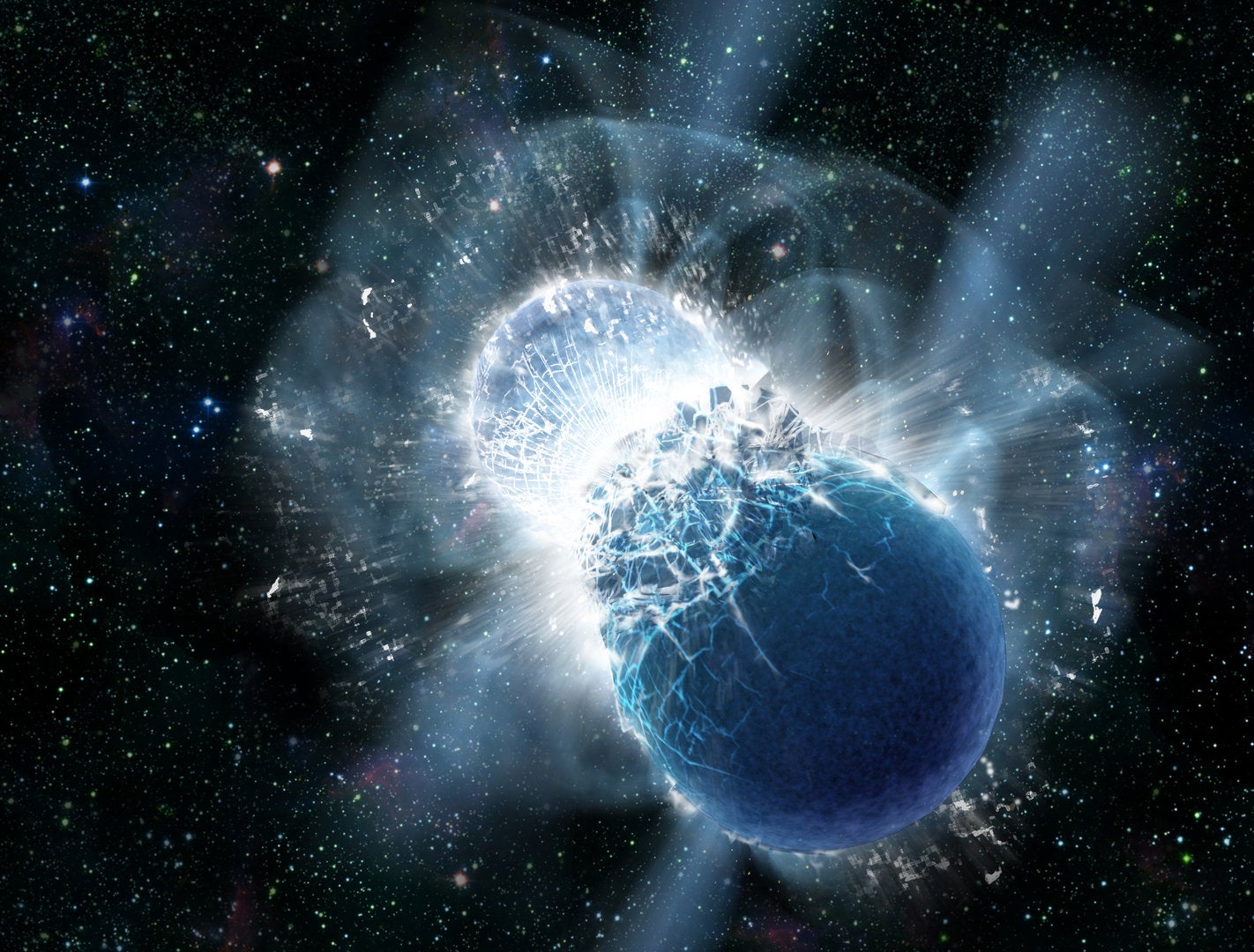
Some of the heaviest elements in the universe are created in chaotic conditions when material is thrown outward when neutron stars collide or massive stars explode. But one stubborn problem limits how well scientists can model these phenomena. That means the heat released when a new element is formed is difficult to calculate in detail, and ignoring it can skew the results.
A team led by GSI/FAIR researchers says they have now found a way around that bottleneck. Using a deep learning system called RHINE, the group built a machine learning model that can estimate the energy released during fast neutron capture nucleosynthesis, better known as the r-process, while running fluid dynamics simulations.
This is important because heat is not just a bookkeeping detail. The speed at which matter moves, its spread in space, and the brightness of the aftermath can change. When neutron stars merge, the aftermath appears as kilonovae, short bursts of electromagnetic light produced by the newly created heavy elements.
“Researchers around the world are trying to understand these complex reactions through theoretical simulations. However, modeling all the parameters requires incredible computational power, so models often need to be simplified,” said Dr. Oliver Just, first author of the study and researcher in GSI/FAIR’s Astronuclear Physics and Structures Division. “Our new model RHINE, using artificial intelligence, provides an efficient alternative.”
Take shortcuts to very complex calculations
The r process is one of nature’s main ways of building heavy atomic nuclei. In these extreme environments, free neutrons are captured by existing atomic nuclei and converted into protons, allowing larger and heavier nuclei to form.
Accurately capturing that process is difficult because it means tracking the behavior of thousands of isotopes at once. In a complete calculation of a nuclear network, each isotope adds another equation, so costs can quickly become prohibitive, especially for multidimensional simulations of intense astrophysical phenomena.
A new approach significantly reduces that burden. Rather than directly tracking thousands of species, RHINE tracks a much smaller set of quantities, including free neutrons, protons, alpha particles, the mass fraction of heavy nuclei, the average mass number of heavy nuclei, and the average mass excess per baryon. A neural network trained with detailed nuclear network calculations estimates the source terms needed to evolve their quantities during the simulation.
“First, the ML model is trained using a large number of reference calculations generated on the full set of nuclear reactions. The model is then employed to perform fluid dynamics simulations to approximate the heating rate during the r process with minimal effort,” said Dr. Zewei Xiong, a GSI/FAIR scientist who helped design the machine learning model.
The researchers describe this as the first use of machine learning to approximate nuclear reaction rates within a multidimensional fluid dynamics simulation of this kind.
Why Lost Heat Changes Things
The team focused on post-processing, a long-recognized problem in merger modeling. Many simulations first calculate the fluid motion and then add detailed nuclear reactions along the extracted trajectories. This saves time, but also means the fluid doesn’t “feel” extra heat while moving.
Research shows that this can be very important, especially for slow ejecta. r Several MeV of heat can be released per baryon during the process. If matter is already moving very fast, its energy will only give a small increase. However, slow materials can change dramatically.
In one series of wind tests, about 3 MeV per baryon had little effect on an outflow already traveling at 0.3 times the speed of light. In contrast, a similar heat input nearly tripled the material’s final velocity, which would otherwise reach just 0.03 times the speed of light. This pattern follows basic conservation of energy, with slower ejecta being more likely to accelerate.
The group validated RHINE against complete nuclear network post-processing in both an idealized spherical wind model and a long-term neutron star merger simulation. In most cases, the net heating energy agreed within about 10%, but the proportion of energy lost to beta-decay neutrinos was more difficult to predict precisely.
The paper points out that this uncertainty is not very important for the overall dynamics, as neutrino losses account for a relatively small portion of the total energy budget.
The strongest effects appear on the slowest ejecta
In the merger simulations, the most obvious changes appeared in the late BH torus ejecta, material ejected later from the black hole, and the surrounding torus left behind after the merger. This material gained an average of about 2.1 MeV per baryon upon r-process heating, and its average velocity increased by about 40%.
The mass of its ejected components also increased. In the model without RHINE, the mass of the BH torus ejecta was 4.929 × 10^-2 solar masses. line, it rose to 6,000 × 10^-2 solar masses.
Faster dynamic ejectors behave differently. They gained slightly more heating energy (about 2.3 MeV per baryon), but their average velocity changed only slightly because they were already moving much faster. The NS-torus ejecta had a higher average electron fraction, about 0.7 MeV per baryon, underwent less heating, and exhibited smaller dynamical changes.
The simulations also suggest that the heating of the r process smooths out the ejecta, making the slow-velocity material more spherical. Still, this effect was not strong enough to make the high-velocity ejecta nearly spherical, leaving open questions about the shape inferred from early observations of the kilonova associated with GW170817.
For elemental yields, changes were indeed seen, but not across the board. Although the overall abundance pattern remained approximately the same, in some cases individual nuclei could change several times. A larger effect appeared on the predicted kilonova signal. The study found that including r-process heating could significantly brighten kilonovae, by about twice as much. This is mainly because the mass of the slow BH torus ejecta becomes larger and faster.
Tools for future merger physics
The authors argue that RHINE is useful not because it upends the overall picture of neutron star mergers, but because it allows refinement of the details without the enormous computational cost of embedding complete nuclear networks everywhere in the simulation. This scheme is self-contained and designed to avoid redundant tracer particle mechanisms and add only a small computational load.
The code is publicly available and part of the project was co-funded by the European Research Council. The researchers say the method could eventually help link future experiments at FAIR with observations of star explosions and neutron star mergers.
We also frame RHINE as a broader proof of concept. If machine learning can replace parts of nuclear reaction networks without losing important physics, similar techniques could be used for other computationally difficult components of astrophysical simulations.
Practical implications of the research
This study provides astrophysicists with a more practical way to incorporate r-process heating into merger simulations. Without this, it would be too expensive to run in full detail.
This should improve predictions of ejecta velocity, mass distribution, shape, and kilonova brightness, especially for slow outflows where heating is most important.
In the long term, tools like RHINE could help strengthen the link between nuclear physics experiments, merger theory, and telescopic observations by making more realistic simulations routinely possible.