
Written by Katherine Pepinster
Artificial intelligence is fast, processes calculations, analyzes information, and is fascinating. Although it transforms much of human behavior, it ultimately does not replace the wisdom that humans bring to thought.
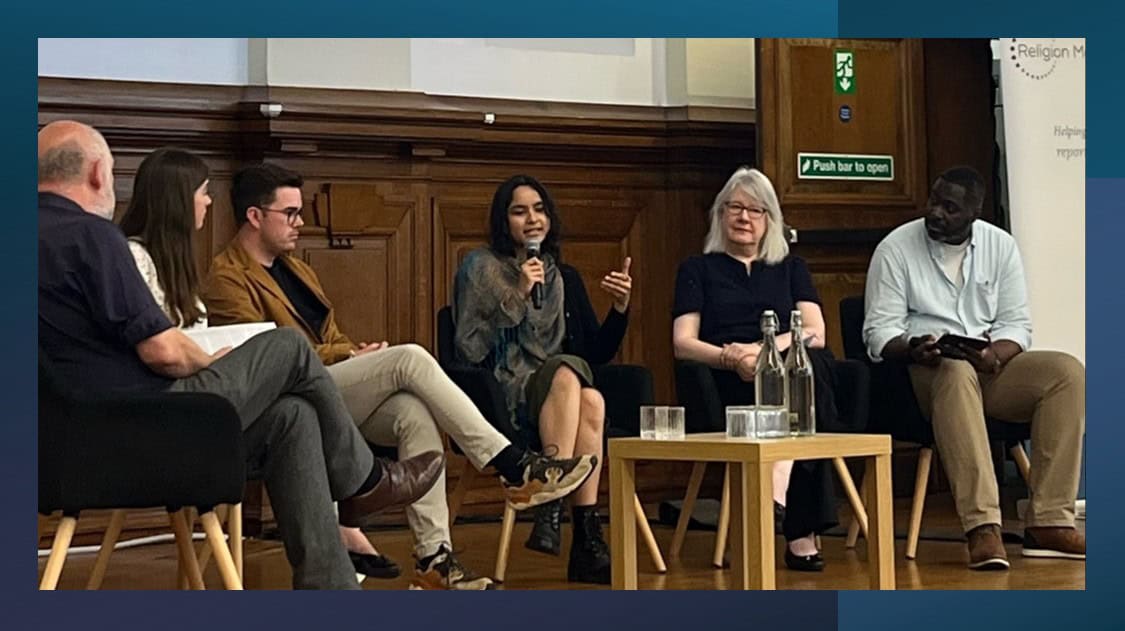
That was the conclusion of a roundtable discussion on AI at the Religious Media Center Festival on Monday.
The panel, chaired by Reverend Pete Phillips, leader of Cliff College’s Center for Digital Theology, explored what’s good about artificial intelligence. While most of the panel believes that AI has significant advantages in solving problems and completing tasks quickly, they also see drawbacks. They believed that AI was not that good, but only conditionally good.
The profound impact of AI on all parts of life, including work, leisure, home life and healthcare, has long been predicted, but Dr. Phillips’ questions to the panel showed that this impact is being felt now and is no longer in the future. Bernard Achampong, founder of Unedited and chairman of Audio UK, said: “Everyone who uses a smartphone is using AI in some way.”
Ashley Singh, a software developer who has worked on Catholic AI, a platform designed to integrate Catholic texts, resources and teachings, explained that AI mimics the way the human brain works.
She explained how AI systems are fed enough data to understand the grammar and sentence structure of a language. The amount of data provided to refine that “thinking” has increased. Large-scale language models (LLMs) are an advanced form of artificial intelligence that can not only read and understand, but also generate human-like text. This is the kind of system that powers bots like ChatGPT and Claude.
Religious groups are beginning to focus on AI and its impact on the human condition. In February 2024, the General Assembly of the Church of England recognized the huge impact that AI will have, particularly in the world of work, calling it a new industrial revolution.
In May of this year, Pope Leo Days later, his warning was backed up by Archbishop of Canterbury Sarah Mulally in the House of Lords, who said society was at risk of unleashing AI “without the theological, philosophical or spiritual framework within which to make decisions to create, manage, use or direct”.
Several members of the RMC panel, including Marina Adami, a digital journalist at the Reuters Institute for Journalism at the University of Oxford, said they use such systems to save time.
“I like to use it for tasks that I otherwise find a bit boring and a waste of time, so I use it a lot for transcription, as many journalists do,” she said.
The Reverend Kathryn Pritchard, adviser to the Church of England’s faith and public life team, praised the usefulness of AI in supporting research. But she and other members of the panel also expressed concerns about AI’s shortcomings.
Acheampong likened it to McDonald’s influence on food. “We all know McDonald’s isn’t the most nutritious. I guess McDonald’s has some interesting practices in terms of keeping the world going, but when it’s 10 o’clock and you need something to eat, that’s all you need,” he says. “The commoditization of AI is here. The sources are good and the technology has great potential, but how to distribute it is the challenge.”
Dr Pritchard warned that chatbots like ChatGPT tend to be programmed to ask what they want to hear and smooth out nuances. She said you have to learn to give more pointed prompts and make them understand that you are the creator and that you are not co-creating ideas with the creator.
Acheampong warned about the impact of AI on employment, saying that while AI may not be 100 percent accurate, it is accurate enough and can perform tasks that humans have done well, which could lead to job losses.
Another panelist, Dr Samuel Tranter, Macdonald Postdoctoral Fellow in Christian Ethics at the University of Oxford, warned that AI could have a negative impact on the way we think.
He explained that he was cautious about the positive aspects of AI. “It is one thing to seek immediate moral or spiritual advice, because the accumulation of knowledge gained through artificial intelligence may replace the wisdom gained through slower, more contemplative thinking and research, or through the interpersonal friction that actually sustains a good life.”
“It’s another thing to talk to someone who has a different inner world, personal history, worldview, and spirituality.”
Dr. Pritchard also wanted to analyze the impact of AI through wisdom, health, and happiness. Any type of technology, she said, must support the interests of society and provide information to society. As an example, he cited the benefits of AI in healthcare, which can process data, speed up screening, and provide rapid diagnosis. But before training an AI, it first involves a lot of slow and painstaking work by humans, who spend time deciding what data to collect, checking quality, ensuring integrity, and validating the data.
AI is not a shortcut, she says. “AI is great when it’s embedded in good practices. I would contrast that with rushing ahead or releasing AI to the public prematurely when you don’t know what’s going to happen when there are so many unexpected things.”
Dr. Tranter was similarly cautious, warning that people are ascribing qualities to AI that don’t necessarily exist, such as consciousness, empathy, and personality. He suggested that atheists who have traditionally thought of the world in materialistic terms may find something mystical about algorithms.
“But in reality,” he added, “if you are a person of faith, the world is already strange and beautiful and mysterious. There is already depth to humans and non-human creatures in creation, and in fact we are just discovering how strange the world of non-human creatures is.”


