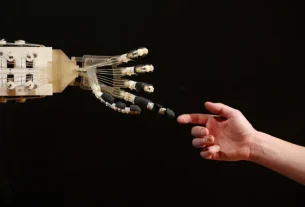
AI is the biggest buzzword these days (Courtesy of ChatGPT). And what do you think? AI is now helping scientists discover planets in space. A recent study by a team of researchers at the University of Georgia confirms evidence of the existence of a new planet outside our solar system, identified by machine learning, a branch of artificial intelligence. This groundbreaking achievement marks the first milestone in the practical application of AI to discover unknown exoplanets.
According to the study, exoplanets can be identified simply by examining protoplanetary disks, the gas around newly formed stars. The research team used conventional techniques to confirm the planets, but the AI model helped run the simulations and showed exactly where the planets could be. How does it work?
The study’s lead author, Jason Terry, suggests that the model indicated the possible existence of planets, as evidenced by images that highlight specific regions within the disk. This region showed the signature signature of the planet: a pronounced change in the surrounding gas velocities.
The Importance of AI in Exoplanet Discovery
The recent discovery of exoplanets with the help of AI suggests that machine learning has the power to delve even deeper into the vast realm of space exploration. In this case, the model successfully identified the signal in the data already analyzed. This means that you may be able to discover things that were previously undetected.
“This demonstrates the ability of our models, and machine learning in general, to quickly and accurately identify important information that people often miss,” Terry said. The authors added that they would be surprised to learn that the entire analysis took almost an hour to analyze the entire catalog and find evidence of an exoplanet at a particular location.
How do conventional methods work for identifying exoplanets?
Over the decades, several prominent telescopes and satellites have identified exoplanets, including the Kepler Space Telescope, the Hubble Space Telescope, the CoRoT satellites, the Transiting Exoplanet Survey Satellite (TESS), and NASA’s Spitzer Space Telescope. has been useful for
These techniques include radial velocity analysis, which measures the Doppler shift of the host star. Gravitational microlensing, on the other hand, is useful when massive objects cause distortions in the optical path, causing gravitational lensing effects that affect the brightness of stars.