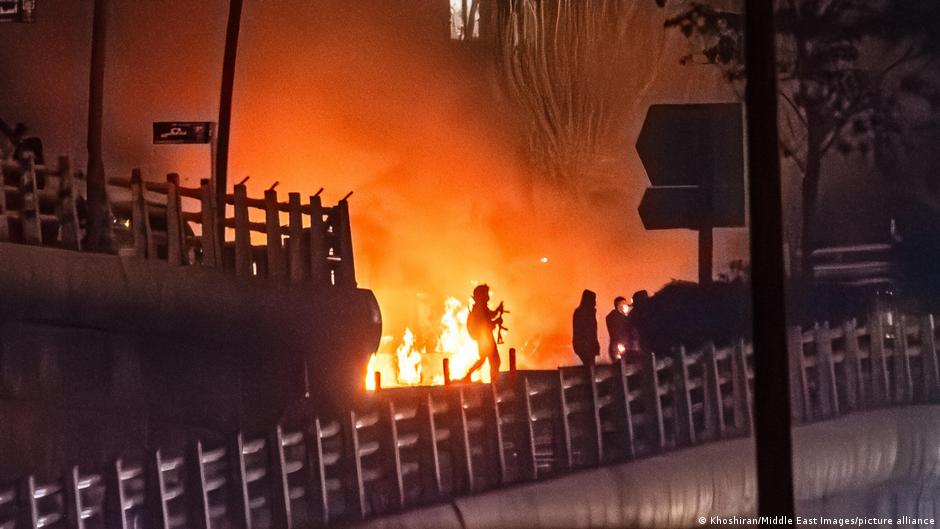
Anti-regime protests have been ongoing in Iran for more than two weeks, with demonstrations reported in several cities and towns. Verifying content related to protests is becoming increasingly difficult. Internet restrictions and strict controls on the flow of information have created an information vacuum, and much of the footage circulating online cannot be independently verified.
Access to reliable information from within Iran remains extremely limited. Foreign media are largely unable to report from within the country, and citizens documenting the protests face serious risks. US-based Human Rights Activist News Agency Reports on Wednesday said at least 2,400 people had been killed in a bloody security crackdown during the latest wave of protests, but some rights groups say the number is much higher.
Experts say this lack of access is not new and is part of a long-standing strategy by the Iranian regime. Sarah Bazoubandi, a senior research fellow and part-time researcher at Germany’s Kiel University Institute for Security Policy, explains that internet shutdowns are a deliberate tactic to sow suspicion when people are unable to share information.
“And we end up confused as to who is telling the truth,” Bazubandi tells DW.
Authorities imposed a near-total suspension of internet and telephone services. International calls were only possible intermittently after several days of disruption. These constraints determine which images and videos reach national and international audiences, opening the door for disinformation and misinformation.
DW Factcheck investigated several examples.
AI-generated video fills in the blanks
Claim: videos circulating Online footage shows large groups of people marching at night with flashing cell phone lights, said to be part of ongoing protests in Iran. The caption reads: “The government cut off the street lights to hide the large group of protesters, but everyone used their cell phone lights to show that the protesters were there.” This video has been viewed over 750,000 times. othersshared Similar claims are widely made.
DW Fact Check: fake
Visual indicators such as a bird’s eye view, lack of visible faces, and patterned flashlights are consistent with the AI-generated images. Later in the video, the hand and cell phone appear unnaturally distorted.
User who posted the videoInstagram claimed it was created using AI tools and confirmed it was not real and was “inspired” by the protests in Iran. This post has been viewed over 60 million times. However, many of the people who downloaded and reshared the videos could not be labeled as AI-generated.
Indeed, other videos are circulating on the internet that claim to have been shot during the Iranian protests, but they are difficult to verify due to communications failures. “This is a complete shutdown,” said Farhad Sousanchi, editor-in-chief of Factname, a Canadian-run fact-checking platform that verifies claims related to Iran. “It’s very difficult to verify specific videos that are out there because you have to cross-match them and cross-reference them.”
Due to a lack of authentic material, old footage is often presented as new, a common pattern during crises.
Repurposed footage from Nepal presented as Iranian protest
Claim: video It shows a man tearing down a flag from a building and is being shared as part of the current protests in Iran. “Protesters, brave patriots of Iran, occupied the headquarters of the Revolutionary Guards and brought down the flag of the republic,” the user wrote on X in Spanish.
DW Fact Check: error
A reverse image search reveals that the footage is old. sharedIt is set against the backdrop of the protests that took place in Nepal in September 2025. The people in the video are wearing summer clothes, and old captions indicate the location is the Nepal Communist Party headquarters. The video has resurfaced amid renewed unrest in Iran and shows how old footage is being misrepresented at a time when new material is lacking.
Visual imbalance of verification and defense of the regime
While footage of anti-regime demonstrations is often difficult to verify, images and videos of pro-regime rallies are easier to authenticate. Many of these rallies were held openly, sometimes with the presence of security personnel, and coverage was shared by Iranian state media and international photo agencies.
However, these images and videos of pro-regime demonstrations do not reveal how these rallies are organized.
“These are government-arranged rallies, government-sanctioned rallies, fully protected, people are provided with placards and everything. There is even transportation for them,” he said, claiming that the rallies were highly publicized.
Separately, social media has also posted pro-regime videos that distort reality.
AI-generated pro-regime video
Claim: Videos circulating online show large crowds holding large Iranian flags and are being broadcast in multiple languages, including Hindi, as a pro-government demonstration. and arabic.
DW Fact Check: fake
DW analysis confirms that the video was digitally generated. Many of the faces are indistinct, and at one point it looks like a person has emerged from the flag itself. This footage uses a wide-angle view to exaggerate the scale. This is a common characteristic of AI-generated videos.
This example shows that synthetic content can appear on both sides of a protest narrative.
A government well-versed in disinformation
Iran has faced similar protests before, and experts say the regime is well versed in disinformation and manipulation strategies.
But Sousanchi said the Iranian regime was surprisingly silent at the beginning of the recent protests. He said there seemed to be “some confusion” and “a lack of strategy” among authorities.
Bazoubandi agreed, saying that some of the methods used by the administration in this particular episode were highly flawed and “in my opinion, chosen in a hurry.”
Kathrin Wesolowski contributed to this report.
Editing: Uta Steinwehr, Rachel Baig