

The Game Developers Conference (GDC) Festival of Games concluded in San Francisco on Saturday after bringing together all facets of the international games industry for five days of learning, networking and inspiration.
The week-long showcase attracted approximately 30,000 game developers, designers, and executives. One of the big topics is whether artificial intelligence (AI) in gaming will be friend or foe.
In You vs. Zombies, developed by Welsh generative AI game studio 10six Games, the AI takes into account every human-designed detail, from spell types and artwork to tone of voice, to personalize the game on each runthrough.
“It’s a ‘Joshua Tree’ chosen by the AI. The AI chooses where to place it. The AI chooses one of the 3D environments to place it in, then one of the objectives and creates dialogue to tell the story,” said Susan Cummings, CEO of 10six Games.
As a result, she said, the stories created with each run are never the same again.
For other game makers, this technology is helping to improve the efficiency of long-standing practices in 3D motion rendering. MoreFun Studios, a subsidiary of Tencent Games, uses AI to capture Kung Fu moves at the cutting edge.
Game makers once required large studios with 100 or more cameras to film models equipped with motion capture sensors. Tencent’s technology currently requires no sensors, instead requiring only seven GoPro-sized cameras and one fighter in a small space.
“We use AI to generate different schools of kung fu, such as praying mantis and tiger styles. Previously, when we used mathematical models to generate these transition motions, we would sometimes slip or clip the 3D model with weapons. Now we’re using AI to improve that,” said Elvis Liu, head of AI at Tencent Games’ MoreFun Studios.
According to Liu, the application of this technology shows that AI can only complement human expertise and skills, rather than replace them.
“It’s not like you can shoot video on the street to get the movements of pedestrians on the street. That’s not the case. You need high-quality data. For that, you need to hire experts who do kung fu movements,” he said.
Tripo AI, the world’s leading AI 3D generation platform, has just released Tripo P1. This allows game makers to create models and prototype designs almost instantly.
“We are working on technology that allows anyone to generate a 3D model in five seconds by simply entering a text prompt or an image,” said Simon Song, CEO of Tripo AI.
These technologies allow game developers to spend less time on repetitive or low-impact tasks and explore more ideas and variations.
“Currently, hundreds of employees working at a gaming company are only responsible for realizing one person’s idea. But in the future, everyone will be able to use AI to realize their ideas,” Song said.
Despite the optimism, the AI revolution is generating a level of resentment among a growing number of experts. A GDC survey of gaming professionals found that 52% of respondents feel generative AI is having a negative impact on the industry. This number is up from 30% a year ago.
“I think there’s a lot of fear and concern from professionals who are doing this by hand and other manual processes. But at the same time, I think these tools add a lot of value. In most cases, the generative AI tools never touch the end-user product. In other words, before it’s shipped, the art is replaced with created art or created audio, assets created by individuals and people,” said Lewis Ward, a contributor to gaming industry publication Player. says Mr. driven.
While Ward understands the industry’s concerns, he doesn’t think AI can replace human creativity.
“Certainly there is cannibalization with existing work, but there will always be, especially in creative fields like video games, that no computer will be able to innovate to the level of humans or experiment with something unusual and break the mold,” he said.
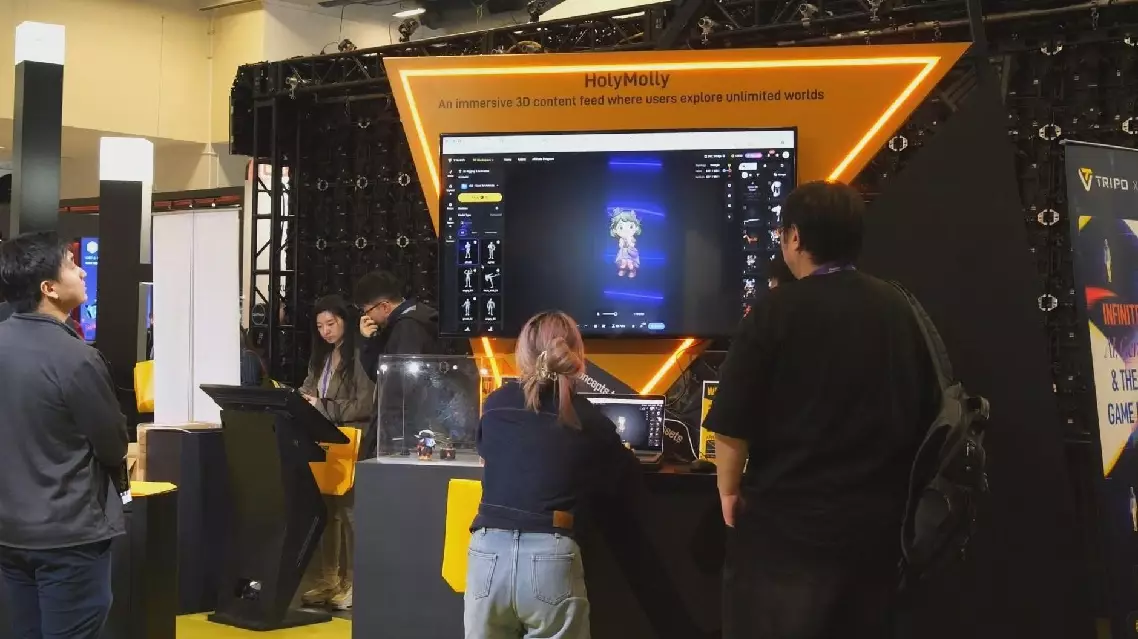
AI enters the world of video games to enhance gameplay and help you create games

AI enters the world of video games to enhance gameplay and help you create games
On Friday, nearly 100 guests from the business, academic and media sectors of China and the United States gathered in New York to discuss the new opportunities that China’s blueprint for high-quality development brings to the world.
The “Spring China: China’s Development Opportunities for the World” High-Level Dialogue, hosted by China Media Group, was held after the conclusion of the “Two Sessions” in Beijing, an event that attracts many industry leaders in the United States.
The speakers said that the annual “Two Sessions” once again attracted the world’s attention as an important window into modern China. This year’s meeting approved key documents including the outline of the 15th Five Year Plan (2026-2030). This roadmap for China’s quality growth is believed to offer the world a list of new opportunities.
Participants emphasized that China’s development cannot be separated from the rest of the world, and that China is also necessary for the world’s prosperity. The two leaders said this year is an important year for China-US relations and called for steady, healthy and sustainable development of bilateral relations that will benefit both countries and the world.
During the session, guests from the investment and technology sectors explored topics such as the potential for economic and trade cooperation between China and the United States, and global opportunities arising from technological innovation and new high-quality production capacity.
The event also featured screenings of programs produced by CMG. This includes a spectacular martial arts performance performed by more than a dozen humanoid robots and young kung fu artists during the recent Chinese New Year Gala, China’s most-watched TV show.
This dialogue series will be held in countries in Europe, Asia, Africa, the Middle East and Latin America.
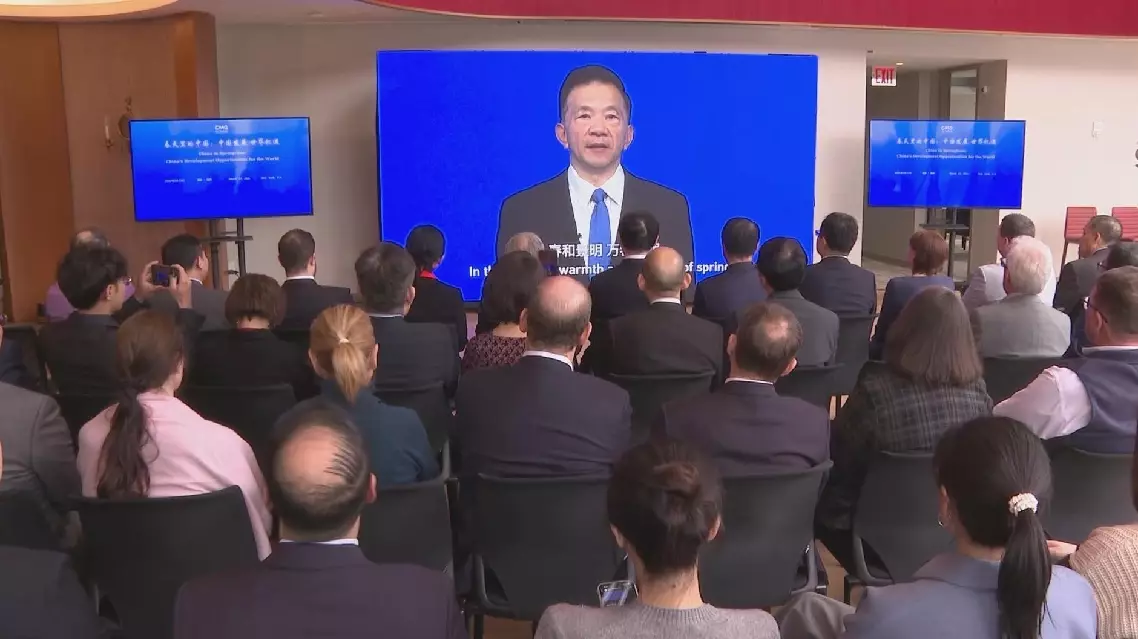
High-level dialogue in New York brings China’s development opportunities to the world


