

AI-enabled Medical Devices Market Revenue Insights
Key Highlights
| Study Period | 2019 – 2032 |
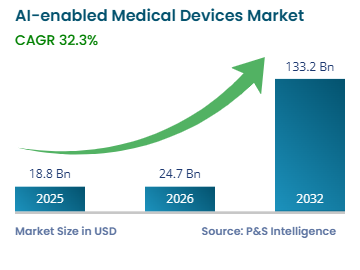
| Market Size in 2025 | USD 18.8 Billion |
| Market Size in 2026 | USD 24.7 Billion |
| Market Size by 2032 | USD 133.2 Billion |
| Projected CAGR | 32.3% |
| Largest Region | North America |
| Fastest-Growing Region | Asia-Pacific |
| Market Structure | Fragmented |
Market Size
Explore the market potential with our data-driven report
AI-enabled Medical Devices Market Future Outlook
The AI-enabled medical devices market size will be an estimated USD 18.8 billion for 2025, and it will grow by 32.3% during 2026–2032, to reach USD 133.2 billion by 2032.
The market expansion is primarily driven by the rising prevalence of chronic diseases, growing aging population, increasing regulatory approvals of AI-powered medical devices, and surging adoption of remote patient monitoring solutions worldwide.
The growing burden of chronic diseases worldwide is driving demand for AI-enabled medical devices. According to the WHO, noncommunicable diseases killed at least 43 million people in 2021, accounting for 75% of non-pandemic-related deaths globally. AI-enabled medical devices offer advanced capabilities for early detection, diagnosis, and continuous monitoring of these conditions, thereby supporting timely clinical interventions and improved patient outcomes.
Additionally, the aging demographic worldwide is another significant growth driver. The WHO projects that the number of people aged 60 years and above will increase from 1.1 billion in 2023 to 1.4 billion by 2030. By 2050, the world’s population of people aged 60 years and older will double to 2.1 billion. Older populations are more susceptible to multiple chronic conditions requiring continuous health monitoring, creating substantial demand for AI-powered diagnostic and monitoring devices that can deliver personalized care and enable aging in place. Regulatory momentum has accelerated significantly. The rapid pace of approvals, with roughly 100 new authorizations annually, signals growing acceptance and integration of AI capabilities across medical specialties, particularly in radiology, cardiology, and neurology.
AI-enabled Medical Devices Market Segmentation Analysis
Component Analysis
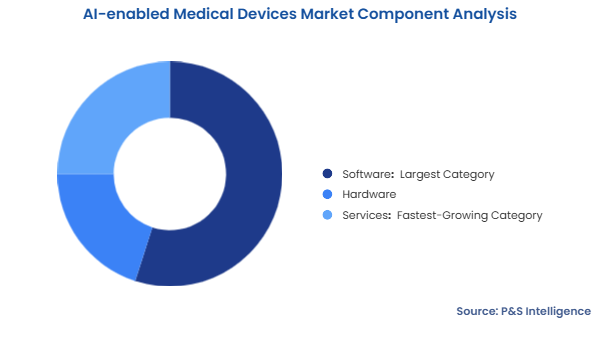
The software category holds the largest market share, of 55%, in 2025. Software represents the core intelligence of AI-enabled medical devices, encompassing machine learning algorithms, deep learning models, natural language processing engines, and computer vision systems that drive diagnostic accuracy, predictive analytics, and clinical decision support capabilities. Moreover, the ongoing development and refinement of AI algorithms, which can be upgraded without needing new hardware, further contribute to the segment.
The services category will have the highest CAGR, of 32.7%, driven by the growing need for implementation support, training, maintenance, and continuous algorithm refinement. As healthcare organizations deploy AI-enabled medical devices, they require comprehensive services, including system integration, data management, algorithm customization, and regulatory compliance support. The services segment also encompasses consulting services that help healthcare organizations develop AI strategies, navigate regulatory pathways, and optimize return on investment from AI implementations.
The components analyzed in this report are:
- Software (Largest Category)
- Hardware
- Services (Fastest-Growing Category)
Technology Analysis
The machine learning category holds the largest market share in 2025, driven by its versatility across diverse medical applications, including diagnostics, prognosis, treatment planning, and operational optimization. Machine learning algorithms excel at identifying patterns in complex medical data, making predictions based on historical patterns, and continuously improving performance through exposure to new data.
Within machine learning, deep learning technologies are experiencing particularly rapid growth due to their superior performance in processing unstructured data such as medical images, waveforms, and clinical notes. Supervised learning approaches remain widely used for classification and prediction tasks where labeled training data is available, while unsupervised learning techniques are gaining prominence for discovering hidden patterns and patient segmentation.
The natural language processing category will have the highest CAGR during the forecast period, as healthcare organizations seek to extract valuable insights from the vast amounts of unstructured clinical text data in electronic health records, clinical notes, research literature, and patient communications. NLP technologies enable automated coding, clinical documentation improvement, adverse event detection, and clinical decision support by understanding medical terminology, context, and relationships within text data.
The technologies analyzed in this report are:
- Machine Learning (Largest Category)
- Deep Learning
- Supervised
- Unsupervised
- Others
- Natural Language Processing (Fastest-Growing Category)
- Computer Vision
- Context-Aware Computing
- Others
Device Type Analysis
The diagnostic category holds the largest market share, of 40%, in 2025, reflecting the critical importance of accurate and timely diagnosis in clinical decision-making. AI-powered diagnostic devices leverage advanced algorithms to analyze patient data, identify disease patterns, and provide diagnostic recommendations with high accuracy and speed. In radiology, AI-enabled diagnostic devices can detect abnormalities in X-rays, CT scans, and MRIs, assisting radiologists in identifying tumors, fractures, and other pathologies. Thus, the AI-based medical imaging market value could cross USD 12.5 billion by 2032.
The monitoring category will have the highest CAGR during the forecast period, driven by increasing adoption of continuous patient monitoring, wearable health devices, and remote patient monitoring solutions. AI-powered monitoring devices continuously observe vital signs, identify irregularities, anticipate clinical decline, and notify healthcare providers of potential issues before they escalate. Wearable monitoring devices equipped with biosensors and AI algorithms enable patients to track their health metrics in daily life, facilitating early detection of irregularities and supporting chronic disease management.
The device types analyzed in this report are:
- Diagnostic (Largest Category)
- Monitoring (Fastest-Growing Category)
- Wearable
- Remote Monitoring
- Others
- Rehabilitation
- Others
Therapeutic Area Analysis
The radiology category holds the largest market share, of 45%, in 2025, as AI applications in medical imaging have achieved the highest level of clinical validation and regulatory approval. The FDA reports that radiology devices account for approximately 76% of all AI medical device approvals. AI systems are highly proficient in interpreting medical images, spotting subtle anomalies, measuring disease progression, and flagging urgent cases for radiologists. The shortage of radiologists in many regions has accelerated the adoption of AI solutions that can extend radiologist capacity and improve diagnostic efficiency.
The cardiology category will have the highest CAGR, of 32.5%, driven by the high prevalence of cardiovascular diseases and the potential for AI to improve outcomes through earlier detection and personalized treatment. The WHO reports that cardiovascular diseases account for 19 million deaths annually, making them the leading cause of death globally. Wearable cardiac monitors equipped with AI algorithms enable continuous heart rhythm monitoring and early detection of atrial fibrillation, which can lead to timely interventions to prevent stroke. AI-powered decision support systems assist cardiologists in treatment planning, risk stratification, and patient management.
The therapeutic areas analyzed in this report are:
- Radiology (Largest Category)
- Cardiology (Fastest-Growing Category)
- Neurology
- Oncology
- Ophthalmology
- Mental & Behavioral Health
- Orthopedics
- Others
End User Analysis
The hospitals & clinics category holds the largest market share, of 50%, in 2025, as these institutions serve as primary adoption sites for advanced medical technologies and have the infrastructure, resources, and clinical expertise required to implement AI-enabled medical devices. Hospitals are integrating AI solutions across multiple departments, including radiology, pathology, cardiology, and emergency medicine, to enhance diagnostic accuracy, improve workflow efficiency, and support clinical decision-making. Large hospital systems are establishing AI centers of excellence and forming partnerships with technology companies to develop and validate AI applications tailored to their specific clinical needs.
The homecare settings category will have the highest CAGR, of 32.6%, reflecting the shift toward patient-centric care models and the growing preference for receiving care at home rather than in institutional settings. AI-enabled medical devices for home use include wearable monitors, smart insulin pumps, portable diagnostic devices, and telemedicine platforms that enable remote consultation and monitoring. These devices empower patients to manage chronic conditions, monitor health parameters, and communicate with healthcare providers from the comfort of their homes.
The end users analyzed in this report are:
- Hospitals & Clinics (Largest Category)
- Diagnostics Centers
- Ambulatory Surgical Centers
- Home Care Settings (Fastest-Growing Category)
- Research & Academic Institutions
- Others
Drive strategic growth with comprehensive market analysis
AI-enabled Medical Devices Market Regional Outlook
North America AI-Enabled Medical Devices Market Size
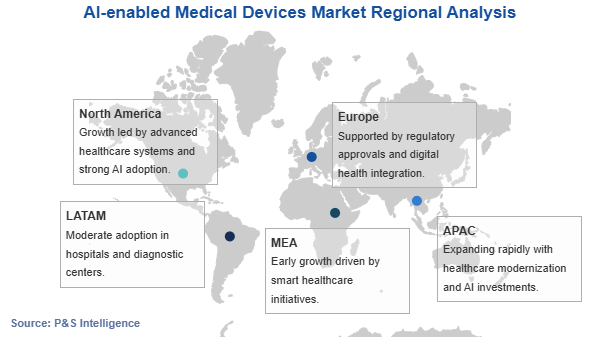
North America holds the largest market share, of 45%, in 2025. This dominance is primarily attributed to the presence of advanced healthcare infrastructure, high adoption rates of cutting-edge technologies, supportive regulatory environment, and significant investments in healthcare innovation. The region benefits from the presence of top medical device manufacturers, tech firms, and research institutions, driving AI innovation and implementation in healthcare.
U.S. AI-Enabled Medical Devices Market Size
The U.S., in particular, represents the largest market within the region, driven by substantial healthcare expenditure, widespread availability of electronic health records, and favorable reimbursement policies for AI-enabled diagnostic and monitoring services.
Regulatory support has been instrumental in market growth. The FDA has established clear pathways for AI medical device approval, including the Predetermined Change Control Plan that streamlines approval for algorithm updates. Medicare’s expansion of reimbursement for remote patient monitoring and AI-assisted diagnostics provides economic incentives for healthcare providers to adopt these technologies. The U.S. healthcare system’s focus on value-based care and quality metrics aligns well with AI capabilities for early disease detection, risk stratification, and preventive interventions.
Asia-Pacific AI-Enabled Medical Devices Market Size
Asia-Pacific will have the highest CAGR, of 32.4%, driven by large patient populations, rising healthcare expenditure, increasing prevalence of chronic diseases, growing government initiatives to promote digital health, and expanding healthcare infrastructure. China, India, Japan, and South Korea are making substantial investments in AI technologies and healthcare digitalization.
China AI-Enabled Medical Devices Market Size
China represents the largest within the Asia Pacific region, supported by government policies promoting AI adoption in healthcare, substantial domestic manufacturing capabilities, and increasing regulatory approvals for AI medical devices. Moreover, China’s ‘Healthy China 2030’ plan and national AI strategies promote large-scale deployment of AI technologies in healthcare, including medical devices, diagnostic tools, and remote monitoring solutions.
India AI-Enabled Medical Devices Market Size
India is experiencing rapid growth driven by a large patient base, increasing burden of chronic diseases, shortage of healthcare professionals, and expanding private healthcare sector. The Indian government’s Digital India initiative and National Digital Health Mission are creating an enabling environment for the adoption of AI-enabled medical devices. The Indian government’s National Digital Health Mission (NDHM) and supportive AI health policies are creating a framework for AI-enabled device adoption and integration into public healthcare.
Japan AI-Enabled Medical Devices Market Size
Japan, with its rapidly aging population, is prioritizing AI solutions for elderly care, chronic disease management, and addressing healthcare workforce shortages. AI-enabled medical devices can extend the reach of healthcare professionals, provide diagnostic support in underserved areas, and improve the efficiency of healthcare delivery. Local manufacturing capabilities are enabling cost-effective production and customization of AI-enabled medical devices for regional markets.
The regions and countries analyzed are as follows:
- North America (Largest Regional Market)
- U.S. (Larger and Faster-Growing Country)
- Canada
- Europe
- Germany (Largest Country)
- U.K. (Fastest-Growing Country)
- France
- Italy
- Spain
- Rest of Europe
- Asia-Pacific (Fastest-Growing Regional Market)
- China (Largest Country)
- India (Fastest-Growing Country)
- Japan
- South Korea
- Australia
- Rest of APAC
- Latin America
- Brazil (Largest Country)
- Mexico (Fastest-Growing Country)
- Rest of LATAM
- Middle East and Africa
- Saudi Arabia (Fastest-Growing Country)
- South Africa
- UAE (Largest Country)
- Rest of MEA
AI-enabled Medical Devices Market Share
The market is fragmented with leading technology companies, established medical device manufacturers, and specialized AI healthcare startups competing across different segments, with room for emerging players and regional competitors. However, the rapid pace of technological innovation and relatively low barriers to software development create opportunities for new entrants with novel AI approaches or specialized applications. Strategic activities shaping the competitive landscape include partnerships for data access and algorithm training, and acquisitions of AI startups to accelerate technology development.
Key AI-enabled Medical Devices Companies:
- Siemens Healthineers
- GE Healthcare
- Philips Healthcare
- Medtronic
- Johnson & Johnson
- Stryker Corporation
- Canon Medical Systems
- Zimmer Biomet
- Abbott Laboratories
- Boston Scientific
- Exo Imaging, Inc.
- Aidoc Medical Ltd.
- Clew Medical
- Eko Health
- Paige AI, Inc.


