Singapore – AI-related demand, mainly for electronics and precision engineering, continued to drive Singapore’s manufacturing production in Q2 2026, but was not enough to maintain the economic growth momentum from the previous quarter.
The Republic’s economy expanded by 5.7% April-June period slowed down compared to the same period last year first quarter According to an announcement by the Ministry of Trade and Industry (MTI) on July 14, it was 6.3%. The expansion remains above the 5.5% median estimate of economists polled by Bloomberg.
MTI said manufacturing in the quarter was primarily driven by volume growth due to strong AI-related demand for semiconductors and semiconductor manufacturing equipment in the Electronics Engineering Cluster and Precision Engineering Cluster, respectively.
However, growth slowed in sectors such as construction, wholesale trade, and retail trade.
Most analysts believe it will be difficult for Singapore’s economy to surpass the growth recorded in the first quarter unless the volatile energy market calms down. After the war, the situation is once again becoming more uncertain. Hostilities between the United States and Iran have recently escalated, The two sides broke a 60-day ceasefire agreed in mid-June.
Oil prices, which fell to a low of $71 per barrel after the ceasefire was announced, have recovered to around $81 per barrel on July 17, but are still far from the $120 level they reached in the weeks since the conflict began on February 28.
AI-related exports are expected to remain a key growth driver in the second half of this year. However, analysts said delays in the spread of conflicts in the Middle East and uncertainty over energy and transport costs were likely to dampen domestic demand and momentum, impacting household spending and business investment.
MTI said the closure of the Strait of Hormuz would disrupt the supply of energy and key inputs such as fertilizer and aluminum, weighing on the global economic outlook.
South Korea’s SK Hynix was hit hardest by the sharp decline in semiconductor stocks.
It’s been a tough week for chip makers, with increased demand for AI not boosting market sentiment toward semiconductor companies, and stock prices falling as AI investment wanes.
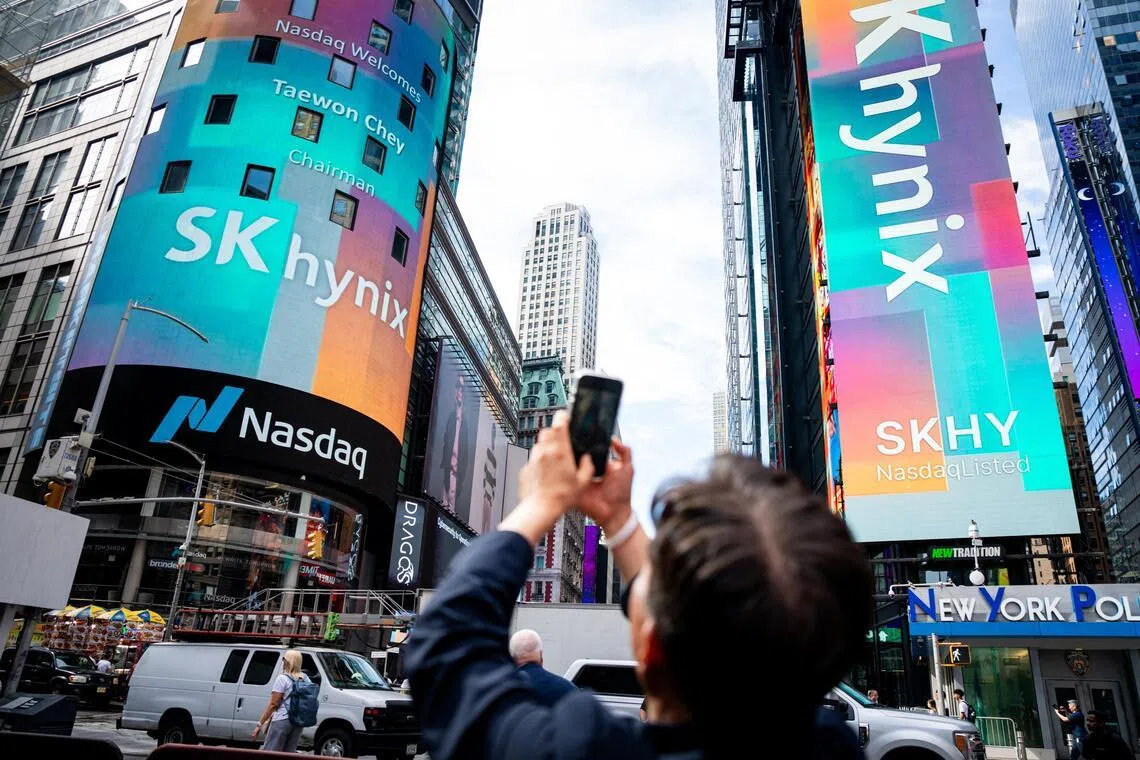
The company that took the biggest brunt was South Korea’s SK Hynix, one of the world’s leading AI memory chip manufacturers, which was listed on the Nasdaq on July 10. The company’s Seoul shares fell more than 15% on July 13, the biggest single-day drop in nearly 20 years, as investors booked profits.
The company’s American Depositary Shares (ADS) opened at $170, 14% above the offering price, and closed the first day of trading up 12.8%.
ADSs are U.S. dollar-denominated shares of foreign companies that can be bought and sold on U.S. stock exchanges. This allows U.S. investors to easily invest in international companies without having to deal with the complexities of overseas transactions, currency conversion, or different trade practices.
Despite a strong debut, SK Hynix has been unable to shake off the worries weighing on South Korea’s chip and memory inventories, with demand for the country’s specialty memory chips already predicted to exceed production capacity well beyond 2030.
After seeing a brief rise on July 15, the company’s shares fell 11.5% on the Korea Exchange the following day, ending the week down 15.5%.
The steep decline may have been partially caused by a July 13 Korea Investment and Securities report that predicted SK Hynix’s latest quarter operating profit would be lower than expected, raising concerns that the company was overvalued.
Domestic rival Samsung Electronics also saw its stock price drop more than 8% this week, despite announcing a 19-fold increase in quarterly profit.
The AI data center boom is driving demand for high-bandwidth memory (HBM) chips. Samsung has announced its next-generation HBM4 chip, but SK Hynix is reportedly delaying the launch of its 6th generation HBM chip in favor of higher-margin DRAM chips used in CPUs and traditional servers. This cast doubt on SK Hynix’s ability to maintain its lead in AI memory.
Samsung is also reportedly considering listing in the United States.
Analysts said the explosive growth of South Korea’s two semiconductor makers has made their stock prices highly volatile and prone to sharp declines, and that the recent decline in stock prices shows that investors’ expectations are becoming increasingly irrational.
This slump spread to the U.S. market, hitting stocks of other semiconductor manufacturers that were doing well.
Shares in Micron, SK Hynix’s biggest U.S. competitor, have fallen more than 13% over the course of the week, Western Digital has fallen 18.1% and SanDisk has fallen nearly 30%.
Singapore’s tech stocks were also not spared the decline.
AEM Holdings, a global leader in semiconductor testing, saw its stock fall on July 16, ending the week down 9.5% at $8.64.
UMS Integration, which had strong demand for advanced packaging and semiconductor equipment, fell 5.1% from the previous week to $2.44.
Frenken Group, which supports wafer manufacturing, assembly and test operations, fell 4.7% to $2.63.
Sheng Siong, Q&M eye dilation
Supermarket chain Sheng Siong aims to expand its current network of 90 stores with a new $520 million integrated headquarters and distribution center.
The new facility, located in Sungei Kadut, will be built on a site approximately 2.5 times larger than the existing distribution center in Mandai Link. It is expected to be completed in 2029 and will be able to support more than 120 stores.
With support from JTC Corporation and Enterprise Singapore, the facility will be equipped with automated storage and retrieval systems, robotics, an intelligent warehouse management system and multi-temperature storage zones.

Sheng Siong’s new facility is expected to be completed in 2029 and will be able to support more than 120 stores.
ST Photo: Brian Teo
Minister of International Trade and Industry and Deputy Prime Minister Gan Kim Yong said at the groundbreaking ceremony on July 13 that end-to-end automation will free up personnel from repetitive manual tasks and reskill warehouse staff to operate automated systems and perform technical maintenance.
Other employees will be trained for front-line roles in e-commerce fulfillment and retail, and new technical positions will be created to support the new system.
Sheng Siong’s stock price rose throughout the week, hitting a weekly high of $3.34, but fell back on July 17, closing 0.3% lower at $3.28.
Meanwhile, Q&M Dental Group, Singapore’s largest private dental practice group, aims to create the largest dental company in the Asia-Pacific region.
On July 12, the company announced that it will fully acquire Australian dental group Experteeth for approximately A$119.6 million (S$107.7 million). Experteeth operates 40 clinics across New South Wales, Victoria, Queensland, Tasmania and the Australian Capital Territory under six brands, including Elevate Dental Group, Lumiere Dental Group and Ace Dental Group, with a clinical team of approximately 120 dentists.
Upon completion of the transaction, Q&M will inject a further A$30.4 million in capital into Expert Teeth Group, primarily to repay existing financing facilities and provide capital growth.
Separately, Q&M will also acquire a 51% stake in Thailand’s Deezy Q&M Dental Group (a network of 33 dental clinics nationwide), in which Q&M has already invested. Q&M said the deal, worth about 994.5 million baht (S$38.2 million), will allow the group to immediately establish a presence in the Thai market without having to build a base from scratch.
The company’s CEO Ng Chin Siau said Thailand has long been a market of interest for the group and Deezy’s clinic network and reputation built over the years are evidence of the company’s growth potential.
The combined value of both transactions is US$113.2 million, and the transactions consist of cash and Q&M consideration shares issued in January 2019. 70 singapore cents This represents a 25.7 per cent premium over the volume-weighted average price of 55.7 cents on July 9, the last trading day before the sale and purchase agreement was signed.
The group is expanding into Thailand and Australia, but plans for Malaysia are on hold for now.
On July 12, the company announced in a stock exchange filing that it would postpone its plans for a secondary listing on Bursa Malaysia, which it first announced in April.
The company said it would continue to consider the suitability of the proposed secondary listing “taking into account the prevailing circumstances and the interests of the company and its shareholders.” The reason for the postponement was not detailed.
Q&M’s stock price fell throughout the week, closing 2.7% lower at 54 cents.
ComfortDelGro appoints first group COO
Transportation giant ComfortDelGro announced on July 15 that it has appointed the group’s first chief operating officer (COO). This newly created role is part of the company’s broader strategy to strengthen its global operations and grow across markets.
Mr. Yap Chee Keen will join the company on October 15th. He has over 20 years of business and leadership experience in Asia and Europe, including working in new business expansion for various organizations such as Carlsberg Group and Jardine Matheson.
Since 2022, he has been co-CEO of Astra Digital Mobil, an Indonesian company that operates a used car platform and digital advertising in Indonesia.
As ComfortDelGro’s group chief operating officer (COO), Yap will work closely with the group CEO, business leaders and senior management team to “strengthen performance discipline” and “drive consistent execution” across the global business, the company said.
Chairman Mark Greaves said establishing the group COO role was “an important step in strengthening ComfortDelGro’s top management team”.
“Mr. Yap brings a strong blend of strategic, commercial and operational experience across Asia, and his appointment adds depth to the leadership team as the group continues to pursue disciplined and sustainable growth internationally.”
In addition to its operations in Singapore, ComfortDelGro also operates taxi and bus services in Australia and the United Kingdom, as well as the Stockholm Metro in Sweden. The company is also aiming to enter China’s self-driving car market.
ComfortDelGro’s stock price briefly rose when the market opened on July 16 following the company’s announcement, but has since fallen. This week’s closing price was flat at $1.34.
Next week’s highlights
Several major U.S. tech companies are scheduled to report their second-quarter results, potentially adding to market volatility.
They include Tesla, Intel, IBM, and Google’s parent company Alphabet.
In Singapore, Keppel DC REIT will announce its first half 2026 results on 23 July.
Singapore Airlines will hold its annual general meeting on July 24, but continued losses from Air India shares are likely to raise questions from shareholders.
On July 17, the group defended its investment in response to questions from the Securities Investors Association (Singapore), noting that Air India has made “tangible progress” in its transformation across various business functions.