A new AI tool, Palaeographicum, is revolutionizing the study of ancient Near Eastern cultures. This identifies personal variations of cuneiform. This is a huge step forward for academia.
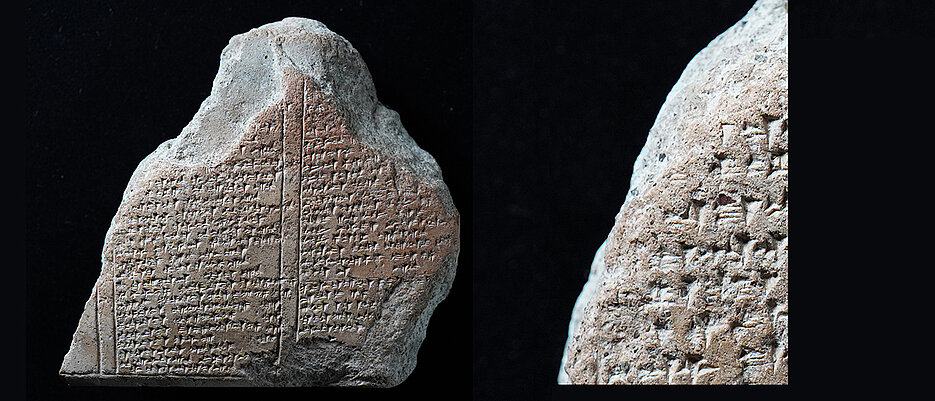
Three thousand years before the Common Era, a highly developed civilization flourished in the Near East, leaving behind a wealth of information on clay tablets inscribed in cuneiform script. This writing system involved pressing wedge-shaped letters with a stylus onto a wet clay tablet and drying to create a durable document.
Most clay tablets break down over time, and their fragments are scattered in museums around the world. Research in the ancient Near East therefore faces the complex challenge of accurately piecing together the fragments. Only then will it be possible to read the complete text and gain insight into life in the ancient Near East.
Researchers from the University of Würzburg and the Mainz Academy of Science and Letters have been working on this study for many years. They focus on the Hittite culture, which lived in what is now Anatolia 3,500 years ago. The “alphabet” of this people was extensive, consisting of at least 375 cuneiform letters, which represented syllables and whole words.
Setting multiple milestones in ancient Near Eastern research
In its research, the Würzburg-Mainz research team has set numerous milestones in the study of the ancient Near East that have attracted worldwide attention.
Twenty-five years ago, Gernot Wilhelm and Gelfrid Müller founded Hethitologie-Portal Mainz, a digital catalog containing all 30,000 known Hittite tablet fragments, as well as numerous research materials and texts. The clay tablet catalog was originally compiled by Sylvin Koshak. Researchers from all over the world contribute to this portal, which is freely accessible via the Internet.
Ten years ago, the team introduced a digital tool that allowed them to capture the unique characteristics of individual cuneiform characters in 3D. This has greatly facilitated the computer-aided reconstruction of ancient clay tablets. TLH in 2023dig This tool allows users to search for text in cuneiform or transliteration.
The individual shapes of cuneiform are important
Currently, the portal presents its latest tool “Palaeographicum”. Recognize individual cuneiform shapes in digitized photographs on Hethitologie-Portal and search for identical or similarly written characters across a collection of clay tablets. Next, cut out the text from the photo and organize it in an image table for easy understanding.
The current version of Palaeographicum provides access to 70,000 photographs documenting over 5 million cuneiform characters. Developed in collaboration with Dortmund University of Technology.
The individual forms of writing are very important for research because they allow us to distinguish between individual scribes. Although cuneiform was pressed into clay with a stylus, individual “handwriting styles” are still discernible within the text. Each scribe had his own style. Some people forcefully pull the stylus out of the clay to form floral patterns, while others place letters at characteristic intervals.
Palaeographicum facilitates comparison of handwriting styles
Recognizing the characteristics of the scribe makes it easier to piece together the fragments of the clay tablets. “To the naked eye, this is usually only possible slowly and with difficulty,” says Gelfrid Müller, professor of ancient Near Eastern studies. This is due to the three-dimensional nature of cuneiform, which makes the text in the photo more or less legible depending on the angle of light.
Professor Daniel Schwemer, head of the Department of Ancient Near Eastern Studies at the University of Würzburg, said: “Paleography is fundamentally changing the way we work. This will allow us to save thousands of hours of time.” For example, it used to take three days to compare the handwriting of individual letters across five clay tablet fragments. Now it can be done in 5 minutes.
As in Europe, handwriting in the ancient Near East changed significantly over the centuries. Since Hittite clay tablets are not dated, this new tool will also help the research community date individual fragments. That’s why it was named “Paleography”. This refers to the study of the historical development of ancient manuscripts, that is, ancient manuscripts.
AI is continuously retrained
This tool isn’t finished yet. “We are continually retraining our AI,” says Gerfrid Müller. The team will also consider user requests when further developing Paleographium “where it is technically feasible and makes work easier for everyone.”
The global Hittitology community has already provided a lot of positive feedback on this new tool. The development team didn’t have to spend a lot of effort promoting their work. An announcement in the news section of Hethitologie-Portal was enough. “All Hittite researchers open their portals first thing in the morning. They can’t do without them,” says Daniel Schwemer.
Perspective: Social history of written culture
The researchers have ambitious goals for the future. We want to train the AI enough to automatically recognize the handwriting of individual scribes.
But it’s a complicated task. One reason for this is that scribes created different handwritings depending on whether they were working in the peaceful surroundings of their homes or hurriedly writing reports during field visits, such as touring the sanctuaries of the Hittite Empire.
“Achieving this goal will allow us to better understand what individual scribes produced during their professional careers, and will allow us to compile a social history of Hittite scribal culture,” said Daniel Schwemer. Perhaps that will be the next milestone set by the team in Wurzburg vs. Mainz.
History of tool development
The foundation for the new tool was laid by the DFG-funded CuKa project (Computer-Assisted Cuneiform Analysis). From 2018 to 2023, Gelfrid Müller collaborated with Dortmund University of Technology to develop the AI model that now forms the basis of Paleographium.
During the course of the project, a web-based demonstrator was also created. Turna Zomer from Mainz Academy was responsible for the philological work for this, annotated the training material and evaluated the training results. The development of the AI model was led by Christopher Rest and Eugen Rusakov from the Dortmund University of Technology.
After the project was completed, Gelfrid Müller, Christopher Rest and Herbert Bayer Seip from the Center for Philology and Digitality at the University of Würzburg further developed visual online tools for demonstrators. Previously, it was difficult to process the huge amount of available photos. This led to the creation of the first version of the paleographium.
Hittite festival rituals
The project “Corpus of Hittite Festival Ritual” is funded by the Academy of Sciences and Letters. It forms part of a joint research program between Mainz and the Academy of Sciences. The Academy’s programs are dedicated to the documentation, preservation and research of cultural traditions from around the world and are currently the largest long-term research program in the Federal Republic of Germany for basic research in the humanities and social sciences.