
May 20, 2026
Singapore – As an engineering student with special educational needs (SEN), Matthew Lim struggled to find information about grants and aid schemes.
Mr. Lim suffers from Coats disease, a disease that gradually causes blindness in his left eye. The 20-year-old, who graduated from the Singapore Institute of Technology with a degree in psychology and human resource management, said that while various forms of support exist, from financial aid to exam accommodation, it was not easy to apply for such schemes as information was not easy to find.
Inspired by his personal experience, he and 10 teammates developed a Telegram chatbot powered by artificial intelligence that provides personalized support based on users’ needs. They named their chatbot Elfi.
The team’s goal was to make information about SEN support more accessible, as it is typically posted across multiple school, organization and government websites.
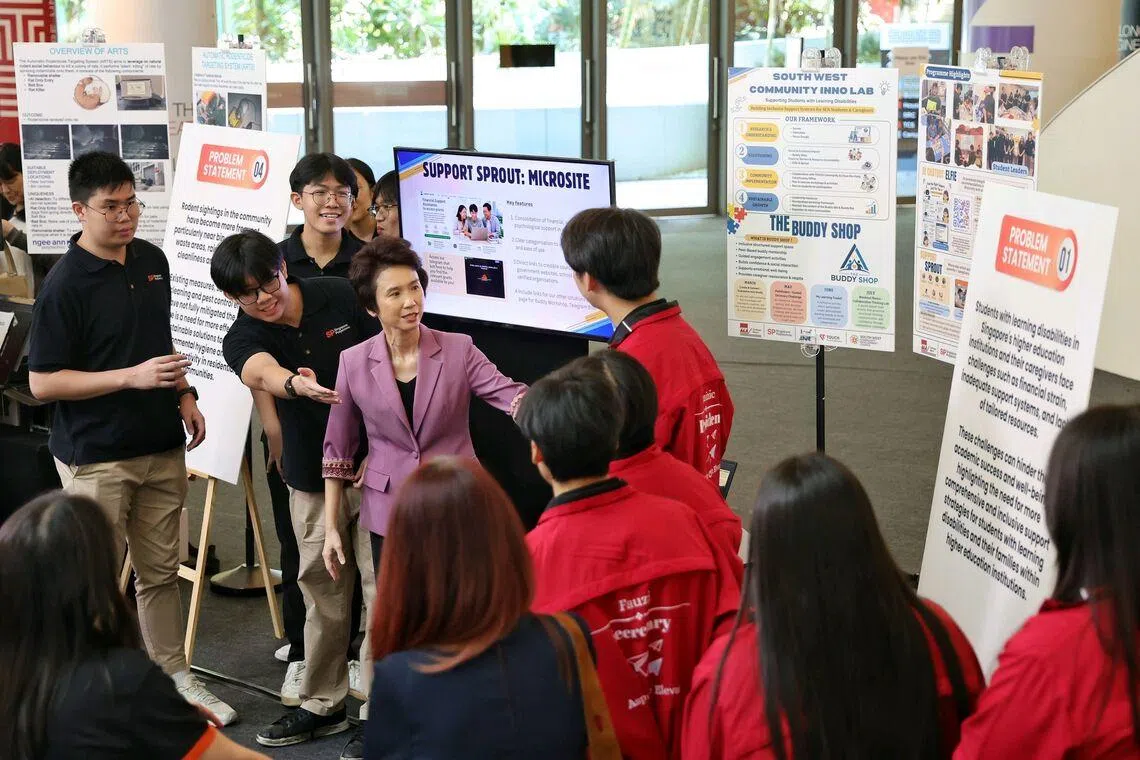
“Information gets buried under layers of buttons and menus, so I coached my team to focus more on making knowledge more accessible,” said Lim, standing next to the project’s booth at the Southwest Community InnoLab Symposium. The event was held at the Singapore University of Technology and Design.
His teammate Elijah Yuen, 20, also a banking and finance graduate from the Singapore Institute of Technology, added: “Students with SEN have to declare their learning disabilities when enrolling in tertiary education. Especially in the first week of enrollment, when our inboxes are full of emails, they may miss out on this period.”
Their project was one of 10 featured at the May 19 event. Launched in 2024, the South West Community Inno Lab is a partnership between the South West Community Development Council (CDC) and nine higher education institutions.
The initiative brought together more than 100 students to come up with solutions to address problems in 10 communities within the Southwest region. Issues addressed range from pest control and waste management to improving accessibility and energy savings.
To complement Mr Lim and Mr Yuen’s efforts, students at ITE College West have organized a series of monthly workshops that began in March, aimed at helping SEN students and carers meet others and find social and emotional support. Sessions facilitated by volunteers include guided activities such as arts and crafts.
Student teams can use the Southwest Community Fund and the Southwest Innovation Fund to purchase materials to create their prototypes. These funds aim to support foundational work by young people and promote volunteerism and community ownership.
Education Minister Desmond Lee, who spoke at the event, said the students’ projects respond to needs faced by families and communities.
These include supporting older people through assistance with the Lasting Power of Attorney process, encouraging households to adopt energy efficient practices, and tackling issues such as rodent infestations and illegal dumping.
Mr Lee, Minister for Social Services Integration and Member of Parliament for West Coast and Jurong West GRC, said: “In a rapidly changing world where technologies such as AI are reshaping the workplace, we will need both these technical skills and human qualities to remain resilient in the face of change, continue to learn and make good use of new tools, and apply them with judgment, wisdom and empathy.”
In response to the increasing number of rodent sightings in housing estates, students at Ngee Ann Polytechnic have developed a trapping system known as the Automated Rodenticide Targeting System, which uses AI capabilities to detect rats even in dimly lit environments. It has a built-in safety feature that prevents other animals from entering the trap.
Their concept is to use the natural grooming behavior of rats to spray rat poison into burrows where rat colonies reside. They partnered with the National Environment Agency and Housing Board to manage the traps.
Ms Lo Yen Lin, Senior Minister for Culture, Communities and Youth Affairs and Mayor of the South West Region, said the South West CDC will continue its support through funding initiatives such as the South West Youth Fund, which provides up to $5,000 per project for foundational youth projects.
“We will also continue our Southwest Innovation Fund, which provides up to $10,000 to help social service agencies and community partners pilot and scale impactful solutions on the ground,” she said.
“Through these grants, we hope more ideas will take root, grow, and benefit our communities.”


