Congratulations to the winners of the 2026 Rosie Supercomputer Super Challenge! This year marks the contest’s fifth anniversary, with 27 entries, the largest number ever, and almost twice as many entries as last year. The winner was chosen after six finalists presented their projects in front of a team of judges including:
- Dr. Dwight Diercks ’90, NVIDIA Senior Vice President of Software Engineering, MSOE Regents
- Nick Haemel ’02, MSOE Regent, NVIDIA Vice President of Medical Imaging and Systems Software
- Dr. Jeremy Kedziora, PieperPower AI Endowed Chair
- Dr. Derek Riley, MSOE Computer Science Program Director
In the annual challenge sponsored by Diercks, MSOE students demonstrate how to use the supercomputer Rosie to solve problems, improve processes, and answer difficult questions during the Rosie Supercomputer Super Challenge.
1st place:
SkyNet: Belief-aware planning in partially observable stochastic games.
Adam Hale, Computer Science and Machine Learning
This project demonstrates how to use reinforcement learning to train an AI agent to play a game called SkyJo that incorporates hidden cards and random chance.
2nd place:
SMEARGLE: Sketch your drafts and let your attention fly
Dylan Norquist, Computer Science and Machine Learning
This project introduces more efficient mechanisms to the Transformer architecture, the AI model structure that underpins most major generative AI models.
3rd place:
Proactive Urban Forestry Management: A Machine Learning Approach to Predict and Prioritize Tree Pruning in Milwaukee
Josh Myers, Computer Science and Machine Learning. Xander Ede, Computer Science and Machine Learning. Eddie Chukwuma, Computer Science; Dylan Norquist, Computer Science and Machine Learning
This project will examine how satellite data can be combined with the City of Milwaukee’s forestry data to help the Forest Service re-prioritize how to proactively and more cost-effectively manage hundreds of thousands of trees across the city.
Honorable mention:
From Revit to robots: BIM-driven simulation for autonomous building operations
Owen Pacetti, computer engineering; Stephen Thomas, biomedical engineering; Joseph Loduca, Software Engineering. Nicolas Picha, Software Engineering. Tanner Cellio, Computer Science and Machine Learning. Diego Gonzalo, Computer Science. Del Solo Sam, Computer Science. Adrian Manchado, Computer Science and Machine Learning
This project will explore the use of a digital twin built from blueprints for MSOE’s new engineering building. The digital twin was used to train the robot to navigate the new building and understand the nuances in advance of the existing building.
Teach your agents how to negotiate with the Settlers of Catan
Mazen Hamid, Computer Science and Machine Learning
This project explores how to use reinforcement learning to train an AI agent to play Settlers of Catan, including the game’s negotiation elements.
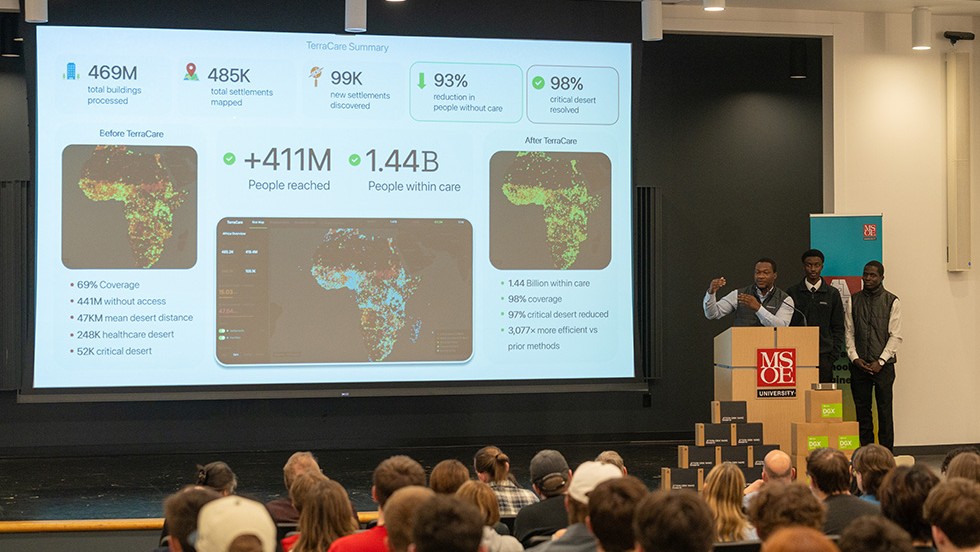
TerraCare: GPU-accelerated healthcare
Alhagie Boye Computer Science and Machine Learning. Wilfred Tapsoba, Computer Engineering
This project will examine how satellite and other data can be used to intelligently identify medical deserts and strategically locate medical facilities across Africa to improve accessibility and patient care.