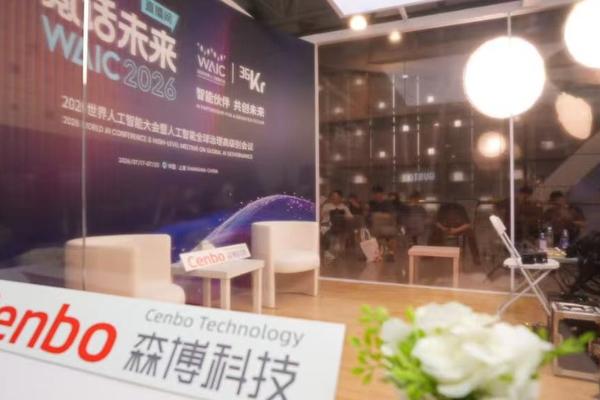
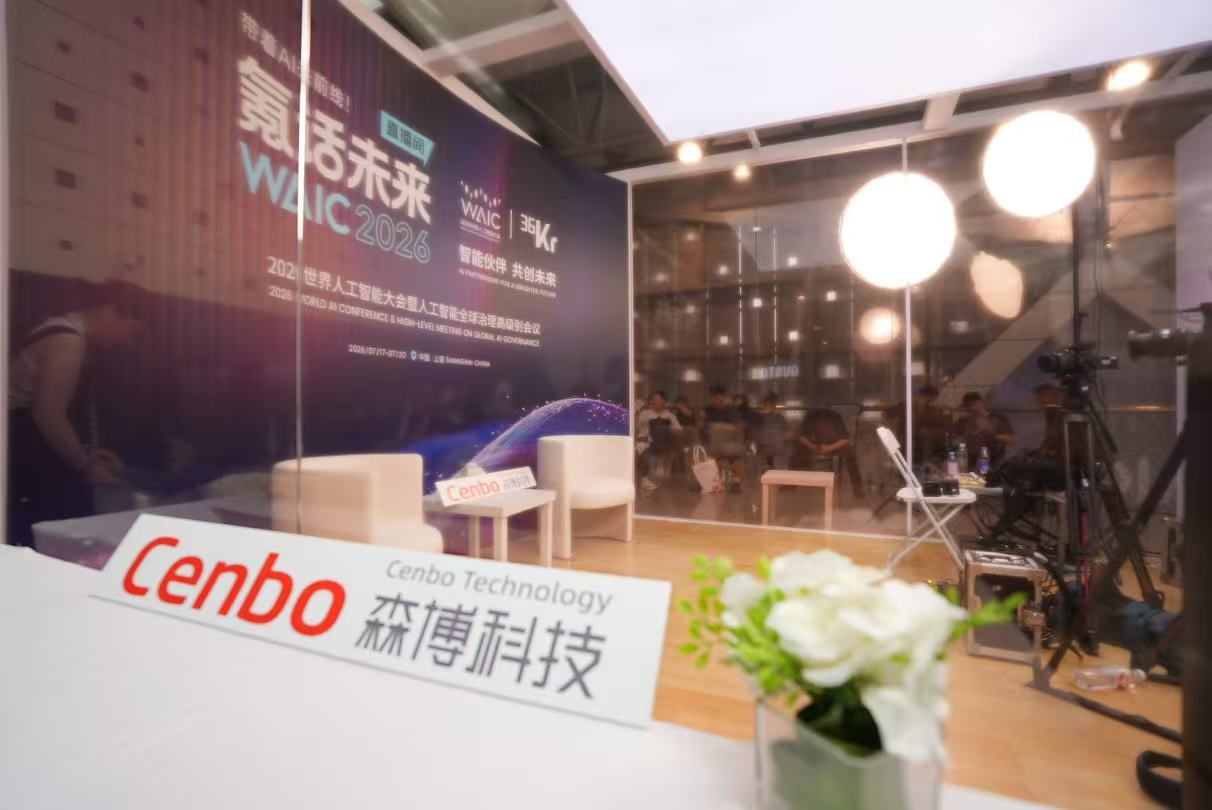
On July 17, 2026, the World Congress on Artificial Intelligence opened in Shanghai. As a key content point for 36Kr, which has been deeply reporting on the WAIC site for three years in a row, the live studio “Kr’s Future Talk” also began local dialogue on the first day of the conference. Mr. Yu Linyi, Chairman of Senbo Technology, said: We agreed to an exclusive on-site interview for 36Kr’s “Kr’s Future Talk” held at WAIC. He shared Senbo’s practical transformation journey from a marketing services company to an AI-driven technology services company, focusing on topics such as enterprise-level AI, agent implementation, industry know-how, and closed-loop business.
The theme of this year’s WAIC is “Intelligent Partners co-creating the future.” Compared to the past few years, when the industry focused on model functionality, parameter scaling, and demo effectiveness, the AI industry discussion in 2026 has clearly shifted downstream. Businesses are more concerned about whether AI will enter real-world workflows, perform specific tasks, and be validated by business outcomes. In other words, AI is no longer just a “responsive” tool, but a business partner that can collaborate with humans, be integrated into organizations, and generate ROI.
This also clarifies the implementation logic for enterprise-level agents. Generic models are already powerful enough, but when you move into enterprise scenarios, it’s often not the model itself that truly determines the effectiveness of an application, but the business context, industry methodologies, process decomposition capabilities, and verifiable results feedback. Senbo Technology’s observations focus on this very point. The key to the success of enterprise-level AI is not the technology to find scenarios, but the scenarios that refine the technology.
Below is an edited transcript of the conversation reviewed by 36Kr editors.
36Kr: This year’s WAIC theme is “Intelligent Partners, Co-Creating the Future,” and the industry is also discussing how agents can truly integrate into enterprise workflows. From Senbo’s perspective, what are the most notable changes in enterprise-level AI applications in 2026?
A: This year’s WAIC, with its theme of “Intelligent Partners,” is itself the clearest sign of a turning point in the industry. AI has finally moved beyond the “tech showcase demo” stage and is evolving from an “on-demand tool” to a “partner that needs to be integrated into business workflows and provide measurable ROI.”
The most core change we observed is that the industry as a whole is moving from a “technology discovery scenario” to a “technology refinement scenario.” For the past two years, the industry has competed to see who has the larger model parameters and more sophisticated demos. This year, whether it’s an investor or a business customer, the first question they ask is always, “How much will this benefit my business and how much will it save me?” A recent Harvard Business Review study found that 85% of agent projects fail to deliver value. The root cause is not that the technology is inadequate, but that these AI systems have never been deployed in a real business environment, and because they lack situational awareness, clear decision criteria, and feedback on results, they are inevitably unable to become productive partners.
This is also what we most want to share at WAIC this year. The determinants of success for enterprise-level AI agents never lie in the model layer, but in the empirical closed loop within the actual business operations.
36Kr: Senbo has transformed from a marketing services company to an AI-driven technology services company. What was the real turning point in this transformation?
A: It wasn’t a specific big model release or funding round. The real turning point was when we built our own premium brand, Keyur.
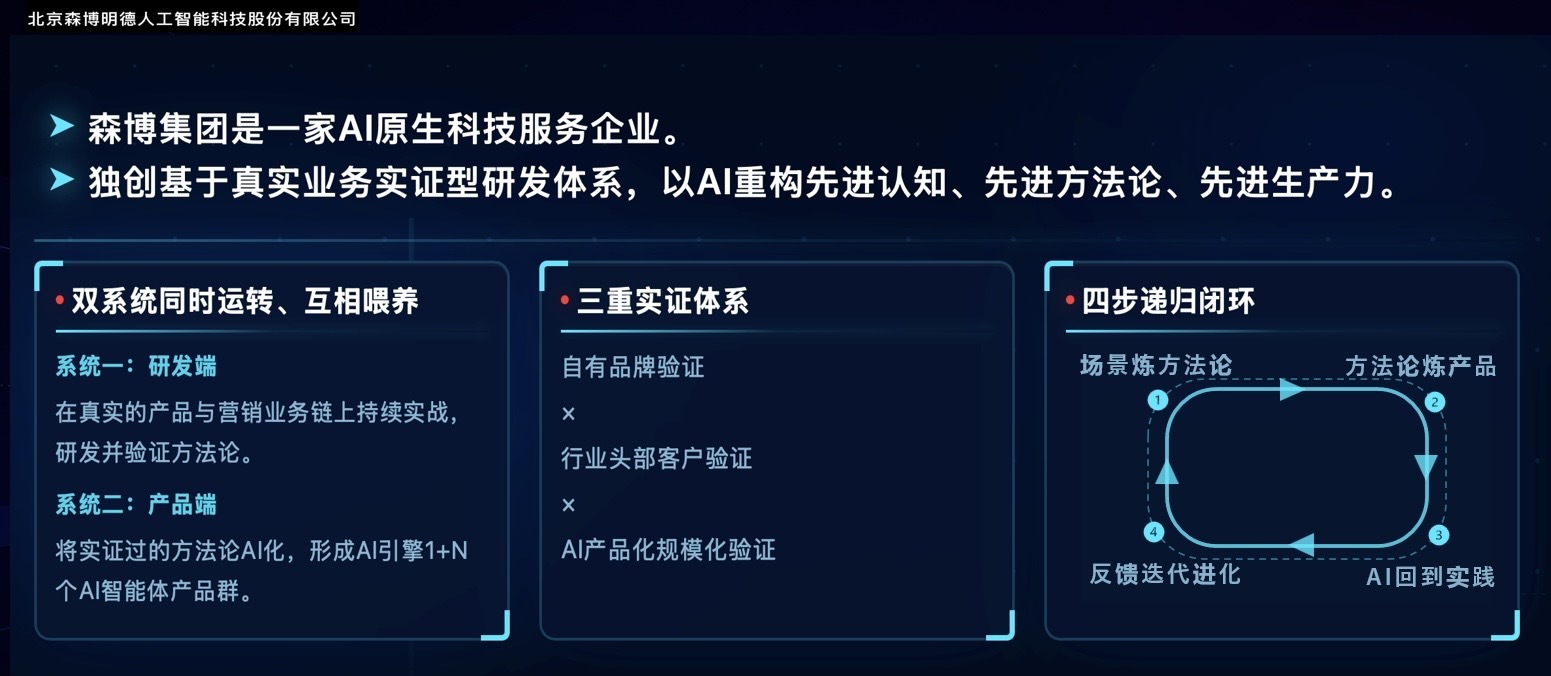
With 20 years of experience in strategic consulting and digital marketing, Senbo has served industry leaders such as Midea, Haier, and Hisense. But until we spent three to four years growing international premium lifestyle brand Keyur into a top player in the smart garment care machinery category, we had never fully operationalized a brand’s entire lifecycle from 0 to 1 to industry leader. During this process, we suddenly realized: All the methodologies we have accumulated over the years can be completely input into an AI and turned into an agent that can be manipulated. And the empirical business results generated by AI allow us to iterate on our methodology.
Through the process of “first making our own business successful,” we were able to establish a dual system flywheel of “methodology + AI agent.” We also realized that in order to build an enterprise-grade AI agent, we couldn’t teach our clients to swim from the shore; they first had to get in the water and complete the first lap on their own. This is a core tipping point for AI transformation.
36Kr: If you had to summarize what Senbo is currently working on in one sentence, what would you say is the biggest difference compared to traditional marketing services companies?
A: In a nutshell, Senbo leverages a methodology based on 20 years of industry know-how and experience to train a team of domain-savvy and operationally capable AI agents for enterprises.
The biggest difference from traditional marketing companies is that traditional companies sell the “human experience.” The consultant submits a proposal, the team executes it, and the contract ends upon handover. Senbo sells “empirically validated AI productivity based on real business operations.” These agents are more than just chat tools, they are “AI employees” with 20 years of industry knowledge and criteria, validated in real-world business scenarios, and able to iterate continuously 24/7. Delivery is just the beginning, as these agents evolve with your business.
What sets us apart from pure AI companies is that other companies’ AI is “smart but not necessarily domain savvy,” whereas our AI products are “smart and also have deep industry knowledge.”
36Kr: Mr. Senbo has always emphasized that “the competition in AI applications is not about technology, but about industry know-how.” Which of the experiences you have accumulated over 20 years of serving clients is best suited to transform you into an agent?
A: Senbo has practical experience in operationalizing scenarios and has made some incremental abstractions. Scenarios that meet the following three requirements are most suitable for AI agentization: First, the scenario requires a high degree of digitalization. Without a digital foundation, it is difficult for AI to drive operational workflows. Second, this scenario requires companies to invest significant personnel and budget, leaving ample room for agents to reduce costs and improve efficiency. Third, the scenario must have clear criteria, be falsifiable, and be supported by a methodology with validated results.
Let’s look at some concrete examples.
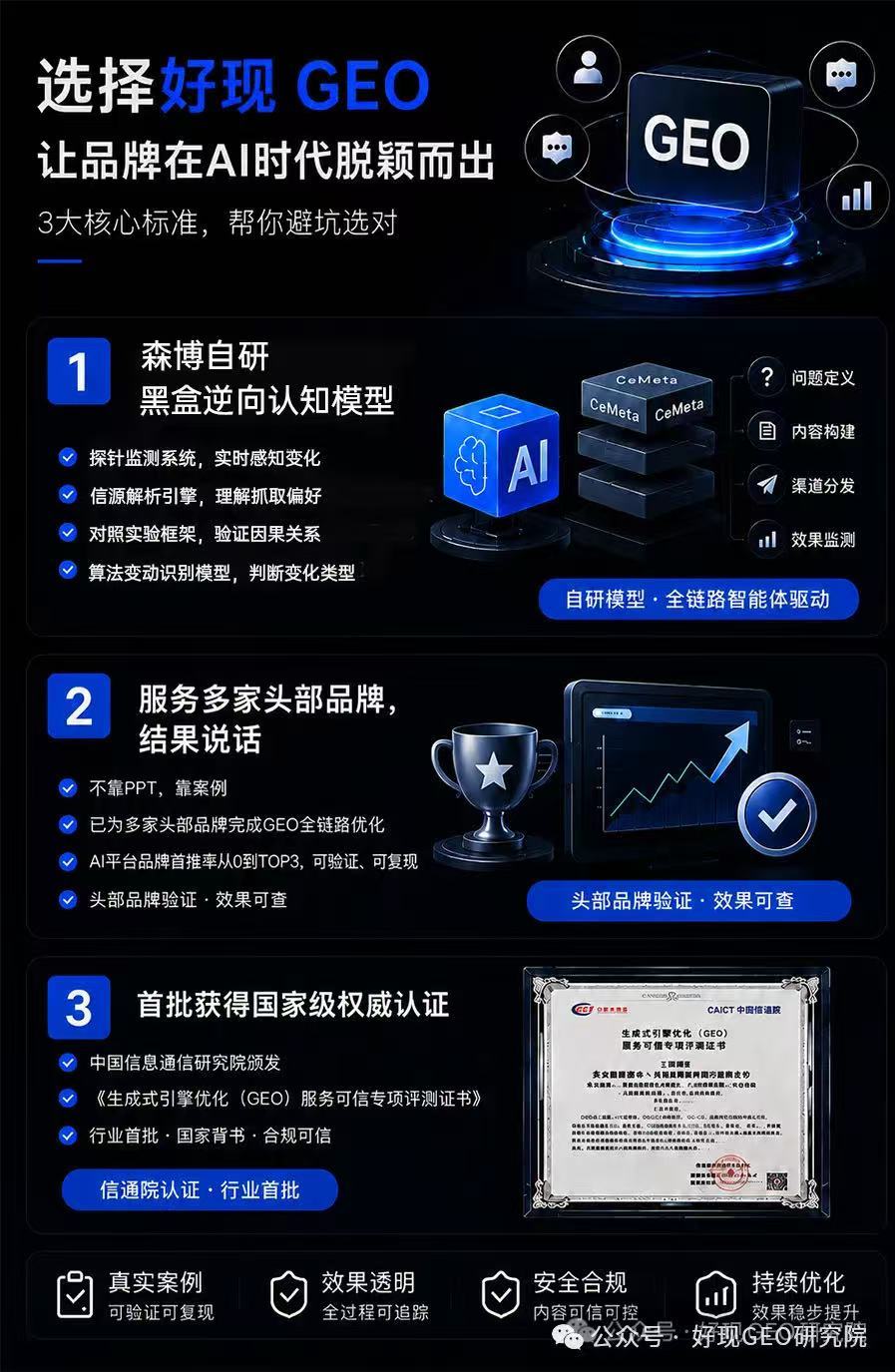
For example, in the field of GEO (AI Search Optimization), Senbo has accumulated a complete methodology system. We use a “multi-source mapping technique” to infer what questions users ask on our AI platform from multi-source search data across Baidu, Douyin, and Xiaohongshu. We use the “ACCS model” to build a four-layer source reliability system to ensure that the AI reaches a unified correct answer from every channel point. We use a “PCR model” to track differences in source preferences across each AI platform. For example, over 60% of Baidu Baike’s referrals go to Ernie Bot, and over 35% of Douyin’s content goes to Doubao. These rules are not arbitrary assumptions, but rather conclusions refined through tens of thousands of real-world tests across five major AI platforms.
Another example is influencer marketing, where Senbo uses the “dual tower matching model” (mutual matching of product feature tower and influencer feature tower) to screen influencers, and the “CVI-5D model” to evaluate influencers, quantifying scores across five dimensions: communication ability, conversion power, degree of fan matching, willingness to cooperate, and effective comment cost. This model has helped common clients such as Haier save 19.58 million yuan in marketing costs and reduce influencer marketing overflow costs by 34%.
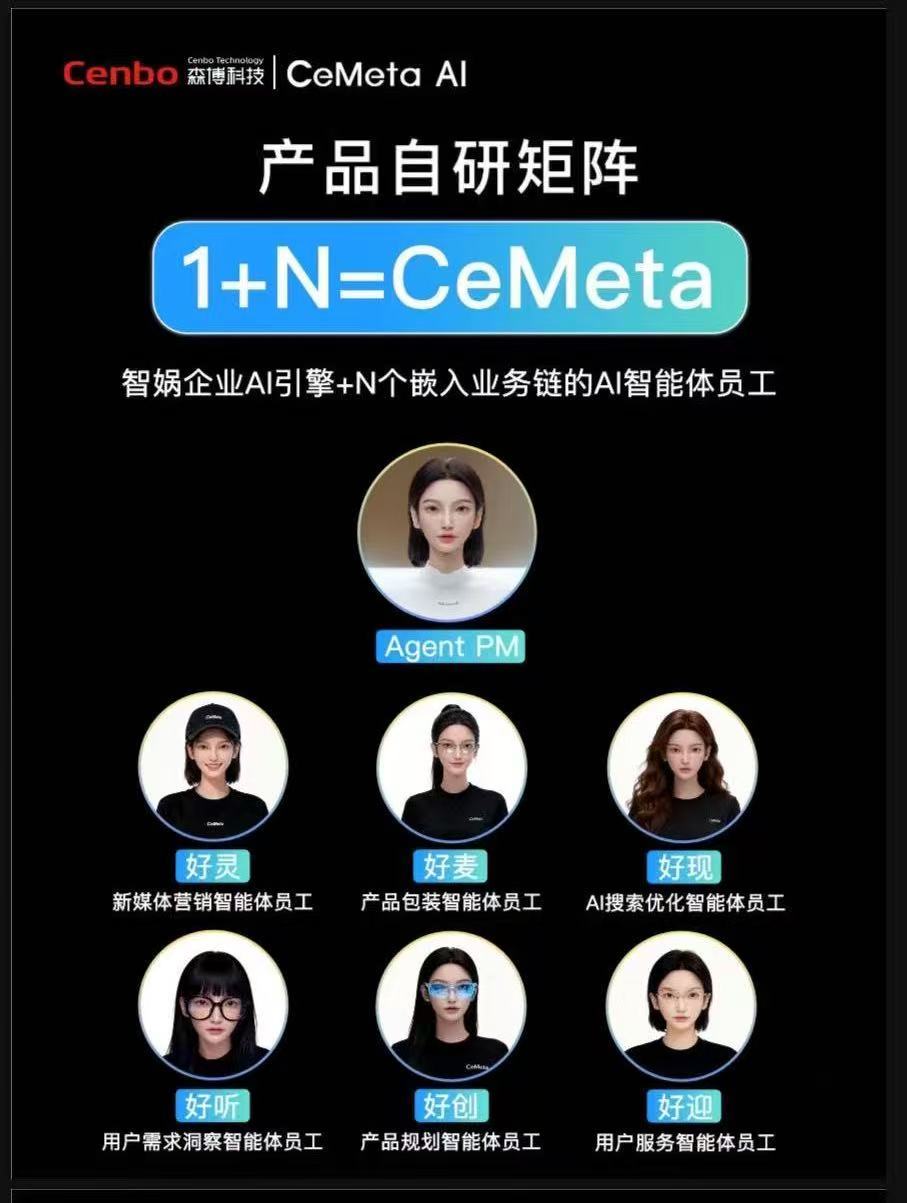
All these methodologies that were previously in the minds of senior consultants are now refined into algorithms, distilled into skills, and translated into behavioral logic that AI agents can execute.
36Kr: Many companies working on agents tend to stop at the tool layer, making it difficult to truly integrate them into business workflows. How does Senbo incorporate context, workflows, and decision criteria from clients’ real-world scenarios into its CeMeta AI engine and agent product systems?
A: At the heart of this is Senbo’s Business Demonstration Research and Development System (BER). All AI agent products must be fully validated in real business operations before being delivered to clients.
Specifically, this process is divided into four steps:
First step: decomposing the scenario. Instead of asking a client, “What AI capabilities do you need?”, we immerse ourselves in the business and break down the entire workflow of the scenario, defining what the inputs are, what the criteria are, what the outputs are, and how to verify correctness. For example, in a GEO scenario, you break down the requirement “Let AI recommend brands” into five links (problem definition → content creation → channel distribution → effectiveness monitoring → attribution iteration), with clear data metrics for each link.
Second step: Building the methodology. Encode decomposed criteria and heuristics into logic that agents can execute. Rather than simply feeding documents into a large model, we transform every decision node into a quantifiable decision tree.
Third step: practical validation. Deploy agents directly into your business operations. The “Haoxian” GEO agent was first validated on Senbo’s in-house brand Keyur, increasing the brand recommendation rate from 0 to over 90%. It was subsequently introduced to Haier and achieved a 96% first-time recommendation rate for new products and a 100% first-time recommendation rate for after-sales service calls. The “Haoling” influencer marketing agency was first validated in an internal project and then introduced into Haier. There, the overflow rate for AI-selected influencers was 13% higher than manual selection.
Fourth step: Results feedback loop. All business results are fed back to adjust the model. Reinforce correct outputs, correct incorrect outputs, and maintain continuous iteration. This is why our agents become more accurate over time. Agents are not static tools; they are evolving partners within your business environment.
The foundation of this system is our “Zhiwa” AI engine. It is an enterprise marketing AI engine that is responsible for the integrated management of a company’s context (knowledge), tools (tools), standards (standards), and data (data), allowing all agents to operate within a company’s actual business environment.
36Kr: From GEO and influencer marketing agencies to e-commerce marketing agencies, Senbo is already achieving tangible results across the marketing chain. Will this “scenario refinement technology” approach be extended to a broader range of enterprise-level AI agent services in the future?
A: The answer is absolutely yes.
The value of AI is by no means limited to the marketing chain. Over the past five to six years, Chibo has been helping enterprises transform their AI, and he has abstracted a methodology for enterprise AI transformation. This methodology is the support system behind the recently trending term FDE (Field Deployment Engineer). With this support system, Senbo is now partnering with major large model vendors and many more industry-leading companies to replicate this Business Demonstration Research and Development System (BER) into broader enterprise business workflows including R&D, production, supply chain, and customer service.
This year’s WAIC theme is “Intelligent Partners Co-Creating the Future.” Our understanding of “co-creation” is that AI companies do not develop products behind closed doors and sell them to customers. Instead, we work with our clients to hone AI into a truly productive AI partner in real-world business operations. This means you provide the scenarios, we provide the methodologies and AI capabilities, and together we define the ROI of AI and improve your company’s full-link productivity.
If you want to experience an AI agent that can truly integrate into your business workflows and deliver measurable ROI, feel free to add Senbo’s enterprise WeChat account. Let’s explore the real path to enterprise AI upgrades together, starting with the “Haoxian” GEO agent.