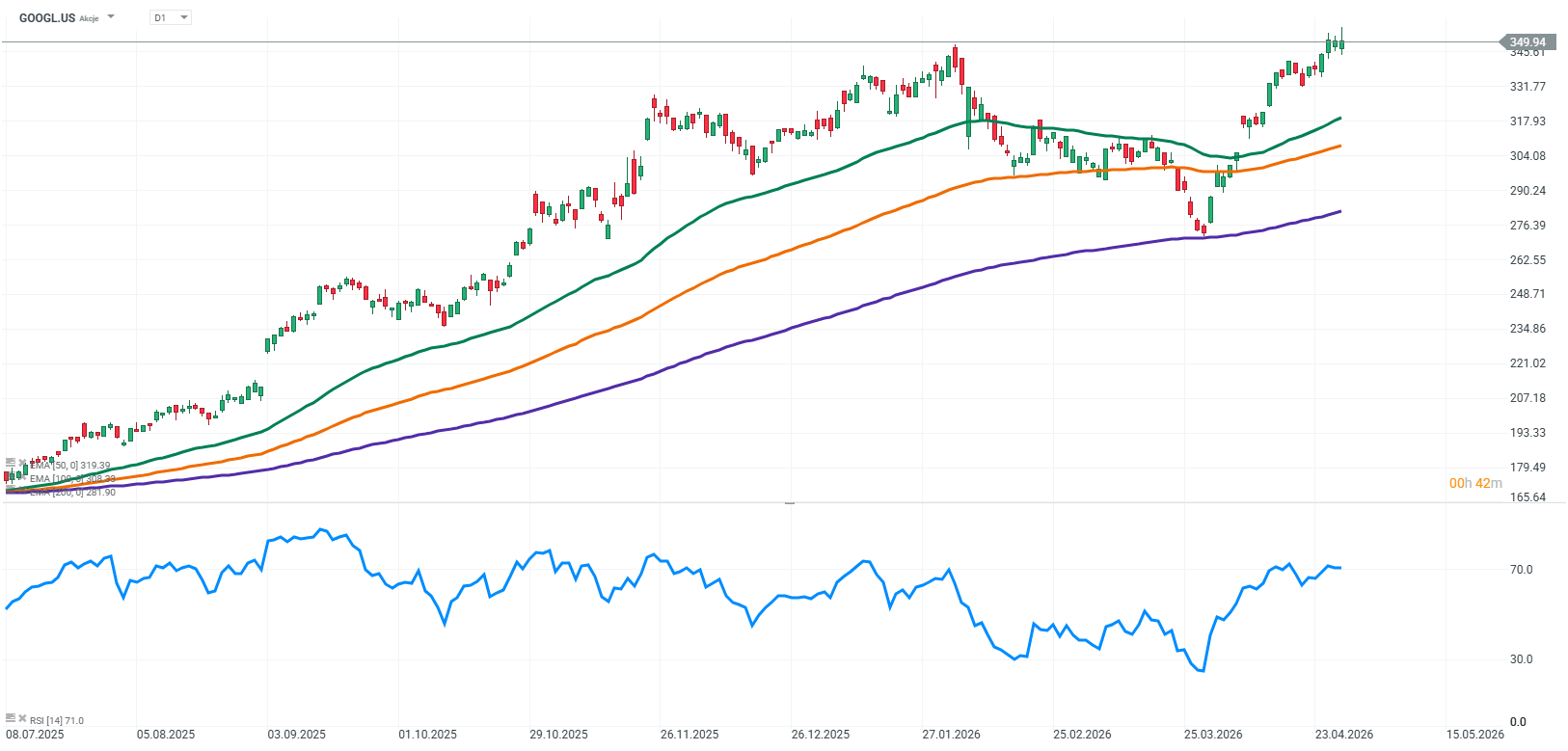
Market reaction to Alphabet’s latest financial results has been clearly positive. The company’s shares rose about 3-4% in after-hours trading after the earnings release, indicating that investors not only appreciate the size of the earnings growth, but are also starting to reevaluate the structure of the company’s overall growth profile.
Alphabet had a very strong performance in the first quarter of 2026, with revenue reaching $109.9 billion, clearly beating the market consensus. But more importantly, operating profit increased 30% year over year and operating margin improved to 36%. This shows that despite the increased investment intensity, the company is not only growing, but also growing more and more efficiently.
Our core business remains unchanged and continues to perform very well. Google Services continues to see steady growth, with advertising revenue increasing 16% year-over-year to $90 billion. Search, which remains the backbone of the entire ecosystem, grew by 19%. This is especially important given previous concerns about the impact of artificial intelligence on the company’s business model. Rather than dampening demand, AI is having the opposite effect. This means increased user engagement and query volume, which directly translates into increased revenue.
However, the real tipping point for this report is Google Cloud. This segment is not only growing, but growing at a pace that is changing the way Alphabet is perceived. Cloud revenue increased 63% year-over-year to more than $20 billion, significantly exceeding expectations. More importantly, what’s happening in terms of profitability? Operating profit nearly tripled, showing that size is increasingly working in the company’s favor.
This is where the most tangible impact of investments in artificial intelligence will be visible. Increased adoption of models such as Gemini and strong demand for AI infrastructure is transforming Google Cloud from a capital-intensive growth segment to one of the key revenue drivers for businesses. What was once considered a major long-term investment commitment is now increasingly resembling one of the most profitable cloud businesses on the market. In practice, this means that Alphabet is evolving from an advertising-driven company to a more diverse technology platform, with cloud and AI playing an increasingly central role.
Against this backdrop, it is even more impressive that the company has maintained high profitability despite large capital investments. Capital spending in the first quarter reached $35.7 billion, more than double the level from the same period last year. This clearly highlights Alphabet’s position in the global race for dominance in AI and infrastructure. However, the main difference compared to previous quarters is that the market is starting to see tangible returns from these investments.
The slightly weaker element of the report remained YouTube, which performed slightly below expectations. However, the overall picture does not change significantly as the core segments continue to show strong momentum.
More broadly, the results highlight a structural shift in Alphabet’s business model. A few years ago, the company relied almost entirely on advertising. The company is now increasingly supported by two parallel growth engines: a profitable and stable advertising business and a rapidly expanding cloud division that is starting to generate significant profits. This dual structure increases business resilience while also increasing impact on long-term AI-driven trends.
This report significantly changes the narrative about Alphabet. The company has demonstrated its ability to maintain a strong advertising core, aggressively expand its cloud business, and invest heavily in future technologies at the same time. Most importantly, artificial intelligence is no longer just a promise, but is becoming a real driver of financial performance.
Alphabet is no longer seen as just an advertising leader, but increasingly as one of the leading companies defining the era of artificial intelligence.
Source: xStation5
The contents of this report have been prepared by XTB SA, registered office in Warsaw, Prosta 67, 00-838 Warsaw, Poland, (KRS number 0000217580) and supervised by the Polish Supervisory Board (No. DDM-M-4021-57-1/2005). This material is a marketing communication in the sense of art. Article 24(3) of Directive 2014/65/EU of the European Parliament and of the Council of 15 May 2014 on markets in financial instruments and amendments to Directive 2002/92/EC and Directive 2011/61/EU (MiFID II). The marketing communications are not information that recommends or suggests investment recommendations or investment strategies within the meaning of Regulation (EU) No 596/2014 of the European Parliament and of the Council of 16 April 2014 on market abuses and of the European Parliament and of the Council, Repealing Directive 2003/6/EC and of the European Commission Directive 2003/124/EC. 2003/125/EC and 2004/72/EC and Commission Delegated Regulation (EU) 2016/958 of 9 March 2016, Regulation (EU) No. 596/2014. Other advice within the meaning of the Financial Instruments and Exchange Act of July 29, 2005 (i.e., Journal of Laws 2019, No. 875, as amended), including in the field of investment advisors. Marketing communications are prepared with the utmost diligence and objectivity, present the facts known to the authors on the date of their creation, and are free of any evaluation elements. Marketing communications are prepared without taking into account the client’s needs or personal financial situation and do not present any investment strategy. Marketing Communications do not constitute a sale, offer, offer to subscribe, solicitation of an offer to buy, advertisement, or promotion of any financial product. XTB SA is not responsible for any actions or omissions of the Customer based on the information contained in this marketing communication, in particular for the acquisition or disposal of financial instruments. Where marketing communications contain information regarding performance with respect to financial products, they do not constitute any guarantee or prediction of future performance.