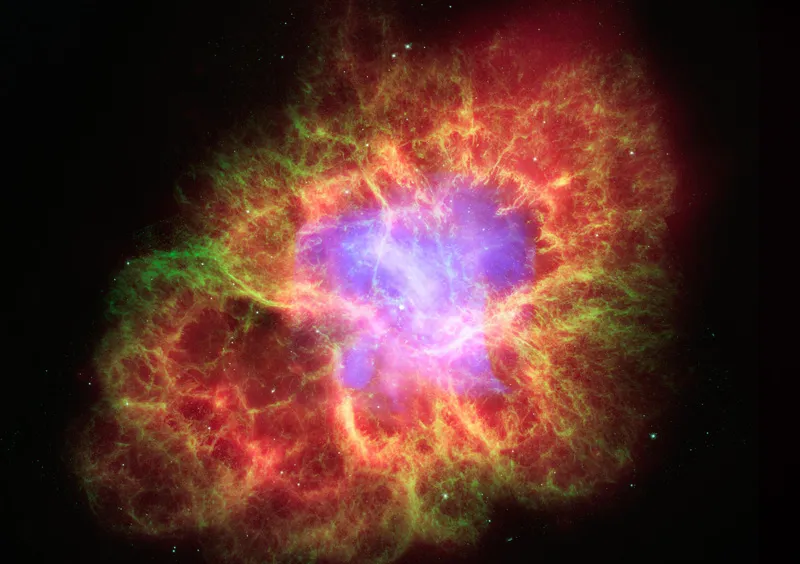
Newswise — A research team is harnessing an explosion in astrophysics to understand the mysterious forces that act on nature’s tiniest building blocks: the atomic nucleus. In a new study published in Nature Communications, the team uses machine learning and artificial intelligence to decipher data from astrophysical observations to better understand at the quantum level how neutrons and protons interact in dense matter.
“This work represents the first time in the field that we have been able to firmly link the macroscopic and microscopic domains and infer neutron-proton interactions directly from astrophysical data,” said Los Alamos physicist Ingo Tews. “By using artificial intelligence and machine learning, our framework has enabled us to take data from remarkable astrophysical phenomena and infer the complex physics of nuclear forces.”
The research team, which included scientists from Germany’s Darmstadt University of Technology, used data detected in 2017 of gravitational waves from a binary neutron star merger, as well as data from telescopes that study neutron stars and their X-ray emissions. Their study uses machine learning to enable important constraints on nuclear binding that describe the strength of nuclear forces.
“Our approach opens a new door into the strong physics of neutrons and protons and their impact on neutron stars,” said co-lead author Isaac Svensson, a scientist at Darmstadt University of Technology. “Our framework allows us to do everything from observing neutron stars to interactions in dense matter.”
AI connects big and small physics
Taking a model of many interacting neutrons and applying it to an incredibly dense neutron star would be “computationally intractable.” Solutions for a single model can run for hours on thousands of CPU cores. Seeking a faster, more easily accessible method, the research team built an AI framework that can almost instantly link nuclear interactions to the properties of neutron stars.
One of the machine learning algorithms used by the research team leveraged an understanding of the underlying quantum physics to arrive at a rapid solution to the properties of dense materials. The second algorithm is a neural network trained on large amounts of data that connects the properties of dense matter and neutron stars. The algorithm serves as a proxy for more complex, high-fidelity calculations in hopes of predicting neutron star properties such as size and tidal deformation.
“The tool we developed worked extremely well and far exceeded our expectations,” said Los Alamos scientist and co-lead author Rahul Somasundaram. “For astrophysical data from recent phenomena, our framework provides constraints that are consistent with what we know from ground-based experiments, albeit with large uncertainties. For future observations with next-generation detectors such as Cosmic Explorer, our approach will provide even better constraints that are very powerful.”
Strong force at neutron star density
Interactions between neutrons are caused by the strong force, one of the four fundamental forces in the universe (along with electromagnetism, the weak force, and gravity). Strong forces bind quarks and gluons to nucleons, such as neutrons and protons, and the nucleons bind to each other within the atomic nucleus. Constructing a robust quantum description of this powerful force remains a challenge in physics.
Neutron stars are some of the densest objects in the universe and are so dense that they can have a mass about twice that of the Sun, despite having a diameter as small as 24 kilometers. Matter of such density exhibits properties similar to those of matter at the center of an atomic nucleus and must be described by modeling interactions between nucleons at the quantum level. In other words, the interactions between dense neutrons determine the properties of the entire neutron star.
By linking the properties of neutron stars with the quantum mechanical properties of neutrons, the researchers are building a way to ultimately understand the properties of the strong force at the highest densities explored anywhere in the universe. This could also help scientists place constraints on exotic forms of matter, such as phase transitions to quarks and gluons.
The team’s insights were particularly helpful in learning about three-body forces, one of the least understood aspects of nuclear interactions. Three-body forces occur only when three or more neutrons or protons are in close proximity.
Gravitational waves and X-rays
The research team used data from the 2017 merger of two neutron stars. At this time, gravitational waves (ripples in the fabric of space-time caused by collisions) were observed by the Laser Interferometer Gravitational-Wave Observatory (LIGO). The event, named GW170817, revealed the tidal deformation that occurs when two neutron stars approach each other. The research team also used data from NASA’s Neutron Star Interior Composition Explorer (NICER). The telescope collects X-ray data from rapidly rotating neutron stars and uses the bending of light in gravitational fields to extract the neutron star’s mass and radius.
Drawing from multiple sources and types of signals in this way is called “multimessenger” astronomy. The research approach developed by the team can be directly applied as new facilities become operational. Several large next-generation detectors are in the planning stages, including the Einstein Telescope in Europe and the Cosmic Explorer in the United States.
paper: “Estimation of three-neutron coupling from multi-messenger neutron star observations” Nature Communications. DOI: 10.1038/s41467-025-64756-6
funding: This research was supported by the National Science Foundation, the Los Alamos Institute-Initiated Research and Development Program, and the Office of Nuclear Physics in the U.S. Department of Energy’s Office of Science. Human resource development for scientists and teachers. and advanced scientific computing research. The European Research Council and the German Research Foundation also supported this research.
LA-UR-25-31936