
Machine learning tools can accelerate all stages of materials discovery, from initial screening to process development. Whether the goal is to identify new uses for known materials or design new molecules for specific tasks, these tools help materials scientists find correlations in large data libraries.
Still, machine learning tools aren't magic. “A software tool is only as good as the people using it and how well they understand the context of the problem they're trying to solve,” said Audra Koch, data scientist at Brewer Science. “AI still relies heavily on human understanding and cannot replace human judgment.”
The need for human expertise begins at the very beginning with the development of training datasets. “The preprocessing step before you start the data training process is even more important than the model itself,” Koch says.
For example, Edward Pyzer-Knapp and colleagues at IBM demonstrated a set of tools to extract materials information from technical papers and similar sources. This is a difficult task with many potential selection biases. Individual papers may include tables of material properties and process conditions, images of crystal structures and deposited films, and graphs showing the dependence of properties on time, temperature, or applied electric field. Results stored in tables or described in text are relatively easy to extract, but image and graphic data can be difficult to access.
Piserknap said information supporting the paper's conclusions will be disseminated through all of these elements. For example, a complete focus/exposure matrix may be required to explain the pattern collapse behavior of photoresists. Knowledge graphs that do not capture all available information will inevitably produce inaccurate results.
The problem of selection bias is further complicated by the fact that not all material has been equally thoroughly researched, and not all research is available under open license. Whether a particular publication or author contributes to an open source data library influences its content and therefore the behavior of models trained on them.
Discovery of a better photoacid generator
Materials discovery efforts that use existing technical literature as a starting point are clearly more likely to be successful in well-researched areas. For example, the IBM group investigated photoacid generators (PAGs) for chemically amplified photoresists. Sulfonium- and iodonium-based PAGs are common in industry but are toxic and bioaccumulative. The IBM Group wanted to identify a more environmentally friendly PAG cation. First, we constructed a knowledge graph from approximately 6,000 patents, papers, and other sources, from which we extracted the chemical structures of approximately 5,000 sulfonium PAGs.[1]
For most of the molecules they studied, the raw materials contained only limited information about key material properties. As a next step, they used machine learning-assisted simulation tools to calculate UV absorption and select sustainability parameters for hundreds of promising sulfonium compounds. They used the resulting set of structure-property relationships to train a generative model.
The generative model generated 3,000 candidate sulfonium cations. However, Pyzer-Knapp pointed out that the training dataset does not incorporate many of the constraints that apply to PAGs for semiconductor lithography. To identify promising candidates, the group used a combination of expert-defined rules and expert machine learning algorithms. These expert-in-the-loop algorithms learn by observing the ranking of candidate materials by human experts.
A Bayesian optimization process then prioritized over 400 candidates based on expected excitation energy and oscillator strength, both important PAG characteristics. The optimized workflow allowed us to find the PAG molecule that appears to perform best at a wavelength of 193 nm while screening only half of the candidates on average.
Finally, human toxicology experts selected the most promising candidate materials for synthetic and experimental studies. Overall, our machine learning-powered methodology allowed us to reduce the number of candidates by a factor of 100 in this final stage.
Another challenge is that model results alone are not sufficient to understand the material system in question. “The best we can do right now is rank the importance of features and build interactive profiling tools and correlation plots to show how changing a few inputs at a time affects the model's predictions,” said Brewer Science's Koch.
Generative models may generate a list of candidate materials that score better than existing materials on some important parameters, but cannot explain the physical mechanisms responsible for their behavior. Therefore, we provide only limited guidance for process development and device integration.
Producing better magnets while reducing supply chain risk
Permanent magnets are a key component of electric motors, making them essential for electric vehicles, power-generating wind turbines, and other elements of the post-fossil fuel industrial infrastructure. Unfortunately, the rare earth minerals commonly used in these magnets pose significant risks to the supply chain.
Claudio Zeni and colleagues at Microsoft Research used the company's MatterGen software to generate candidate magnet materials that include more readily available construction materials. They fine-tuned a generic model using 605,000 known structures with DFT magnetic density labels to produce structures with targeted magnetic density values. They quantified potential supply chain risks using the Herfindahl-Hirschman index, a measure of the amount of competition within an industry. Constraining the model to only use materials with HHI less than 1,250 completely removes elements such as cobalt and gadolinium from the generated structure.[2]
However, Zeni pointed out that the model preferentially generates structures with triclinic space groups that do not have reflection symmetry, a bias that is not present in the training data. Without further experimental verification, it is impossible to determine whether materials with low symmetry really make better permanent magnets, or whether the structure of the model itself is limiting the results produced.
With the advent of GPUs and advanced machine learning tools, simulations are significantly faster. “Our latest version, which was just released in June, is now 5x to 10x faster on GPUs,” said Anders Blom, Principal Solutions Engineer at Synopsys. “A few years ago we were celebrating being 20% faster.”
Still, not everything can be calculated in a reasonable amount of time. Therefore, screening approaches use multiple filters to step-by-step narrow down the list of candidate materials.
Screening crosspoint memory selector
Crosspoint memory is a new high-density memory option. Although its name suggests that it can rely solely on row and column activation to select individual cells, actual devices use transistor or diode selector elements to prevent sneak path activation. Most designs combine the selector with a phase change material that acts as the actual storage battery. According to Samsung's Ha-Jun Sung and colleagues, selector-only memory reduces manufacturing complexity and increases device density by eliminating phase-change materials. However, the Ge-As-Se compounds used in traditional selectors may not be an ideal choice for selector-only memory.
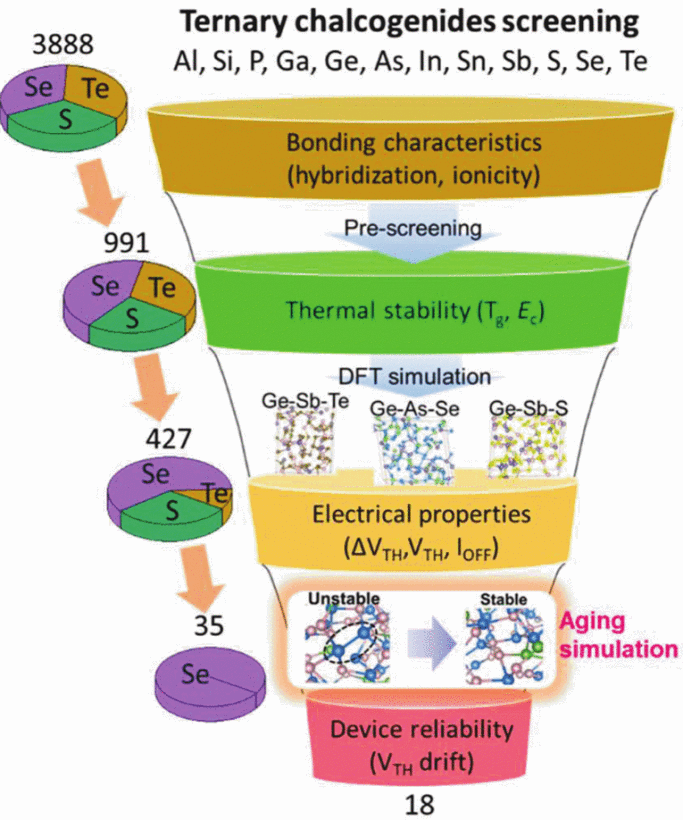
In an effort to identify better selector materials, the Samsung group focused on A-form ternary compounds.×By×100-xyHere, A and B are extracted from Al, Si, P, Ga, Ge, As, In, Sn, and Sb. X can be S, Se, or Te. They identified 3,888 potential materials from this group and used a series of ab initio computational screens. First, we focused on binding properties such as orbital hybridization and ionicity, which measures the degree of charge localization. Selection criteria were defined using equipment reported in the literature and the list of candidate materials was narrowed down to 991. DFT simulations of amorphous structures have made it possible to evaluate the cohesive energy associated with thermal stability. A total of 427 candidates emerged from this screen.[3]

Figure 1: Four-step screening process to identify amorphous chalcogenide materials suitable for selector-only memory applications. Source: IEDM
In the next step, density-of-state calculations were used to extract properties such as activation energy and trap density, allowing the IV properties to be simulated. Sixty-eight candidates, all Se-based chalcogenides, also passed this screen.
Finally, we simulated the electric field behavior of the remaining candidates to identify those likely to act as selector-only memories. In these memories, interfacial defects form space charge regions in the presence of nonuniform electric fields. A larger space charge area means a wider memory window. Increasing the selenium content reduces the memory window. This final screen identified 35 candidates with properties superior to Ge.20as30Se50existing material.
As these examples demonstrate, “AI” for materials discovery is not a single tool, but a rapidly evolving toolkit. To decide which tools to deploy, human engineers need to know what training data is available and relevant to the task, and have a thorough understanding of the problem to be solved.
- Peiser-Knapp, EO, Pitera, JW, Starr, PWJ, et al. “Accelerating materials discovery using artificial intelligence, high-performance computing, and robotics.” NPJ Computometer 8, 84 (2022). https://doi.org/10.1038/s41524-022-00765-z
- Zeni, C., Pinsler, R., Zügner, D. Generative models for the design of other inorganic materials. Nature 639, 624–632 (2025). https://doi.org/10.1038/s41586-025-08628-5
- H. -J. Sung et al., “First-principles screening of amorphous chalcogenides in selector-only memory (SOM) by electrical properties and device reliability,” 2024 IEEE International Conference on Electronic Devices (IEDM), San Francisco, CA, USA, 2024, pp. 1-4, doi: 10.1109/IEDM50854.2024.10873326.
Related books
Machine learning tools accelerate materials discovery
But only if the data is in a machine-understandable format and context.


