story
March 3, 2026

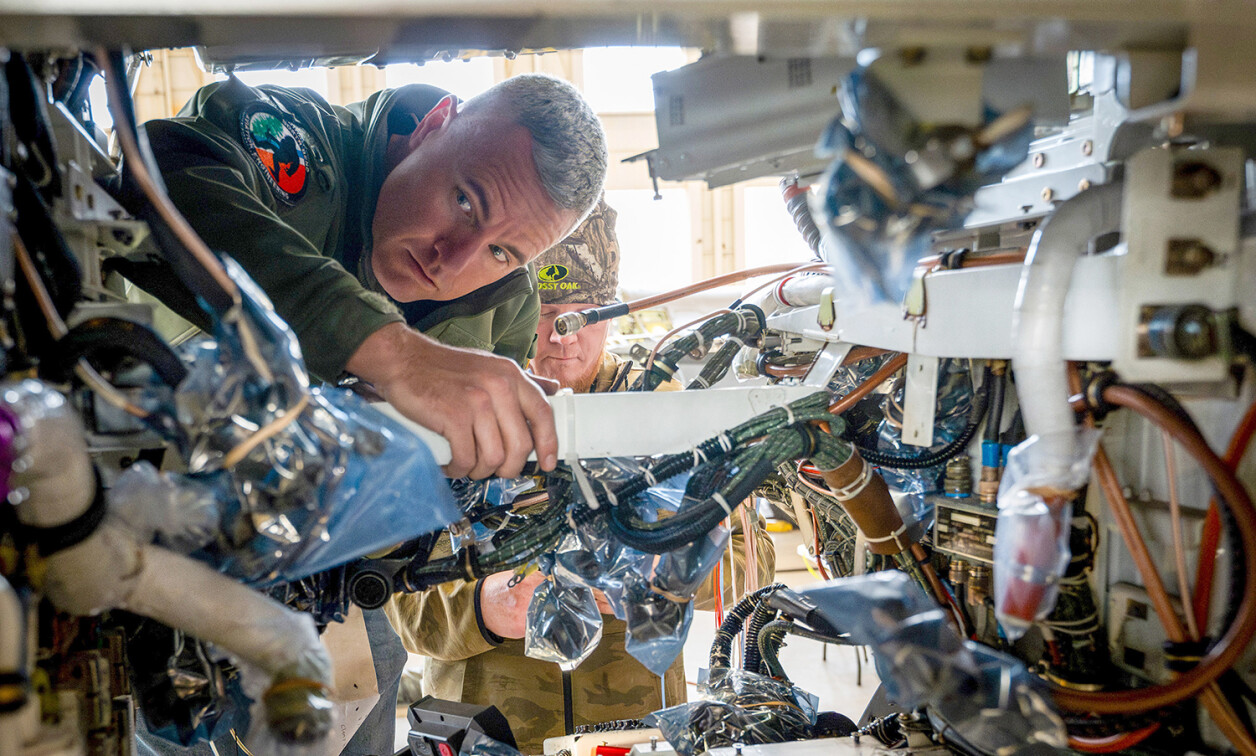
Across defense programs, autonomous artificial intelligence (AI) systems frequently stall between successful prototyping and field deployment. The software itself is rarely the limiting factor. Rather, progress will be slowed if the underlying hardware platform is not designed to evolve with rapidly changing AI workloads, sensors, and operational requirements. As the U.S. Department of Defense (DoD) accelerates AI adoption, platform-level engineering decisions that determine whether autonomous AI platforms can move from experimentation to real-world operations are becoming increasingly important.
Over the past several years, the deployment of autonomous artificial intelligence (AI) systems has become a strategic priority for the U.S. Department of Defense (DoD). Autonomous platforms are expected to sense, decide, and act independently, often in competitive environments. While advances in AI algorithms and software models are getting a lot of attention, the practical challenge facing many programs is not whether they can achieve autonomy, but whether they can deploy, maintain, and iterate on it at operational speed.
Evolution of U.S. Department of Defense AI Policy
The Department of Defense and other U.S. organizations have used AI on an ad hoc basis for the past 60 years, but 2018 saw a shift to a more formalized process with the publication of the 2018 Department of Defense Artificial Intelligence Strategy. The document outlining the 2018 strategy emphasized the need to create a centralized infrastructure for AI development, bridge AI technology development from the Department of Defense research and engineering communities, and provide international leadership in military ethics and AI safety.
Subsequent DoD strategies, such as the 2020 DoD Data Strategy and the creation of the Chief Digital and Artificial Intelligence Office (CDAO), further emphasized the importance of a data-centric approach and optimizing AI capabilities across the DoD.
The 2023 Department of Defense Data, Analytics, and AI Adoption Strategy focuses on speed, agility, learning, and accountability. It emphasized decentralizing authority and creating tight feedback loops between developers and end users, all aimed at strengthening decision-making processes within the Department of Defense. Our 2023 Strategy outlines a fundamentally guiding approach to AI, rather than a step-by-step guide.
2026 AI Acceleration Strategy
On January 12, 2026, the U.S. Secretary of Defense released a memo outlining the Department of Defense’s AI strategy. The 2026 Policy represents a major shift in both the tone and approach to the Department of Defense’s use of AI. Previous policy documents set a range of top-level goals, including improving access to data across departments, developing top-notch AI talent, and responsible development of AI applications. In contrast, the 2026 policy focuses on speed and “identifying and eliminating bureaucratic barriers to deeper integration that are remnants of traditional information technologies and modes of warfare.”
From a more practical perspective, the 2026 DoD AI Strategy goes further than its predecessor in establishing what it calls seven Pace Setting Projects (PSPs), which will initially be managed by the CDAO. These PSPs “serve as a tangible, results-oriented vehicle to rapidly complete the construction of the foundational AI enablers needed to accelerate AI integration across the department.” For the Department of Defense, these PSPs also aim to establish a new standard of execution for AI adoption: “a single accountable leader, aggressive timelines, measurable outcomes, and rapid iterations where failure drives learning and improvement.”
What faster speeds mean for autonomous AI systems
The 2026 DoD AI Strategy reframes speed of adoption as a requirement rather than a vague goal. This speed is perhaps most important for autonomous systems, where AI must operate onboard, in real-time, and often without relying on cloud connectivity or centralized computing resources.
For hardware designers and manufacturers, accelerating the speed of development and iteration poses fundamental tensions. While AI software stacks evolve rapidly as models grow, hardware platforms are expected to remain stable, certifiable, and deployable over a long service life. When platforms are designed based on fixed assumptions, they often require redesigns, recertification cycles, and delays that ultimately conflict with acceleration goals.
Why autonomous AI stalls between prototyping and deployment
Many autonomous AI prototypes are built to prove feasibility under controlled conditions. Power budgets are tightly set, thermal solutions are optimized for known workloads, and I/O configurations are selected for specific sensor suites. While these designs may be successful in demonstration, they often lack the flexibility needed for deployment.
As AI software stacks mature, new requirements and operating conditions often emerge. This may include higher inference speeds or more complex models, adding more or different sensors or data sources, expanding mission scope, new accelerators or computing architectures, or increasing environmental or reliability constraints.
If the hardware platform cannot adapt to the integration of these changes, the program will stop. Redesigns consume schedules and budgets, and advances in AI software outpace hardware readiness. As a result, the gap between the capabilities of autonomous AI platforms and the reality of what hardware can actually implement them widens.
Power and thermal headroom for speed
Designing a platform with average power consumption in mind is not enough for autonomous AI hardware. First, AI workloads are dynamic in nature. Additionally, inference patterns are not uniform, which can lead to unexpected spikes in computing demands. Another factor: The power profile of AI accelerators will likely evolve with each new generation.
Making conscious design decisions to increase both the power and thermal headroom of a hardware platform early in product development provides flexibility to meet the many AI acceleration challenges outlined by the Department of Defense. This hardware flexibility allows you to introduce new models and accelerators without redesigning. Additionally, these buffers can handle fluctuating computational load spikes in AI workflows without throttling performance. Perhaps most importantly, building in this headroom from the early stages of design reduces the need for late-stage thermal recertification or recertification.
The thermal margin plays a particularly important role. Edge systems are exposed to extreme temperatures, limited airflow, shock, vibration, and size constraints, all of which place unique demands on system design. Since external thermal conditions cannot be controlled, engineers must focus on minimizing internal heat generation and maximizing heat dissipation. Localized heating due to hardware accelerators can destabilize decision loops in unexpected cases. Platforms designed with sufficient margin from the beginning can evolve without sacrificing reliability or flexibility.
Modular architecture increases adaptability and flexibility
Modularity has become a key design principle for accelerating the iterative design and development of autonomous AI platforms. Modular computing, I/O, and subsystem architectures allow the platform to quickly adapt to changes in hardware, software, or the environment. The modular architecture greatly simplifies aspects such as sensor upgrades and calculation changes without redesign or requalification.
Rather than treating integration as a one-time event, a design that uses a modular platform better supports continuous iteration and ultimately aligns hardware development with the rapid feedback-driven execution model that PSP emphasizes. (Figure 1)
[Figure 1 ǀ Mission-command hardware gets configured as part of preparations for the Next Generation Command and Control (NGC2) capability during a technical setup and integration event as part of an Army exercise in late 2025. During the exercise, soldiers integrated advanced power systems and emerging AI-enabled tools onto vehicles in support of the Army’s NGC2 initiative, which aims to deliver faster, more resilient and more data-driven decision-making on the battlefield. U.S. Army photo by Staff Sgt. Tyler Ewing.]
Rapid experiment-to-production reproducibility
As mentioned earlier, autonomous AI platforms often stall in the transition period between experimentation and production. Lab platforms optimized for flexibility often lack the consistency and robustness needed for deployment in the field, and production hardware may arrive too late to impact AI development.
To this end, PSP will benefit from a platform that supports early experiments with production hardware, using standardized interfaces that persist from the lab to the field, and a manufacturable design that can be expanded without significant changes.
Durability and flexibility as an acceleration tool
Making durability decisions early in the design process can greatly accelerate deployment. Pay early attention to characteristics such as shock, vibration, and extreme temperatures. Power quality and signal integrity. Mechanical and thermal robustness also helps reduce downstream delays caused by redesign, recertification, and field failures.
The Department of Defense’s AI Acceleration Strategy sets speed as a primary goal, stating that AI capabilities must move more quickly between concept, design stages, and operational deployment. Ultimately, iteration speed depends more on the capabilities and flexibility of the underlying hardware platform than the AI software stack. Hardware systems built with careful attention to flexibility and modularity can evolve at the pace outlined in Department of Defense policy.
True speed in the deployment of autonomous AI systems does not come from speeding up the software layer alone. It comes from designing a platform that is intentionally designed to be able to modify, scale, and survive the transition from experimentation to production deployment.
Drew Thompson is a technical writer and content specialist at Sealevel Systems. in Global Studies and International Affairs from Northeastern University. Thompson can be contacted at: [email protected].
Sea Level System https://www.sealevel.com/
Featured companies