Abridge, a company focused on transforming clinical documentation with AI, announced the integration of GPT-5.5 into its platform. This advancement aims to significantly improve the quality and efficiency of generating clinical notes from recorded medical conversations. This development highlights continued advances in large-scale language models and their practical application in the demanding medical field.
Visual TL;DR. The provider’s burden goes to Abridge. Abridge integrates GPT-5.5 integration. GPT-5.5 integration enables improved fact extraction. Improved fact extraction powers AI notes. Enhanced AI memos will reduce your burden. Reduced burden allows for an improved patient experience. ABRIDGE values partnerships.
Provider Burden: High demands on clinicians for documentation and note-taking
Abridge: A company transforming clinical documentation with AI
GPT-5.5 Integration: New AI Models to Enhance Clinical Note Generation
Improved fact extraction: Accurately extract more facts from conversations.
Enhanced AI notes: higher quality, more accurate clinical documentation
Reduced burden: Providers spend less time on documentation.
Improved patient experience: Healthcare providers can focus more on patient care
Partnerships: Collaboration is driving AI advancement in healthcare
Visual TL;DR
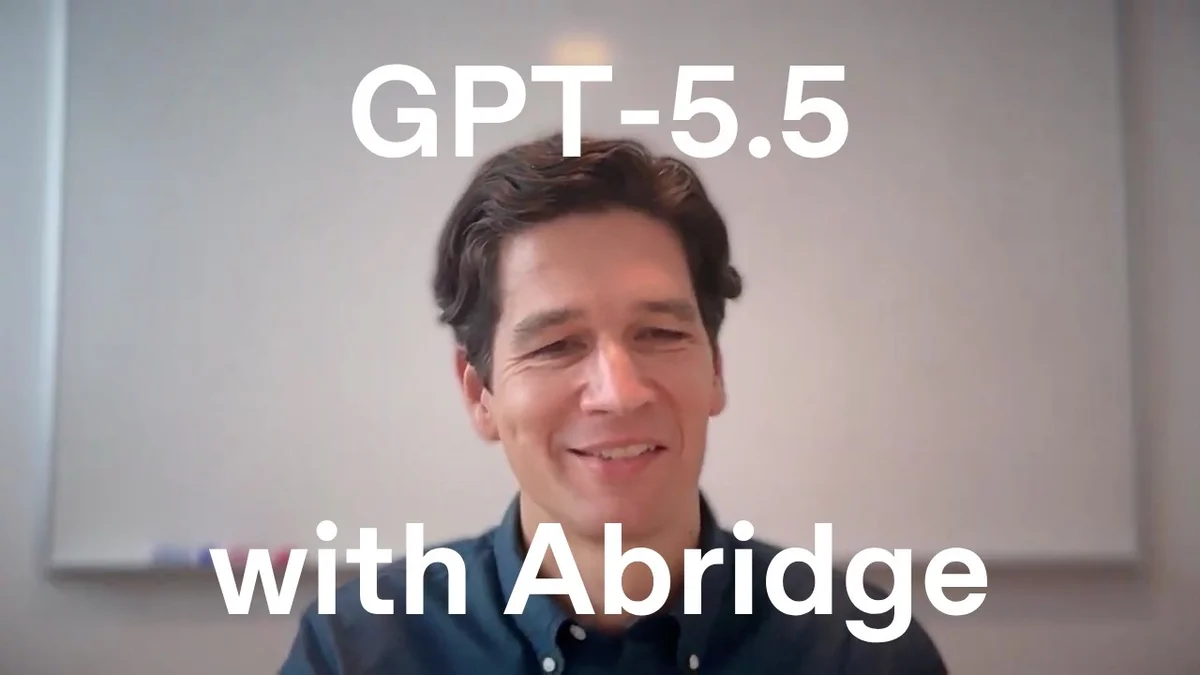
Matt Saunders, senior engineering manager for note generation at Abridge, explained the impact of this new integration. He noted that the use of GPT-5.5 will increase the number of facts that can be accurately extracted directly from conversations between healthcare providers and patients. This directly impacts the quality of notes provided and ultimately aims to provide healthcare providers with the best possible experience for their patients.
The full discussion can be found at: OpenAI YoutubeYouTube channel.
Built with GPT-5.5: Summary of Clinical AI Notes — from OpenAI Youtube
Improving clinical conversations with AI
At the core of Abridge’s technology is its ability to analyze conversations between healthcare providers and patients. The goal is to extract the most important information and transform it into comprehensive clinical documentation. Elaborating on how this process works, Sanders said, “We work collaboratively with the conversations between providers and patients, extracting the most important information from them and working to help providers get the best possible documentation for their visit.”
This process is especially important in areas where accurate and detailed record-keeping is paramount. The ability to capture nuances from conversations and turn them into structured notes greatly reduces the administrative burden on clinicians, allowing them to focus more on patient care.
GPT-5.5: A leap forward in consistency and fact extraction
Abridge’s exploration of GPT-5.5 has yielded promising results, especially in areas where previous AI models have sometimes struggled. “There are several interesting things for us regarding GPT-5.5,” Sanders emphasized. He specifically pointed to improved first-pass consistency and fact extraction when analyzing conversations. Previously, nuances in patient-provider interactions could lead to confusion and inaccuracies in AI-generated notes. However, GPT-5.5 shows that the model has a “much better level of fact extraction in these specific situations.”
This improvement in accuracy is extremely important in clinical practice. When healthcare providers and patients discuss complex medical histories and sensitive information, AI’s ability to accurately identify and record important details is essential. Sanders further explained that GPT-5.5’s ability to perform “ambient documentation is very powerful in reducing the burden on healthcare providers, enabling more complete documentation, and better capturing what is actually happening in the clinical conversation.”
The value of partnerships in advancing AI
Abridge clearly acknowledged its fundamental role in advancing AI research and development. “We see a lot of value in OpenAI, which ultimately allows us to deliver better notes across the board,” Sanders said. Reliance on leading AI models, such as those developed by OpenAI, highlights the collaborative nature of AI progress, with specialized applications built on the broad capabilities of the underlying models.
The use of advanced AI models like GPT-5.5 in the healthcare field has the potential to reshape the way healthcare professionals manage administrative tasks. Abridge and companies like it are working to address provider burnout by automating and improving accuracy of clinical note creation and improving the overall quality of patient care through improved data management.