
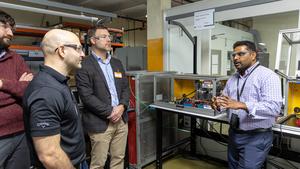
Industry experts from technology companies, equipment manufacturers, utilities, and data center developers recently gathered at the Department of Energy’s Oak Ridge National Laboratory to brainstorm research and technology pathways to securely integrate AI data centers with the power grid.
“Data centers are reshaping the nation’s electricity load profile faster than any other sector in history, especially when training AI,” said Michael Pesin, assistant secretary for the Grid Systems and Components Division at DOE’s Office of Power.
His remarks kicked off the Next Generation Data Center Power and Security Workshop at ORNL. The workshop focused on supporting U.S. AI leadership while keeping both data centers and power affordable, resilient, and secure. Topics include data center and grid integration, power architecture, supply chain challenges, new grid technologies, cybersecurity, and more.
To support this goal, Pesin said there is a need to keep existing power plants operational and streamline the approval process for new transmission lines. At the same time, AI data centers must limit the impact of extreme weather events and manage rapid fluctuations in power demand, which can fluctuate by hundreds of megawatts during AI training.
Pesin introduced the “do no harm” principle, stressing that data centers must be able to integrate with the grid without causing instability and provide support in emergencies. Citing the recent severe cold snap on the East Coast as an example, he cited DOE orders issued under Section 202(c) of the Federal Power Act that have made it easier to access backup power generation from industrial sites and data centers, preventing grid instability and rolling blackouts.
Robert Wagner, ORNL’s associate laboratory director for energy science and technology, said national laboratories play a critical role in turning science into practical solutions. ORNL recently announced a new next-generation data center laboratory that brings together expertise in energy technology, high-performance computing, cybersecurity, and grid science.
The workshop identified priority research areas including DC power architectures that reduce energy losses, flexible and networked microgrids, real-time energy demand modeling and feedback, developing the U.S. manufacturing workforce, secure data center design, and grid equipment security testing.
Grid interconnection and data center flexibility
Utility companies and technology companies discussed the difficulty of predicting future data center energy demands. “Rapid growth has created a challenge in not fully understanding the long-term power requirements of each facility,” said Ray Knotts, senior director of the Tennessee Valley Authority. “We don’t want to disrupt our data center, jeopardize reliability, or increase system costs based on shaky engineering estimates.”
Grid and data center experts took a closer look at how data centers can support the grid by reducing demand during periods of peak stress on the system.
“Faster grid connectivity is an incentive for hyperscalers to consider flexibility,” said Anish Gaikwad, deputy director of the Electric Power Research Institute, which facilitates data center flex programs. “You don’t need flexibility every hour of the year. You might only need a few hours at certain times of the year.” If data centers reduce demand at that point, utilities may not need to add as much capacity, reducing interconnect latency.
In his keynote speech, STAK Energy CEO Sparrow Mahoney advocated for data centers that are completely independent of the electrical grid. Her company is planning a large data center platform in Alaska that will be powered by natural gas from neighboring Prudhoe Bay. “As the load shape of AI data centers changes and data architectures advance, we argue that locations like Alaska’s North Slope are not only viable, they are now inevitable,” Mahoney said.
Supply chain and workforce challenges
No matter where a data center is built, it relies on a tight supply chain of gas turbines, switchgear, circuit boards, and transformers. Much of the shortage is due to overseas procurement of materials such as electrical steel sheets for transformers, copper for conductors, semiconductors for chips, graphite for grid batteries, and gallium for optical fibers.
Some manufacturers said increasing recycling of rare materials from obsolete equipment would help. Workshop panelist Ross Bernson, president and CEO of Indium Corporation, advocated pursuing new mining, refining, and capture of trace metals domestically and in North America. Additionally, new technologies are emerging that reduce metal consumption and improve system performance and efficiency, such as solid-state transformers that use less copper.
However, new technologies can create new bottlenecks in the supply chain. Workshop panelist Evira Melgoza, data center product and technology leader at Schneider Electric, welcomed innovations such as solid-state transformers and DC architectures, but expressed concerns about their supply chains. Schneider is aggressively expanding and expanding its manufacturing capacity as demand surges and unprecedented data center growth is expected.
Mr. Melgoza emphasized the importance of continued investment in workforce development for manufacturing readiness. He said building a strong pipeline of engineers, distribution electrical engineers and power electronics experts is essential to supporting industry growth.
Workshop participants said national labs can support the smooth integration of AI data centers by developing validated load models for data center energy usage and creating “resilience hubs” to develop and test next-generation data center technologies.
UT-Battelle manages ORNL for the Department of Energy’s Office of Science, the largest supporter of basic research in the physical sciences in the United States. The Office of Science works to address some of the most pressing challenges of our time. For more information, visit energy.gov/science.
Disclaimer: AAAS and EurekAlert! We are not responsible for the accuracy of news releases posted on EurekAlert! Use of Information by Contributing Institutions or via the EurekAlert System.


