Nell Watson
A quiet revolution is underway in boardrooms around the world. Artificial intelligence, once confined to routine tasks, is now poised to transform leadership. As AI systems become increasingly sophisticated, leaders must grapple with a pressing question: How does AI improve performance?
The potential of AI in leadership is fascinating. Imagine a CEO who stays up all night continuously analyzing market trends and making decisions based on petabytes of data rather than intuition. Advanced agent AI systems are coming to market that can create sophisticated plans of action for complex problems. These systems can process and synthesize information at a scale far beyond human capabilities, potentially leading to more informed decisions across many aspects of business operations.
Agent AI systems can analyze massive data sets at incredible speed, scouring financial reports, market trends, and news articles to discover key insights and patterns. Using advanced machine learning algorithms, they can identify subtle correlations and anomalies and predict future trends with a high degree of accuracy.
But the rise of AI in leadership roles is not without challenges: there is the risk of dehumanization of the workplace and mistakes being made that could have serious consequences. The UK's Horizon Post Office scandal, where a flawed AI-driven system led to a wrongful conviction, is a stark reminder of the potential pitfalls of unchecked algorithmic decision-making.
Therefore, it is imperative to embrace AI as an augmentation of human leadership, not a replacement. AI should be seen as a tool to handle data analytics, day-to-day decision-making, and augment our capabilities. This will allow human leaders to focus on strategy, innovation, and talent management, creating a symbiotic relationship that leverages the best of both worlds: AI and human intelligence.
Fostering AI literacy is crucial. Leaders need to develop a deep understanding of AI concepts and capabilities so they can ask the right questions and make informed decisions about AI implementation. This knowledge becomes even more important as AI technology evolves rapidly and requires continuous learning.
Leaders must promote responsible use of AI and ensure transparency, fairness, and accountability. This includes regular audits for bias and unexpected results, especially in critical areas such as hiring and performance reviews. Clear guidelines should clearly distinguish which tasks are suitable for AI processing and which require human judgment. Regular training and open dialogue about working with AI will help build a culture of human-AI synergy.
As AI becomes more deeply involved in decision-making processes, ensuring transparency and accountability will become increasingly important. Human oversight must be maintained, especially for high-profile decisions. Leaders must remain vigilant about how AI may exacerbate inequalities or perpetuate bias. Employees must have the means to challenge AI-driven decisions.
The impact of AI on leadership will vary across cultures and economies. Countries that are more accepting of technology in governance may see AI-enabled leadership adopted more easily. In contrast, countries with stronger traditions of human-centered leadership may face more resistance.
Uniquely human qualities such as emotional intelligence, ethical judgment, and the ability to inspire a team remain invaluable. Leadership is not just about making the right decisions, it's about inspiring others, navigating uncertainty, and embodying the values of the organization. While AI is better at data analysis and pattern recognition, the human aspects of leadership such as empathy, ethical judgment, and the ability to inspire remain essential.
We must be careful about over-reliance on AI. As we have seen in companies that have aggressively pursued automation, over-reliance on AI can lead to a dangerous erosion of organizational knowledge and creative thinking. The most successful ventures are often built on non-consensus ideas that require human intuition and the courage to pursue them.
The essence of leadership will never be the same. Future leaders will need to be comfortable coexisting with AI, interpreting its insights, and applying it in the context of human values and goals. They will need to promote the ethical use of AI and ensure that these powerful tools are deployed responsibly and in line with societal values.
In executive search, agent AI can be transformative. By analyzing vast amounts of data on executive performance, leadership style, and cultural fit, these systems help identify the ideal candidates to lead your company to success. AI-powered search can identify leaders with the vision and skills to drive innovation and long-term value creation.
While AI has the potential to significantly enhance leadership capabilities, it cannot replace the core of great leadership. Rather, AI gives us the tools to become more informed, efficient, and potentially effective leaders. The key to succeeding in this new era is finding the right balance: letting AI handle the tasks it excels at, and focusing human capabilities where they can truly add unique value.
Successful leaders in an AI-enhanced future will be those who can harness the analytical power of AI while retaining their human touch. They will use AI to make more informed decisions, but rely on their judgement to address complex ethical considerations. They will use AI to identify trends and opportunities, but use their creativity and intuition to come up with innovative solutions.
Will AI make us better leaders? The answer is conditionally yes, but only if we approach it with wisdom, ethical sensitivity, and a determination to maintain the human element that is at the core of truly great leadership. The rise of AI-enabled leadership may be closer than we think, but its success will ultimately depend on our ability to integrate these powerful tools with human expertise and values.
About the Author
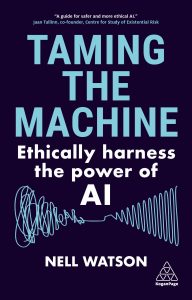
 Nell Watson Nel is a researcher, author, speaker, and applied technology ethicist. She has spoken at venues such as the World Bank and the United Nations General Assembly, inspiring audiences to work toward a brighter future. Nel is the author of Taming the Machine: Ethically leverage the power of AI, published by Kogan Page.