

An international collaborative research team has developed image recognition technology that can accurately determine a battery's elemental composition and number of charge/discharge cycles by using AI learning to examine only the surface morphology of the battery.
KAIST (President Lee Kwang-hyun) announced on July 2 that Professor Hong Seung-beom of the Department of Materials Science and Engineering, in collaboration with the Electronics and Telecommunications Research Institute (ETRI) and Drexel University, has developed a method to predict the major element composition and charge/discharge state of NCM positive electrode materials with 99.6% accuracy using a convolutional neural network (CNN)*.
*Convolutional Neural Network (CNN): A type of multi-layer feed-forward artificial neural network used to analyze visual images.
The research team pointed out that scanning electron microscopes (SEMs) are used in semiconductor manufacturing to inspect wafers for defects, but are rarely used to inspect batteries. Battery SEMs are only used in research to analyze particle size, and in the case of degraded battery materials, the reliability is predicted from the shape of the crushed particles and fractures.
The research team determined that it would be revolutionary if an automated SEM, similar to semiconductor manufacturing, could be used in the battery manufacturing process to inspect the surface of cathode materials to determine whether they have been synthesized according to the desired composition and whether their lifetime is reliable, thereby reducing reject rates.
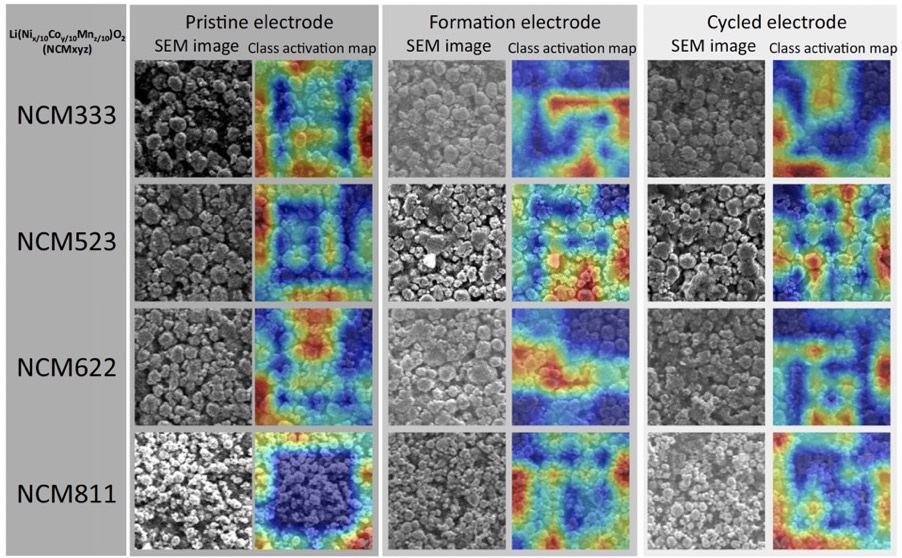
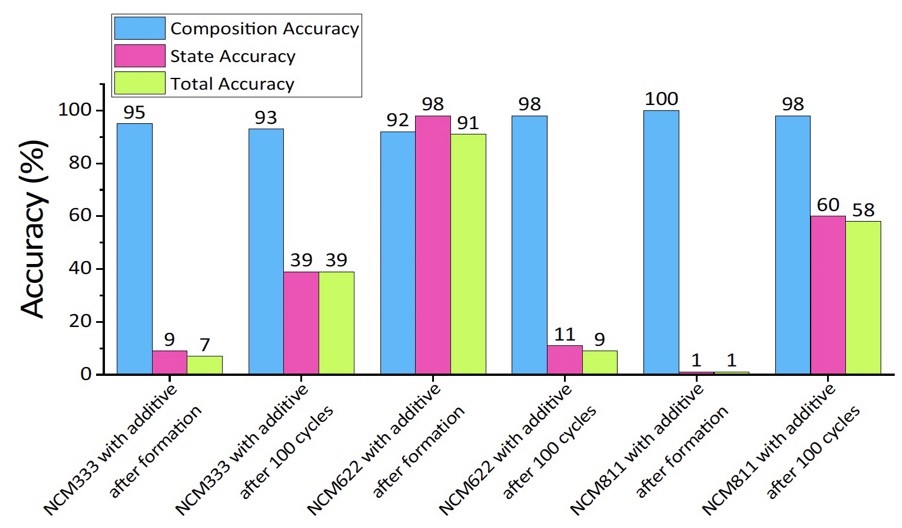
The researchers trained a CNN-based AI that can be applied to self-driving cars to learn surface images of battery materials, enabling it to predict the main elemental composition of the positive electrode material and the charge-discharge cycle state. The results showed that the method can accurately predict the composition of materials containing additives, but has low accuracy in predicting the charge-discharge state. The research team plans to further train the AI with various forms of battery materials manufactured by different processes, and ultimately use it to inspect the composition uniformity and predict the lifespan of next-generation batteries.
“In the future, artificial intelligence will be applied not only to battery materials, but also to a variety of dynamic processes such as the synthesis of functional materials, generating clean energy through nuclear fusion, and understanding the fundamentals of elementary particles and the universe,” said Joshua C. Agar, a professor of mechanical engineering at Drexel University and a co-investigator on the project.
Professor Hong Seung-beom of KAIST, who led the research, said, “This research is significant in that it is the first in the world to develop an AI-based methodology that can quickly and accurately predict a battery's major element composition and state from structural data of micron-scale SEM images. The methodology developed in this research to identify the composition and state of battery materials based on microscopic images is expected to play an important role in improving the performance and quality of battery materials in the future.”
The research was conducted by KAIST Materials Science and Engineering graduates Dr. Jimin Oh and Dr. Jiwon Yeom, co-first authors, in collaboration with ETRI's Professor Josh Agar and Dr. Kwang Man Kim. It was supported by the National Research Foundation of Korea, the KAIST Global Singularity Project, and an international collaboration with a US research team. The research results were published in the international journal npj Computational Materials on May 4th. (Paper title: “Composition and state prediction of lithium-ion cathodes using a convolutional neural network trained on scanning electron microscope images.”)
/Public Release. This material from the originating organization/author may be out of date and has been edited for clarity, style and length. Mirage.News does not take any organizational stance or position and all views, positions and conclusions expressed here are solely those of the authors. Read the full article here.


