In recent years, ML algorithms have gained increasing recognition in ecological modeling, including the prediction of soil organic carbon (SOC). However, their application to small-scale datasets typical of long-term soil studies has not yet been thoroughly evaluated, especially in comparison with traditional process-based models. A study conducted in Austria used data from five long-term experimental sites to compare ML algorithms, such as random forests and support vector machines, with process-based models, such as RothC and ICBM. Findings revealed that ML algorithms performed better when large datasets were available. Nevertheless, accuracy decreased with smaller training sets or more rigorous cross-validation methods, such as leave-one-site-out. Process-based models, although requiring careful tuning, provide a better understanding of the biophysical and biochemical mechanisms underlying SOC dynamics. Therefore, this study recommended combining ML algorithms and process-based models to leverage the strengths of each to provide robust SOC predictions at different scales and conditions.
Because SOC is crucial for soil health, maintaining and increasing SOC levels is essential to enhance soil fertility, increase resilience to climate change, and reduce carbon emissions. Achieving these goals requires reliable monitoring systems and predictive models, especially considering changing environmental conditions and land use practices. In this effort, both ML and process-based models play an important role. ML is particularly useful with large datasets, while process-based models provide comprehensive insights into soil mechanisms. Combining these approaches can mitigate the shortcomings of each and lead to more accurate and adaptive predictions, which are essential for effective soil management and environmental conservation worldwide.
Methods and Materials:
The study utilized data from five long-term field experiments conducted across Austria, covering a range of management practices aimed at SOC accumulation. These experiments covered 53 treatment variations, providing detailed information on soil properties, climatic data and management practices. Soil samples were collected at 0-25 cm depending on the location. Daily climatic data such as temperature, precipitation and evaporation were obtained from high-quality datasets. Process-based SOC models such as RothC, AMG.v2, ICBM and C-TOOL were used together with machine learning algorithms (random forest, SVM and Gaussian process regression) to predict SOC dynamics.
Summary of research methodology:
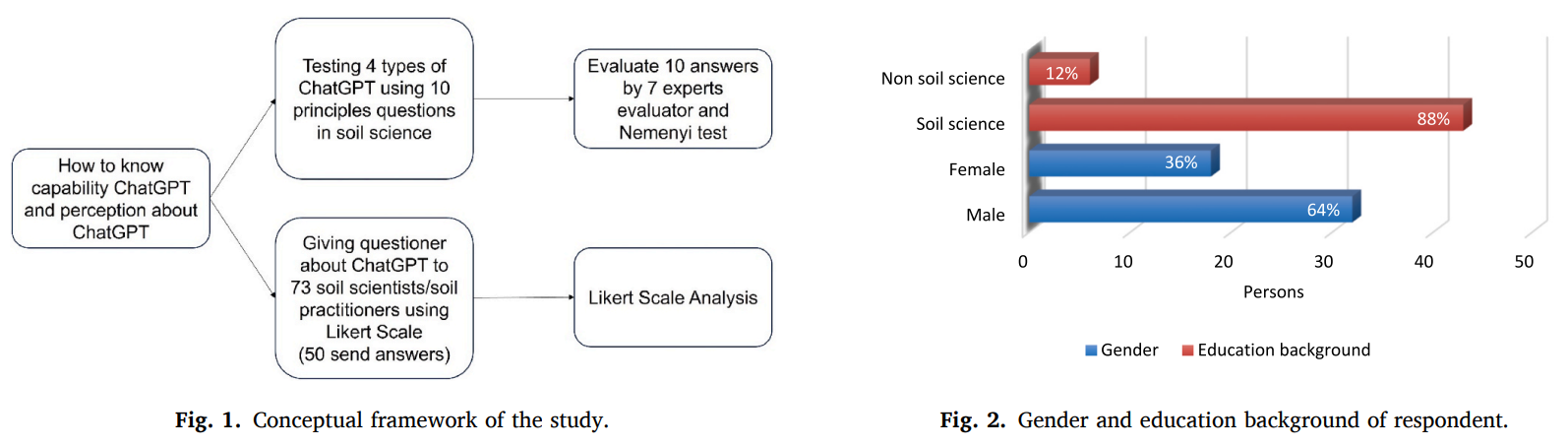
The survey, conducted between February 25 and March 5, 2023, assessed ChatGPT's ability to answer fundamental questions in modern soil science. There were four ChatGPT responses evaluated: free ChatGPT-3.5, short and long responses (Pro-a and Pro-b) from paid ChatGPT-3.5, and responses from paid ChatGPT-4.0. Responses began with a prompt to “act as a soil scientist” followed by “continue” if timed out. In the expert evaluation, five experts rated the responses on a scale of 0-100 and averaged the final score. Additionally, a Likert scale survey collected perceptions of ChatGPT's knowledge and credibility from 73 soil scientists and obtained responses from 50 participants for analysis.
Overview of SOC sequestration and modeling approach:
The annual sequestration rates observed at five locations in Austria are in line with other studies, covering a range of soil and climatic conditions typical for Central-Eastern Europe. The study found that certain ML algorithms, such as random forest and SVM with polynomial kernel, outperformed process-based models due to their ability to capture nonlinear relationships. Combining ML and process-based models improved predictions. For robust SOC modeling, uncalibrated models are recommended when data is scarce, calibrated models with cross-validation when data is sufficient, and ML models when data is abundant. Accurate SOC modeling requires comprehensive, long-term datasets covering a range of agricultural practices and conditions.
Recognition and contributions of ChatGPT in soil science:
A survey investigating Indonesian soil scientists’ perceptions of ChatGPT revealed important findings: the community is primarily composed of 64% males and 36% females, with the majority (88%) having formal education in soil science. Most respondents (76%) know ChatGPT, 60% use it, and primarily appreciate its potential to help with research and academic writing. 86% do not consider ChatGPT to be fraudulent, but agree that it requires validation and rephrasing before use in a scientific context. ChatGPT-4.0 was praised for its accuracy, especially in providing relevant answers in English. Despite their confidence in ChatGPT’s potential to advance soil science, respondents emphasized that human oversight is necessary to ensure the tool is used responsibly and effectively.

Conclusions regarding the use of ChatGPT in soil science and machine learning for SOC prediction:
This study highlights the valuable role of ChatGPT and ML in soil science. Indonesian soil scientists have over 80% trust in ChatGPT and prefer ChatGPT-4.0 for its superior accuracy in supporting research and education, although the free and paid versions of ChatGPT-3.5 are also considered reliable. However, ChatGPT's response recognition accuracy is generally 55%, indicating room for improvement in the future. At the same time, nonlinear ML models, especially when combined with process-based models such as random forests, are promising for predicting SOC dynamics, especially in datasets from long-term agricultural studies. Integrating ML with expert knowledge can improve the accuracy of SOC predictions, highlighting the importance of human oversight and model refinement.
source:


Sana Hassan, a Consulting Intern at Marktechpost and a dual degree student at Indian Institute of Technology Madras, is passionate about applying technology and AI to address real-world challenges. With a keen interest in solving practical problems, she brings a fresh perspective to the intersection of AI and real-world solutions.